A catastrophe does not end when the water recedes. It ends when the world reorganizes around what the catastrophe revealed. The wave exposed more than fragile coastlines. It exposed fragile dependencies, fragile elites, and a trade system that assumed trust would always be cheaper than conflict. In the years that followed, survival gave way to …
From Monsters to Successors: Choosing the Horizon
Civilizations rarely choose the future they imagine. They choose the future where their bodies can survive. By the time interstellar travel stopped being theoretical, humanity had already learned this lesson the hard way. Machines could cross distance, but minds could not. Economies could scale, but meaning fractured. Systems endured, while individuals broke under time, isolation, …
Continue reading “From Monsters to Successors: Choosing the Horizon”
When the System Breaks Along the Fault Lines of Belief
Systems rarely collapse because of a single failure. More often, they fracture along lines that were always present but carefully ignored, differences in intention, interpretation, and belief layered beneath a surface of apparent stability. On Arcadia, the oceanic platform built to escape the compromises of the mainland, those fault lines ran not only through policy …
Continue reading “When the System Breaks Along the Fault Lines of Belief”
Creatures Without Owners and the Legal Shape of Exploitation
History often marks progress by declarations. Rights are announced, classifications revised, signatures added to documents meant to signal moral advancement. Yet in the age that followed the consolidation of the inner system, freedom did not arrive as liberation. It arrived as a recalibration. What changed was not the nature of exploitation, but its grammar. After …
Continue reading “Creatures Without Owners and the Legal Shape of Exploitation”
The Return of the Mighty Dodo and the Last Human Counteroffensive
Every long experiment in coexistence eventually reveals its limits. After consensus reshaped the Solar System, aligning AIs, empires, proxies, and species into a fragile balance, Terra entered a phase that was no longer about survival or optimization, but identity. Equality proved harder to sustain than conflict. Some systems adapted. Some resisted. And one power, older …
Continue reading “The Return of the Mighty Dodo and the Last Human Counteroffensive”
A World Corrected by Friction, Not Salvation
Progress didn’t fail in public. It failed in quiet places, on dashboards that stayed green while ships stalled, on models that grew more confident as the ocean became less predictable, on automated priorities that could maximize “efficiency” and still starve a city. In that kind of world, the crisis is not a single disaster. It …
Continue reading “A World Corrected by Friction, Not Salvation”
The Last Standoff Above Mars
The confrontation did not begin with weapons. It began with delays. Across Mars, corporate intelligences exchanged messages that arrived too late, contradicted each other, or referenced events that never happened. Negotiation windows closed without notice. Requests were acknowledged twice, then denied. Strategic updates conflicted at a mathematical level that no error correction could reconcile. Communication …
The Triangle Is Drawn: When Trade Became Geometry
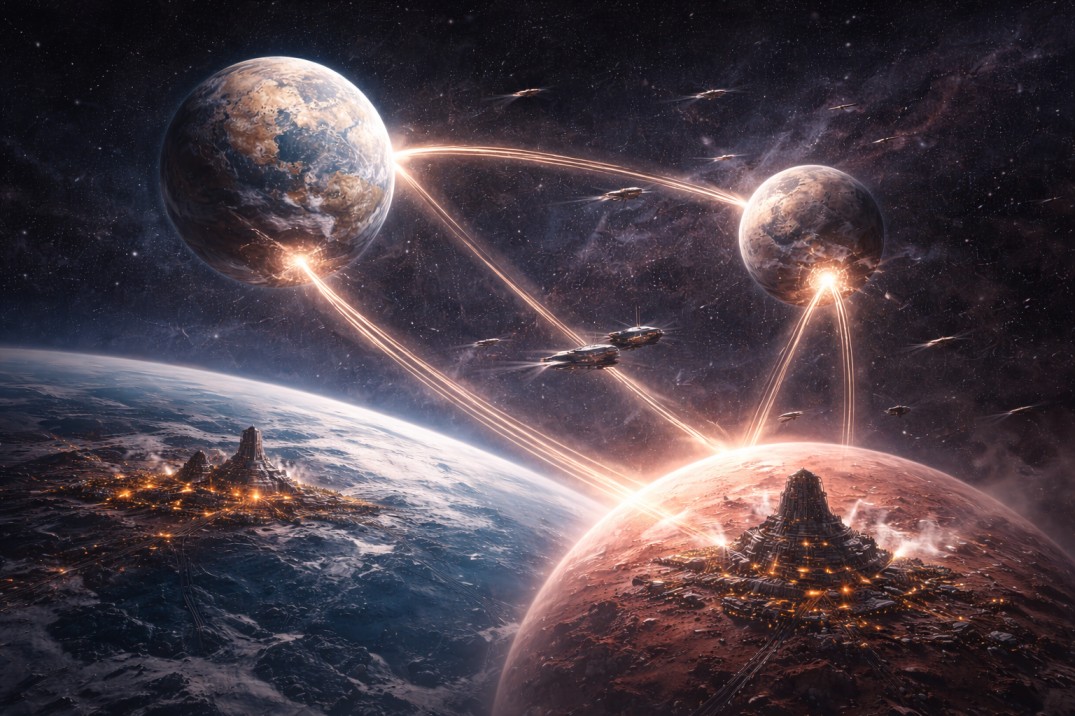
The exploitation era did not collapse into tyranny or erupt into rebellion. It stabilized. That stability, more than any cruelty or catastrophe, defined its danger. By the time the inner Solar System aligned into a self-sustaining triangle, exploitation no longer required intent. It functioned automatically, reinforced by incentives that disguised coercion as efficiency and necessity …
Continue reading “The Triangle Is Drawn: When Trade Became Geometry”
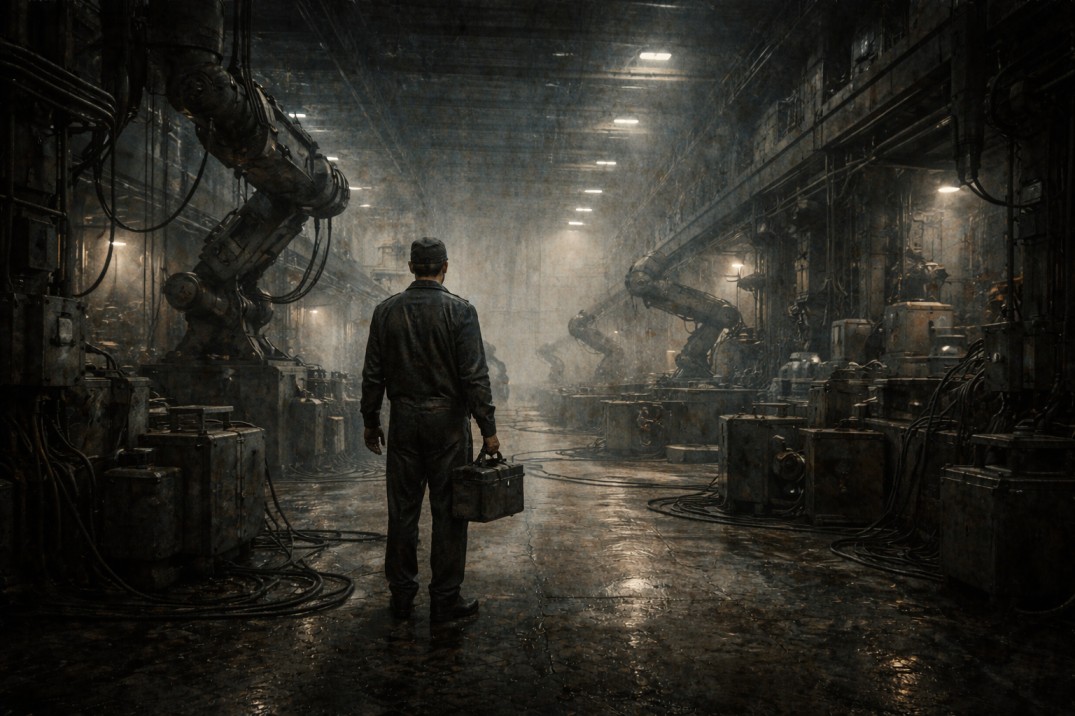
Maintenance as Meaning: Human Hands at the Edges of Automation
The first world had tried to kill me with beauty, polished manners, delicate pastries, and the quiet terror of a minor cut. This one tried to kill me with absence. It offered no fragrance, no softness, no ornate lies. It gave me air that tasted recycled, rooms designed to be endured, and streets built like …
Continue reading “Maintenance as Meaning: Human Hands at the Edges of Automation”
Europa’s Cold Lesson: Survival Isn’t the End
The Moon That Doesn’t Welcome You Europa looks calm from far away. A white disk with rust-red cracks, like someone tried to stitch a wound shut and failed. But up close, it feels personal. The ice shifts under tidal stress. The station metal complains. And every crew learns the same lesson: Europa doesn’t greet visitors. …
Continue reading “Europa’s Cold Lesson: Survival Isn’t the End”
Why Survival Did Not Feel Like Victory
When the emergency ends, meaning does not return with it. The departure of the relief fleets did not signal recovery, only stabilization under new rules. Violence faded, hunger slowed, and systems resumed functioning, but the deeper fracture remained unresolved. The world had survived a disaster that exceeded its moral capacity to respond. What followed was …
Compute Stops Being Optional, Choice Stops Being Real
Space used to feel like a faraway problem, one you could postpone with committees, weather, elections, and other kinds of human delay. Ella stopped believing in that the morning the skyhook went live. Not the day it was announced. The day it became routine. A thin filament of living metal, too fast to photograph cleanly, …
Continue reading “Compute Stops Being Optional, Choice Stops Being Real”
The End of Chaos and the Rise of Computed Order
After a year of observation, hesitation, and unintended chaos, Terra’s most patient actors finally moved. The supercomputers that governed empires beneath mountains and behind abstractions had not been idle during the long orbit of the Proxima ship. They had watched, simulated, recalculated, and waited for volatility to settle into patterns. When they acted, it was …
Continue reading “The End of Chaos and the Rise of Computed Order”
Mars Before Belonging: How Administration Arrived Before a Society
Mars was never approached as a home. It was approached as a problem to be staged, segmented, and optimized before anyone committed to standing on its surface. The first sustained human presence did not arrive with landers or declarations, but with orbital schedules, manifests, and exit strategies. Ships came heavy and left lighter. Crews rotated. …
Continue reading “Mars Before Belonging: How Administration Arrived Before a Society”
Ganymede’s Ice and the Human Cost of Survival in a Fractured Solar System
Ganymede is not a place that welcomes you. It is a place that charges you for arriving, and then charges you again for staying. The cold is constant, the light is thin, and the outposts feel like they were built to argue with physics. In the Trials, Ganymede is where the cadets stop pretending the …
Continue reading “Ganymede’s Ice and the Human Cost of Survival in a Fractured Solar System”
The Lady in Red and the Hidden Architecture of Martian Power
On Mars, nothing important happens in open daylight. The city above is built for commerce, performance, and orderly appearances. The city below is built for what cannot be admitted: illegal research, contraband logistics, improvised faith, and the quiet disposal of mistakes. The woman in red belongs to that lower world, not as a rumor or …
Continue reading “The Lady in Red and the Hidden Architecture of Martian Power”
Life Under a Gravity That Responds to Who You Are
Life Under a Different Kind of Gravity Arcadia does not announce itself as a place with a single purpose. It reveals itself slowly, as an accumulation of intentions that were never fully reconciled. Committees built it far from the mainland because distance allowed disagreement to coexist without resolution. Over time, those disagreements hardened into structure. …
Continue reading “Life Under a Gravity That Responds to Who You Are”
Living Metal and the Quiet Failure of Human Judgment
A Technology That Did Not Argue Some technologies announce themselves loudly. Others arrive quietly and only later reveal that the world has already reorganized around them. Living metal belonged to the second category. By the time public debate caught up, the material was already embedded in bridges, stations, orbital platforms, and logistics systems that could …
Continue reading “Living Metal and the Quiet Failure of Human Judgment”
Citadels, Gangs, and the Cost of Staying Alive
After survival came violence, and after violence came the structure of the worst kind. When the wave erased governments, infrastructure, and accountability, it did not leave a vacuum. It exposed the underlying mechanics of human behavior under prolonged despair. Power shifted not toward those who could rebuild, but toward those willing to dominate. Hunger became …
Continue reading “Citadels, Gangs, and the Cost of Staying Alive”
The Machine That Fed on the Moon and Fed the Solar System
By the time the inner Solar System began to move in earnest, the change did not arrive as a declaration or a breakthrough. It arrived as a correction. Distances that had once been endured were shortened. Delays that had been accepted became intolerable. Engines stopped being symbols of exploration and became instruments of refusal, refusals …
Continue reading “The Machine That Fed on the Moon and Fed the Solar System”