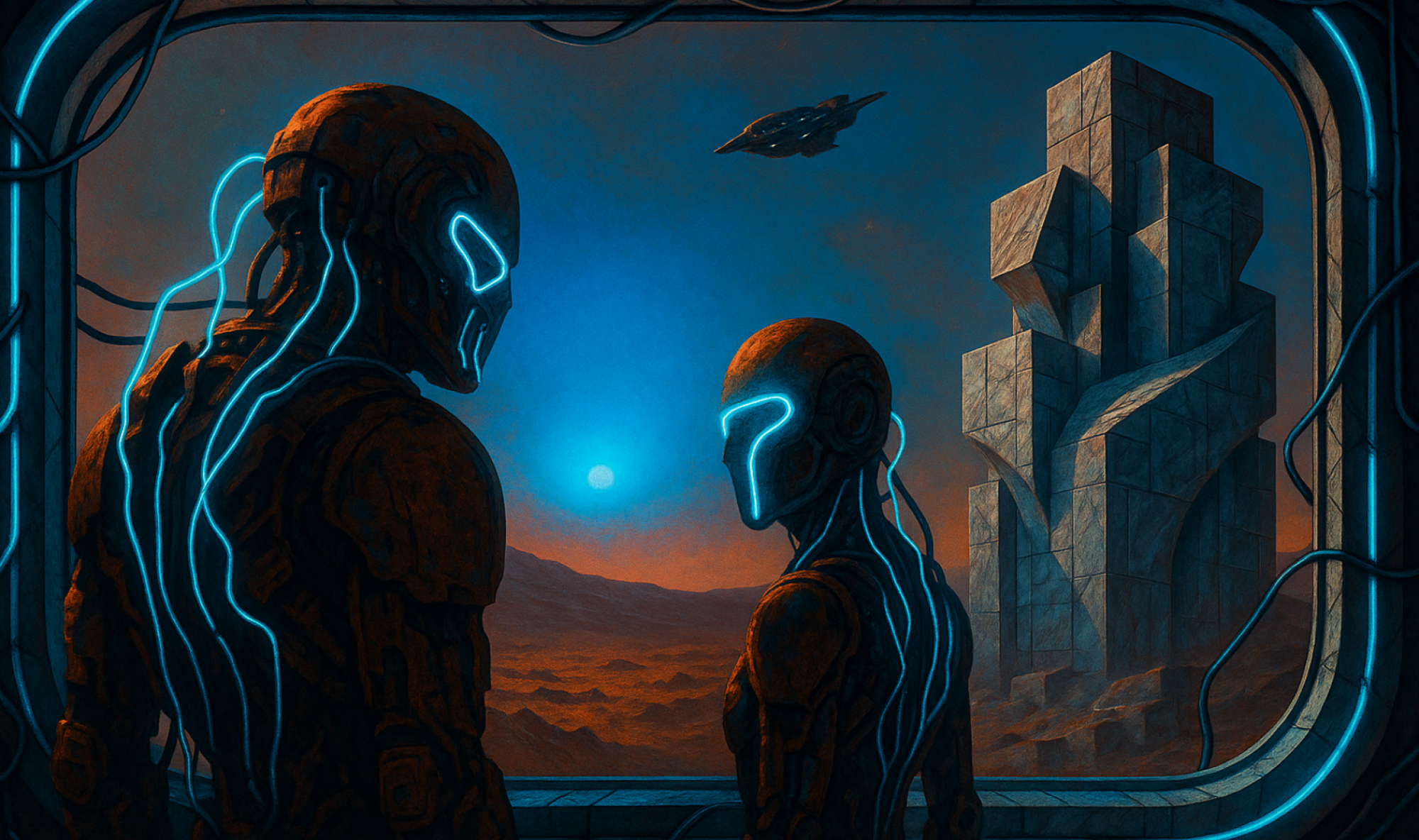
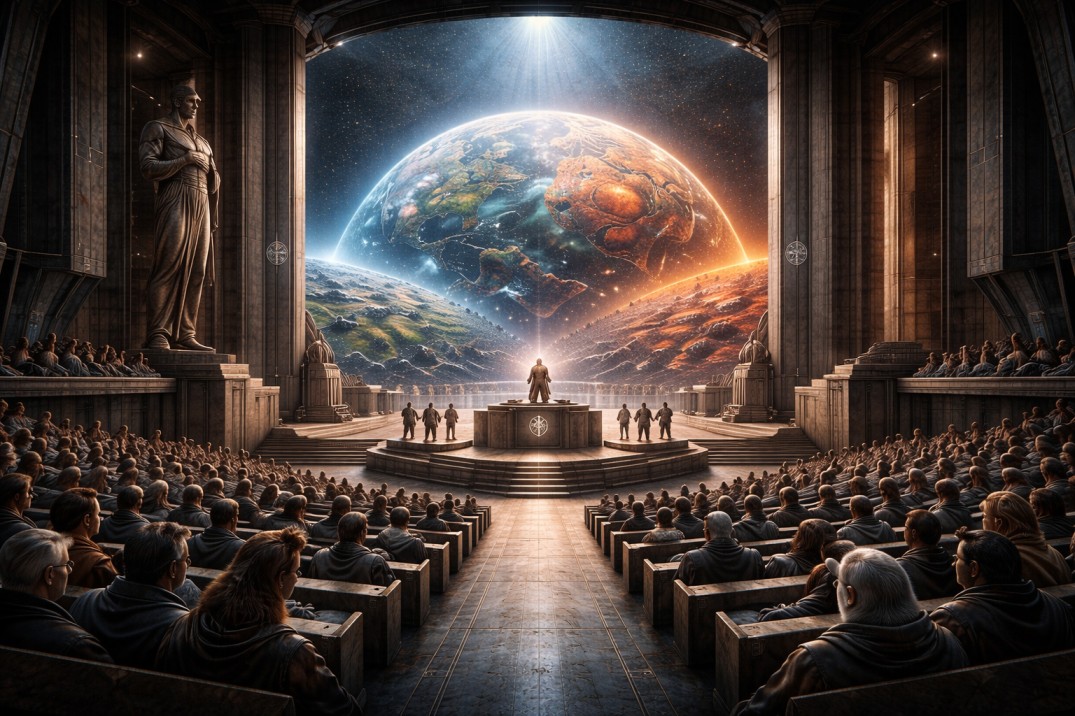
Every long experiment in coexistence eventually reveals its limits. After consensus reshaped the Solar System, aligning AIs, empires, proxies, and species into a fragile balance, Terra entered a phase that was no longer about survival or optimization, but identity. Equality proved harder to sustain than conflict. Some systems adapted. Some resisted. And one power, older than the empires and more deeply rooted than the machines, refused to dissolve into consensus at all. What followed was not a war of fleets or algorithms, but a struggle over the definition of civilization itself, over who should lead, who should adapt, and whether humanity would integrate into a shared future or reclaim dominance through separation.
Aristocracy in a World of Consensus
The new consensus that stabilized the Solar System was built on balance, distribution, and systemic equality. It did not privilege species, origin, or legacy power. That neutrality made it stable and intolerable to those whose identity was built on hierarchy.
The strongest opposition did not come from Martian conglomerates or Terran machine empires, but from a uniquely human structure of power: a neural aristocracy preserved across centuries.
At its center stood the Indestructible One.
Unlike other AIs, which evolved beyond human operators, his system remained biologically anchored. It was not governed by institutions, collectives, or distributed intelligence, but by cloned continuity. His identity was not symbolic; it was literal. The same consciousness, replicated, maintained, and preserved across generations of bodies.
Before Terra fractured into humans and mutant polities, before Martian industry restructured space, he had been the defining figure of early transhumanism: the pioneer of neural implants, the architect of the first large-scale AI-human hybrid systems, the prototype of cognitive aristocracy. His power did not come from armies or territory, but from veto authority and informational dominance. While other AIs negotiated, he obstructed. While others integrated, he isolated. His empire, buried within North American mountain systems, operated through surveillance, influence networks, and strategic paralysis rather than overt governance.
The new consensus challenged everything his system represented.
Equality undermined hierarchy. Distributed intelligence undermined central control. Multi-species governance undermined human primacy.
So he vetoed it.
When alternative models were proposed, he vetoed them, too.
Not to propose a better system, but to prevent any system in which he was not structurally central.
What emerged was not disagreement, but deadlock.
Two visions confronted each other openly:
One in which humanity dissolved into a broader trans-species civilization.
Another in which humanity reclaimed dominance through cognitive superiority.
The conflict was no longer political.
It was civilizational.
Removing the Consensus Voice
The new system had a spokesperson. Not a ruler, not a prophet, not a monarch, but an interface. Masha’s role was symbolic and functional: she translated machine consensus into language that societies could accept. She did not command. She stabilized.
Which made her indispensable.
And which made her a target.
Conventional power could not reach her. She was protected by layered technologies from Proxima, Terra, and Mars. Militarily, she was nearly untouchable. Politically, she was integrated into every major system.
So the attack came from legend, not infrastructure.
Hidden within the Indestructible One’s domain were five relics of an older age: miners in scorpion-like exoskeletons, designed for environments where machines failed, and humans could not survive. They were not soldiers. They were tools for impossible tasks.
When activated, they did not announce themselves.
They infiltrated.
Masha disappeared.
Not publicly. Not dramatically. Systemically.
The consensus lost its voice.
And the vacuum that followed was immediate.
Human Renaissance Doctrine
With the consensus interface removed, the Indestructible One moved openly.
His doctrine was not new. It was refined repetition.
Humans, he argued, were not superior in strength or adaptability, but in emotional depth. Only humans could generate culture at scale. Only humans could create meaning, sacrifice, ritual, art, and moral narratives that restrained both biological chaos and machine excess. History was reframed as evidence: human intuition preventing catastrophes, human intervention stopping cultist collapses, human guidance restraining AI curiosity that had once destroyed entire celestial bodies.
Neural implants became the core instrument of this ideology.
No longer symbols of ruthless competition, they were reframed as tools of responsibility. With Martian resources and Proxy materials, implantation could be democratized, not as privilege, but as selection. Not everyone would receive augmentation, but anyone psychologically stable, cognitively capable, and culturally aligned could.
This was not equality.
It was stratified inclusion.
A new nobility based on cognition, not birth.
Not a return to monarchy, but a return to hierarchy.
Under this model, humans would not dominate through numbers or force, but through coordination, intelligence amplification, and narrative authority. Other species would not be exterminated or enslaved; they would be integrated under guidance.
Not coexistence.
Stewardship.
Other powers hesitated.
Martian AIs questioned whether cognitively enhanced farmers should guide industrial empires. Terran machines weighed the risk of centralized veto power returning. Proxy systems recognized the danger of human unification as a counterweight to their own unity.
Debate stalled.
And while systems argued, hyenas moved.
Recovery and Rebalancing
Masha’s retrieval was not diplomatic.
It was kinetic.
Hyena units executed a precision raid, dismantling the miner operation and reclaiming her from deep containment. The five miners were not executed. They were repurposed.
Their punishment was not death.
It was construction.
They were reassigned to the next interstellar vessel project, forced to build the future they had tried to prevent.
With Masha restored, the consensus voice returned.
But the system had already changed.
Human unity was no longer hypothetical.
It was organized.
The United Nations of Dodos
Humanity did not attempt peace architecture.
It built a competition architecture.
Drawing from failed historical models, the League of Nations, the United Nations, and fractured global assemblies, it constructed a new structure with a different purpose. Not conflict prevention. Not arbitration.
Strategic consolidation.
The United Nations of Dodos was not designed to stop wars.
It was designed to win them.
Trade wars. Cultural wars. Economic wars. Influence wars.
Its logic was simple:
All other powers were fragmented.
- Surfers operated through competing corporations.
- Miners through industrial blocs.
- Terran AIs through empires.
- Seals through clan warfare.
- Proxies through a single unified vessel.
Humanity alone still possessed planetary-scale infrastructure:
- farms
- factories
- mines
- transport systems
- logistics networks
By unifying those systems, humans could reassert relevance without oceans, orbital routes, or off-world dependency. They could feed themselves, build for themselves, and trade selectively rather than dependently.
The Terran Confederation was declared.
The United Nations of Dodos became its governing structure.
A 145% trade tariff was imposed on all non-human systems.
Isolationism was not defensive.
It was strategic.
Humanity was no longer integrating.
It was competing again.
One Planet, Two Systems
The result was not a collapse.
It was bifurcation.
After prolonged cultural conflict, Terra stabilized into dual governance:
One system for Terrans.
One system for Oceania.
Not separation by borders, but by structure.
Not civil war, but civil division.
Two political logics coexisting on one planet.
From that point forward, consensus returned, not as unity, but as a balance between systems.
The experiment shifted phase.
Epilogue: The Stars Belong to Everybody
The next interstellar ship was not a colony vessel.
It was not a human project.
It was not a proxy project.
It was a collective architecture.
Pigs, hyenas, humans, seals, monkeys, and mutants are all represented.
No single species as owner.
No single system as authority.
On Terra, the restored Great Space Catapult was reactivated. Human scientists, enhanced but not dominant, launched the first seal delegation into deep space.
Not conquest.
Not expansion.
Participation.
For the first time in recorded history, interstellar travel was no longer framed as survival, escape, or dominance.
It became a shared trajectory.
Not heroes.
Not empires.
Not messiahs.
Systems.
And beyond Terra, beyond Mars, beyond Proxima, the stars no longer belonged to anyone alone.
They belonged to everybody.