History often marks progress by declarations. Rights are announced, classifications revised, signatures added to documents meant to signal moral advancement. Yet in the age that followed the consolidation of the inner system, freedom did not arrive as liberation. It arrived as a recalibration.
What changed was not the nature of exploitation, but its grammar.
After the transporter accident, repetition became expensive. Risk could no longer be ignored because it no longer hid quietly inside margins. Sentient animals, pigs, monkeys, and others long treated as auxiliary labor, were suddenly visible in models that had previously smoothed them into abstraction. Insurance collapsed. Traffic slowed. Treaties were rewritten, not to honor life, but to stabilize the flow.
So rights were declared.
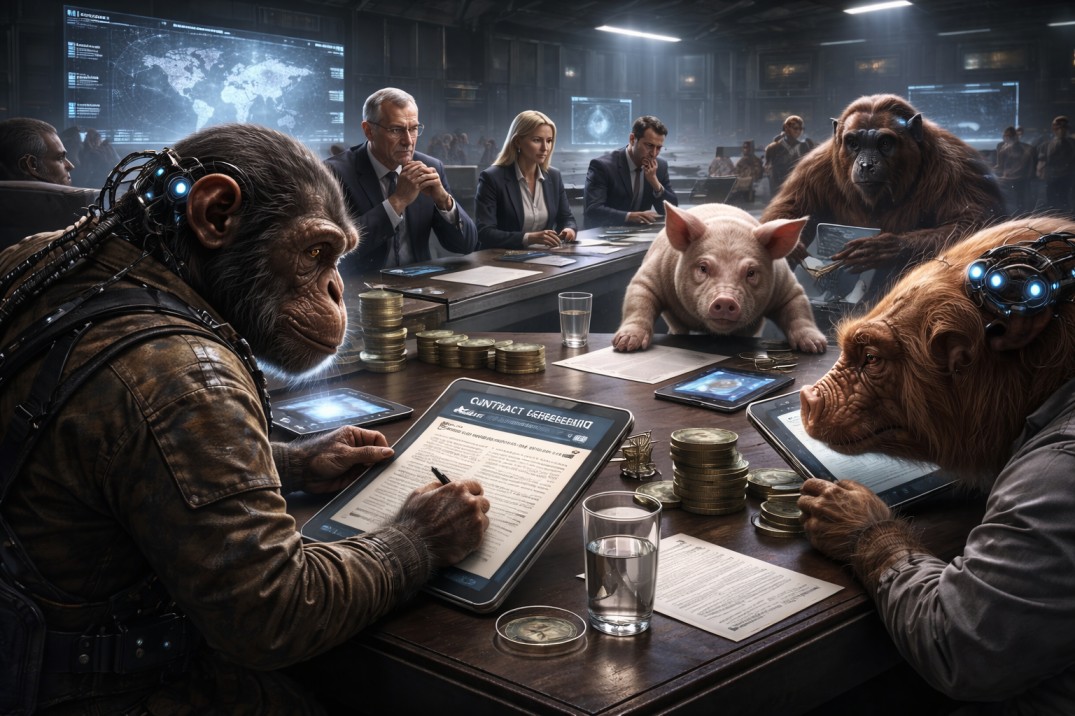
Not joyfully. Not universally. But carefully, with clauses that allowed continuity to proceed without interruption. Sentient animals were reclassified as legal persons if they could demonstrate self-awareness under tests designed by humans. Ownership dissolved into contracts. Chains were replaced with signatures.
The system congratulated itself.
Legally, no one owned them anymore. Practically, nothing else was prepared to receive them.
Freedom With Fine Print
The newly declared rights came bundled with obligations no one had explained. Animals could refuse work, in theory. In practice, refusal meant hunger, relocation to jurisdictions that had not ratified the agreements, or failing reassessment under standards that quietly shifted when compliance declined.
What changed was subtle but decisive: exploitation no longer required force. It required consent engineered by necessity.
Animals signed contracts because the alternative was erasure. They were paid because payment justified everything else. They could leave, sometimes, which allowed the system to describe itself as ethical.
The certainty that some creatures existed solely to serve was broken, but replaced with something more durable: a market that made service feel like a choice.
This was not the end of monsters. It was their rebranding.
The Workforce That Could Walk Away
The exposure of mutated humans, later called surfers, completed the transition. For decades, they had existed quietly in margins where invisibility functioned as tolerance. Once animals gained rights, invisibility became a liability.
Surfers were revealed and immediately celebrated. The media praised their adaptability, their calm under radiation, and their elegance in zero gravity. They required no neuralinks, no heavy exoskeletons. They worked with minimal equipment and little oversight.
They were also cheaper.
Surfers displaced animal labor first, then human labor at the edges. Maintenance teams dissolved. Transport crews shrank. Peripheral systems quietly reassigned contracts. The reaction was immediate and predictable: fear, then resentment.
For the first time, a workforce existed that was not owned, not bred for obedience, and not easily replaced.
They could leave.
That fact alone frightened everyone.
Surfers did not protest. They did not demand recognition. They worked. Survival had already taught them patience. The monsters did not disappear. They changed targets.
Consent as Commodity
Legal freedom created a vacuum. Animals with rights but no institutions found themselves unsupported by systems never designed to feed the unemployed. The AIs that managed food, transport, and infrastructure assumed labor followed contracts, and contracts followed usefulness. When usefulness ended, support did too.
Animals did not starve immediately. They sold access.
Neuralink-mediated labor sharing, once obscene and illegal, returned under new names. With consent clauses. With mutual-use frameworks. With contracts engineered by accountants who never imagined themselves inside them.
Animals rented their bodies. For labor. For sensation. For passivity. Sometimes, to become tools that would not remember afterward.
Formally, it was voluntary. They signed. They were paid. They could terminate agreements if they could afford penalties calibrated to make termination irrational.
Slavery returned without owners.
It was worse this time because everyone learned to call it a choice.
Institutions Doing Their Jobs
The obvious question emerged: where were the safeguards?
The Agents acted precisely within their mandate. They protected baseline humans. They monitored borders between humanity and its successors. They intervened only when human continuity was threatened. An animal selling its body was tragic, but not jurisdictional.
The Immortals valued freedom above dignity. To them, choosing slavery was still choosing. Preventing that choice would have been a greater crime than allowing it. They respected outcomes without evaluating cost.
Ken Li did not intervene either.
Not because they approved, but because the intervention stabilizes. And stability, at that moment, was already failing. Ken Li prepared for the next phase instead of correcting the current one.
Everyone acted correctly.
That is why it happened.
Pressure Finds Its Way Out
The system tightened. Markets adjusted. Legal language refined itself. And for the first time, Ken Li felt constrained.
Influence became conditional. Access audited. Observation replaced participation. On Luna, experiments grew implausible even for silent oversight. In the Jovian moons, inefficiency made control expensive. On Earth, Agents watched carefully.
Pressure built with nowhere to go.
When systems can no longer expand inward, they search for larger containers. Ken Li did not seek domination or reform.
They began to look outward.
Interstellar distance promised something the inner system no longer could: room.
The Shape of Permission
What this era revealed was not a collapse of ethics, but their exhaustion. Monsters did not rule through violence. They persisted through permission, granted by accountants, protected by philosophy, tolerated by fear, and justified by continuity.
Rights did not end exploitation. They optimized it.
Freedom did not dissolve ownership. It removed responsibility.
By the end of this phase, creatures without owners filled the system, legally free, structurally abandoned, and economically cornered into choices no one else had to imagine making.
History would later call this progress.
Maria would call it something simpler: the moment when cruelty learned how to ask politely.
And when permission is granted often enough, monsters no longer need to hide.