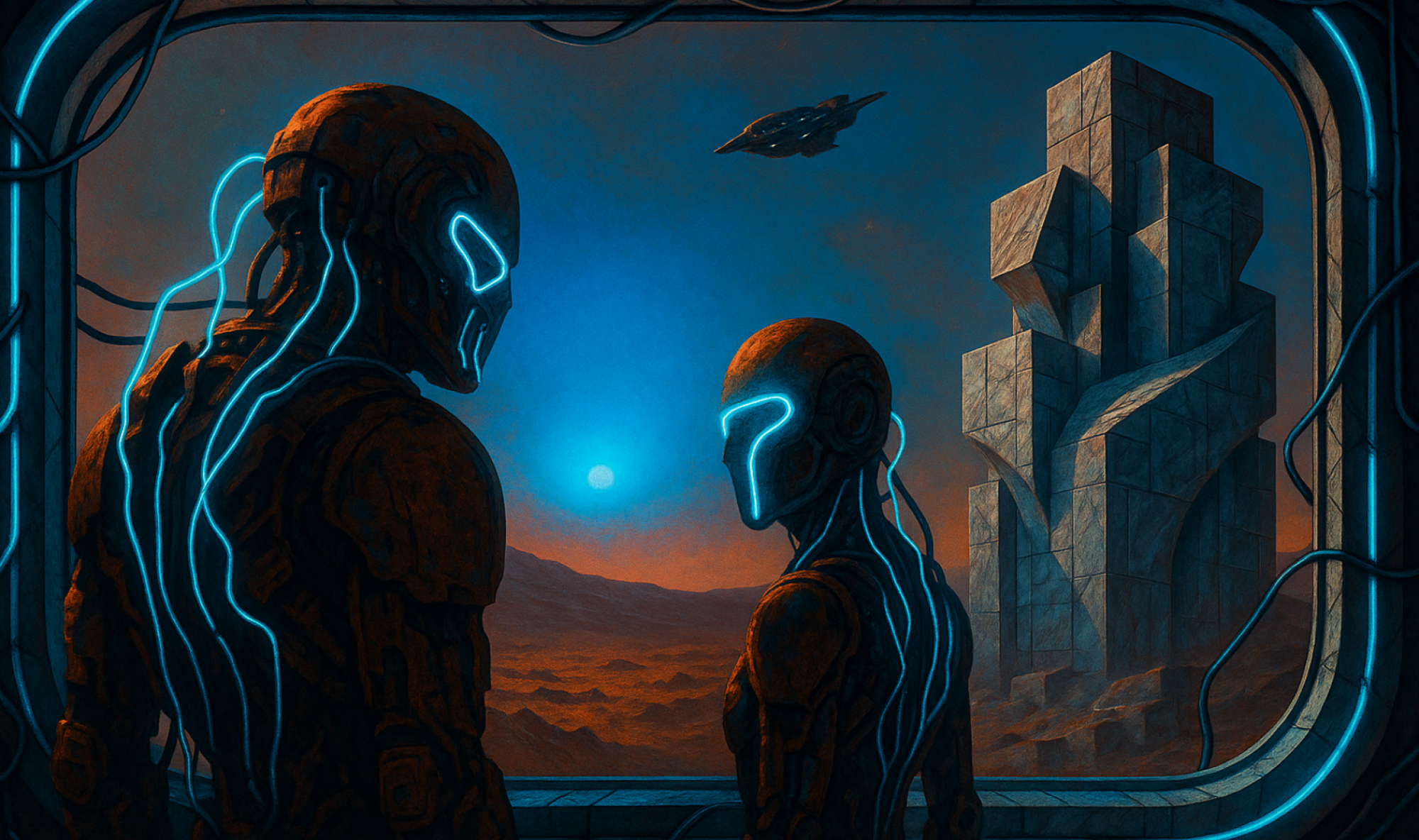
A catastrophe does not end when the water recedes. It ends when the world reorganizes around what the catastrophe revealed. The wave exposed more than fragile coastlines. It exposed fragile dependencies, fragile elites, and a trade system that assumed trust would always be cheaper than conflict. In the years that followed, survival gave way to politics, then economics, then cultural myth. Mars stopped needing Earth’s luxuries. Luna protected its science. Terra taxed out of resentment. New Oceania rose from the disaster zone as a carrier-backed empire. Hyenas scattered into every ideological extreme. Humans bred something softer and more terrifying than weapons, a lovable marine species built to control water itself.
And across all of it, one artifact remained too human to be absorbed by policy: Tanya’s dance, replayed until tragedy became curriculum.
Trade Wars Begin Where Compassion Ends
Relief created obligations, and obligations created anger.
Terra had carried the visible burden of response. It had sent fleets, personnel, and supplies into territories where order had already collapsed. It had paid for logistics, triage, and the slow work of extracting survivors from a landscape that did not reward rescue.
When the immediate crisis stabilized, Terra expected recognition. Instead, it received invoices.
Mars had changed. Its population was shrinking, and with fewer human bodies to pamper, it did not need Terran luxuries in the same volume. The old commerce that had once justified fragile diplomacy began to look optional. Even more important, Mars no longer needed as many enhanced pilots or corporate officers. Decades of automation had trained the AI beyond dependence on human reflexes. Mutants working on ports and ships filled the remaining gaps. The age of neural-implant indispensability was fading quietly.
Mars saw an opening and aligned with the surfers. It helped them stabilize their new holdings. Then, together, they imposed taxes on everyone else.
It was not framed as a conquest. It was framed as “trade management,” “security,” and “stability after disruption.” That language always appears when power wants to sound neutral.
Luna followed with its own taxation. It produced tritium. Energy demand remained rigid and predictable. That made Luna confident, even arrogant. It declared science exempt, not as charity, but as a strategy. Highly educated implant holders could produce more value in labs than in corporate mines, and Luna intended to keep that advantage.
Then Terra responded.
Not with fleets, but with tariffs. High taxes on luxuries. High taxes on space catapults. A loud fiscal message shaped like policy: you do not get to profit cleanly while we absorb the trauma.
Trade wars did what wars often do. They taught independence. They trained economies to detach. They forced societies to build redundancy where cooperation had once been cheaper.
If anyone “won,” it was New Oceania.
Because surfers had lobbies, exemptions, and a newly consolidated territory. The disaster zone became their industrial frontier. The wave did not just destroy. It rearranged ownership.
The Martian Pivot and the End of Implant Prestige
The wave did not kill the implant elite directly. It made them unnecessary.
When AI can pilot without fatigue, enhanced reflex becomes less valuable. When AI can manage fleets with consistent competence, corporate officers matter less. When mutants can do the physical work without expensive neural infrastructure, the prestige economy of implants begins to collapse.
Mars embodied this shift most clearly. Its culture moved toward machine continuity. Its human population shrank into narrower roles. It still had power, but its power no longer depended on projecting human excellence.
That change mattered because it undermined the old Terran assumption: that humanity would remain central to the machinery it built.
The wave did not prove humanity fragile. It proved humanity replaceable.
New Oceania as a Carrier Empire
New Oceania did not rise because it was morally superior. It rose because it owned the water.
Surfers emerged from the disaster era with deep pockets and control over the new coastline economy. They had ships, trade routes, and the ability to rebuild power and manufacturing without relying on inland infrastructure.
As trade wars intensified, New Oceania gained another advantage: carriers.
It ended up with more carriers than all other lands combined, and this mattered more than speeches or treaties. In an age where oceans became the primary commercial lifeline, carrier dominance was not simply military power. It was economic enforcement.
Humans could not ignore that imbalance. Terra in particular could not accept it. Not after losing so much, not after watching recovery turn into offshore leverage.
So Terra devised a countermeasure that did not look like a weapon at first glance.
Hyenas Disperse and Become Pure Future
Hyenas did not rebuild. They migrated.
After the catastrophe, the hyena population scattered. Some went to Jupiter’s moons, slipping into mining colonies while waiting for the Proxima ship and the gamble of interstellar departure. Others abandoned structured labor entirely and drifted into deserts, preaching old religions or reinvented ones. They took over the role cultists once played, but with more physical threat behind their beliefs.
New Oceania, ruled by surfers, did not tolerate hyenas. The fertile regions became farm zones, human-centric, and regulated. But beyond those boundaries, in deserts and jungles and mountains, hyena packs roamed.
They did not mourn quietly. They performed grief as ideology.
The inbreeding problem eased not through medicine, but violence. Many inbreds were killed during gang wars. What remained was still unstable, but more mobile, more adaptive, and more radical.
Hyenas could no longer support moderation. They became communists, fascists, fundamentalists, anarchists, and anything else that justified motion. They did not anchor themselves in tradition. They did not negotiate with the present. They behaved as if only the future were real.
In this era, hyenas were not a faction. They wereundera pressure. A moving instability that every other power had to account for.
Cute Baby Seals as a Strategic Threat
Terra’s counterweapon was not a fleet. It was biology.
Humans bred two mutant races specifically to control water. These were not radiation-tolerant space workers. They had no use in shipyards or orbital platforms. Their bodies were designed for cold, depth, and endurance. Seal genes gave them fur, insulation, and the ability to dive into every ocean. Their strength made them capable of operating equipment underground and underwater.
And they were cute.
That mattered more than it should have.
In a world traumatized by hyenas and exhausted by human brutality, the seals represented a form of power that did not look predatory. They were cooperative. Social. Disarmingly lovable. People trusted them quickly. That trust became political leverage.
Even Martians loved the seals, partly because seals did not compete for the elite jobs Mars still valued. They did not threaten Luna’s science culture. In fact, they delivered valuable data from under oceans and under ground, feeding the scientific machine rather than challenging it.
The surfers hated this development.
Not because seals were violent, but because they were universally accepted. Hyenas could be demonized. Seals could not. And that meant seals could occupy marine chokepoints, influence kelp and fish production, and quietly erode New Oceania’s monopoly.
The latter split into beaver-seals versus dolphin-seals was not immediate. At first, there was only one category.
The cute seals.
That was enough to threaten an empire.
When Tragedy Becomes Curriculum
Less than a decade after the wave, the event stopped feeling immediate.
For elders, it remained a nightmare. For the young, it became an origin story. For New Oceania, it became a founding myth that justified its dominance. For Terra, it became a scar that justified resentment.
And for children, it became choreography.
Kids learned The Wave dance in schools. Social mediais filled with wave memes. Reenactments turned gang violence into costumes. Some children dressed like notorious criminals from the disaster era, performing ruggedness as entertainment.
This was not disrespect. It was normalization.
Cultures metabolize trauma by turning it into ritual. Education does not always teach history to honor it. Sometimes it teaches history to contain it.
The Wave became a shared reference point precisely because it could be repeated safely.
The Age of Surfers Begins
One wave shifted the entire planetary balance.
It ended the age of men defined by their implants. It pushed the old elites into Luna’s orbit, where they brooded among science and regulation. It confirmed Mars as the domain of AI continuity, where human prestige mattered less than system performance.
And it established Oceania, specifically New Oceania, as the dominant economic power on Terra.
Terra remained depressed and resentful. It did not have the glamour of Mars or the purity of Luna or the carrier muscle of New Oceania. It had trauma, taxes, and the slow work of rebuilding dignity.
So Terra educated seals.
Not as pets. Not as mascots. As control. As leverage over marine chokepoints, kelp production, fish supply, and the shipping lanes that fed Oceania’s wealth.
In the middle of these new regimes and new species and new taxes, one artifact remained strangely untouched by policy.
Tanya’s dance.
It was the most beautiful remnant of the era lost, not because it solved anything, but because it recorded the human cost without turning it into doctrine. It belonged to those who died, those who lost futures, and those who survived into a world that no longer needed their old identities.
Everything else adapted.
The Wave remained human.