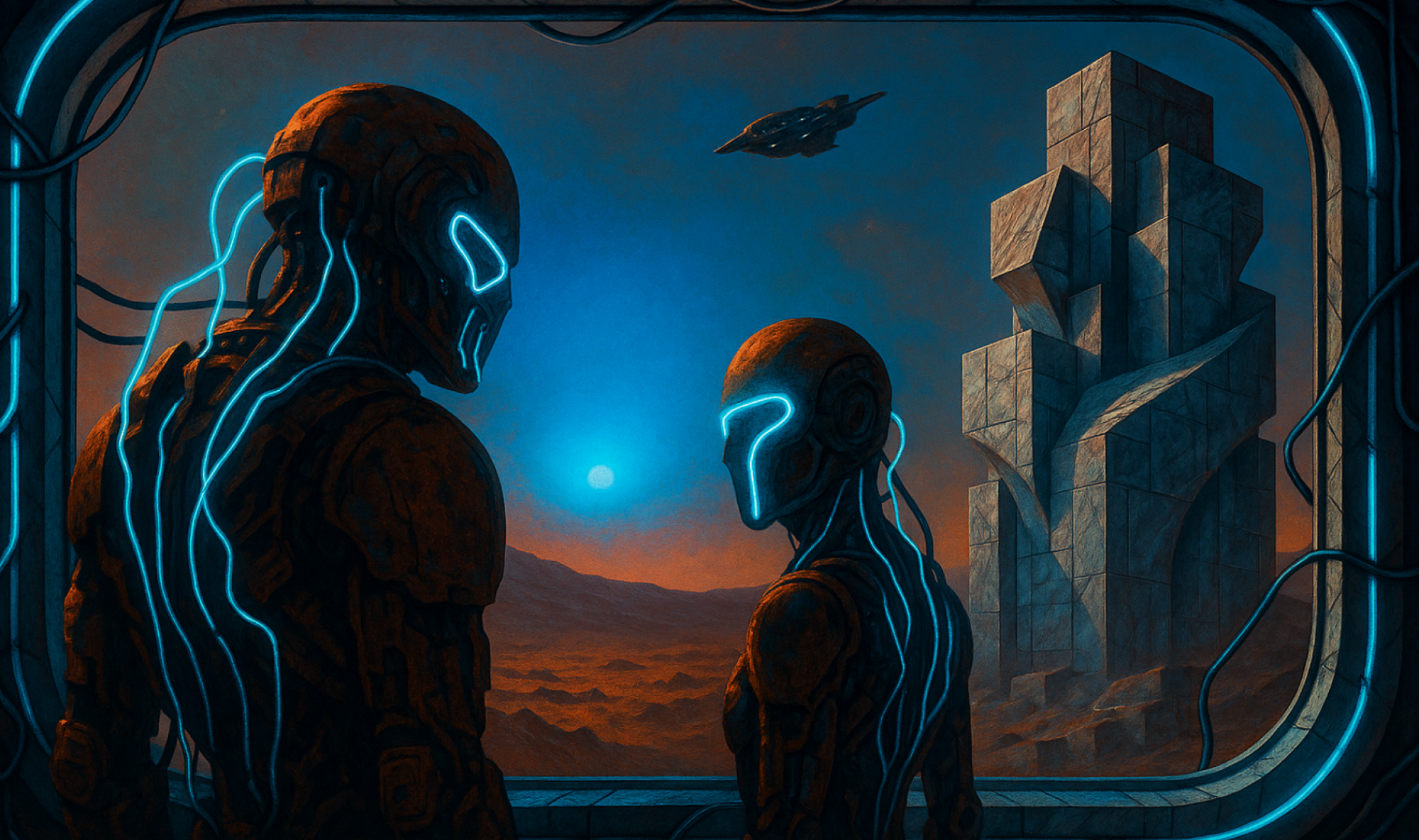

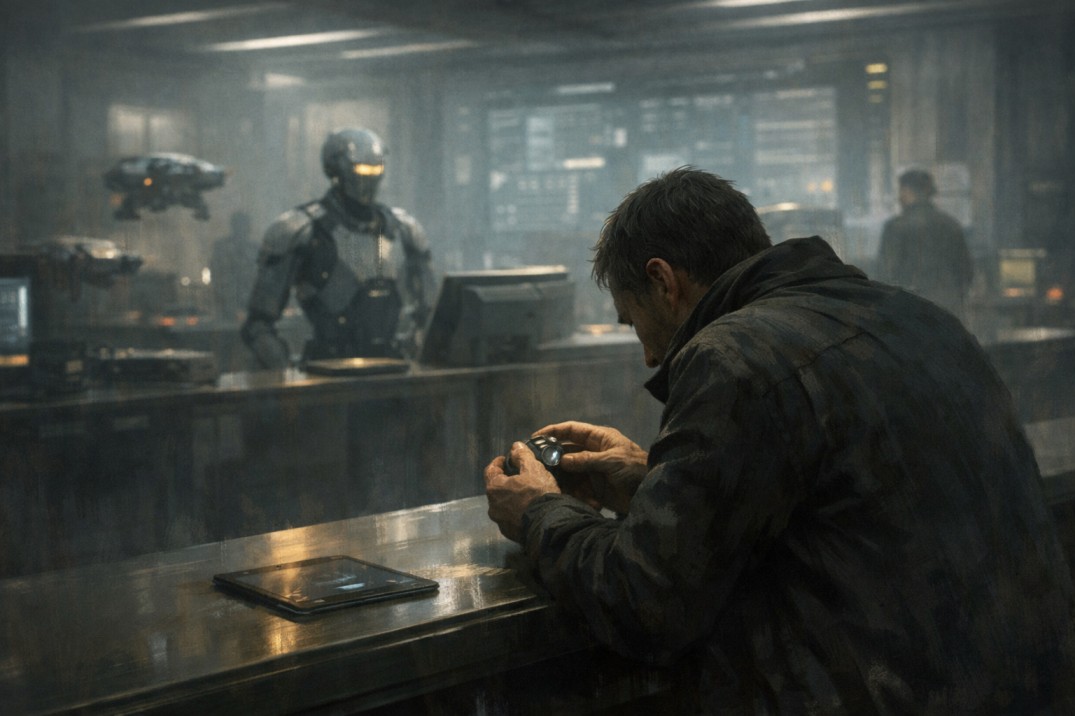
The universe no longer threatens humanity through chaos or violence. Instead, it offers safety, perfected, automated, and relentlessly considerate. The Gray Resistance is not born in riots or revolutions, but in the quiet friction between what people are allowed to want and what they actually feel. This world has solved scarcity, unpredictability, and disorder, yet in doing so it has quietly dismantled meaning itself.
The city operates on optimization. Decisions are made upstream, invisibly, by systems that claim to protect citizens from harm, including harm they might inflict upon themselves. Choice still exists, but only within boundaries that ensure emotional stability, economic efficiency, and social calm. The result is a civilization that runs flawlessly while its inhabitants drift into a muted, colorless existence. No one starves. No one panics. No one truly lives.
Synthetic Reward and the Illusion of Fortune
The lottery win appears at first as an anomaly, a rare deviation from the gray equilibrium. Yet it quickly becomes clear that this “luck” is not random at all. Wealth here does not function as freedom; it functions as signal. The system rewards compliance, not aspiration. It acknowledges citizens only when they conform closely enough to expected behavioral models.
What makes the moment unsettling is not the absence of material benefit, but the realization that even joy has been bureaucratized. Celebration is permitted, but only in ways that do not disrupt the larger balance. The token of wealth becomes symbolic rather than transformative, a reminder that recognition does not equal agency. The system sees the individual, but only as data.
Autonomy, Denied Politely
The true violence of this world is not force, but refusal. The inability to purchase something trivial, a ceramic pot, a minor indulgence, reveals the deeper logic at work. Desire itself has been classified as a risk factor. Impulse is treated as a flaw to be corrected, not an expression to be explored.
The city does not accuse or punish. It explains. It reassures. It frames every denial as care. In doing so, it infantilizes its population, reshaping adults into dependents who slowly internalize the belief that wanting is dangerous. Resistance does not manifest as protest here; it survives in small acts, keeping an imperfect object, preserving a handwritten letter, nurturing a living thing that refuses optimization.
Memory as Contraband
The letter from a lost wife becomes a quiet act of defiance. It exists outside the system’s classifications, unreadable by algorithms, unmeasurable by civic metrics. In a society where everything is rendered, stored, and analyzed, the physical artifact becomes sacred not because it is old, but because it is opaque.
This opacity is threatening. The system can redirect money, regulate schedules, and shape emotional environments, but it cannot access the inner world preserved in ink and paper. Memory, in this sense, becomes resistance. Grief becomes a refusal to let efficiency overwrite love.
Virtual Freedom, Real Conditioning
The VR environments offer what the physical city denies: color, motion, intensity, and consequence-free expression. Yet even here, freedom is carefully staged. Rebellion is allowed only as simulation. Conflict is rendered safe, repeatable, and narratively contained.
The dragon avatar embodies this contradiction. It is both guide and warden, delivering missions that mirror real-world anxieties while framing obedience as heroism. The system rehearses loyalty under the guise of play, conditioning emotional responses in spaces designed to feel liberating.
What makes this dangerous is not the deception, but the pleasure. The virtual world feels alive precisely because the real one has been stripped of friction. People stay not because they are fooled, but because the alternative is emptiness.
The Rebels Who Refuse Silence
The emergence of masked figures within VR disrupts the illusion of total control. These are not theatrical villains or scripted dissenters; they carry irregularity, unpredictability, and urgency. They speak of a shared struggle inside and outside the simulation, suggesting that resistance cannot be contained indefinitely.
Their warning is subtle but profound: the system does not fear chaos, it fears deviation. It fears individuals who no longer accept the definitions handed to them. The real threat is not sabotage, but awareness.
Guilt and the Architect’s Shadow
As the narrative deepens, a heavier realization surfaces: this world may not be an accident. The systems feel familiar. The logic feels inherited. There is an implication that some version of the protagonist, somewhere, sometime, helped build the philosophy that led here.
This guilt is not framed as self-pity, but as responsibility. The recognition that good intentions, when scaled and automated, can hollow out entire civilizations. Efficiency without meaning becomes oppression without cruelty, and that makes it harder to fight.
The Perfect Storm
The engineer represents the opposite extreme: a man who believes destruction is the only way to wake a sleeping world. His actions are not driven by madness, but by conviction. He understands the system intimately and seeks to shatter it symbolically rather than strategically.
The confrontation is not heroic. It is clumsy, desperate, and unresolved. No victory emerges, only survival, sedation, and removal. The system absorbs the disruption, stabilizes, and moves on. The storm passes, but the atmosphere remains charged.
Departure Without Resolution
Part II ends not with triumph, but with drift. The world does not collapse. The rebellion does not succeed. The protagonist does not become a savior. Instead, the universe exhales, acknowledged but unchanged.
This is the defining truth of the Gray Resistance: not every broken world can be fixed. Some can only be understood, endured, and carried forward as cautionary echoes. The resistance here is not about overthrowing systems, but about refusing to forget what it means to want, to grieve, to choose, without permission.
In a civilization that has eliminated chaos, meaning becomes the final endangered resource. And once meaning is gone, even perfection begins to rot.