
A Technology That Did Not Argue
Some technologies announce themselves loudly. Others arrive quietly and only later reveal that the world has already reorganized around them. Living metal belonged to the second category.
By the time public debate caught up, the material was already embedded in bridges, stations, orbital platforms, and logistics systems that could no longer be imagined without it. It did not promise transcendence, immortality, or escape from the human condition. Instead, it promised something far more dangerous: reliability.
Living Metal as a Philosophy of Restraint
Andrew Brown never described living metal as revolutionary. That word, in his vocabulary, belonged to political movements and software platforms, things that displaced rather than supported. Living metal, by contrast, was framed as continuity.
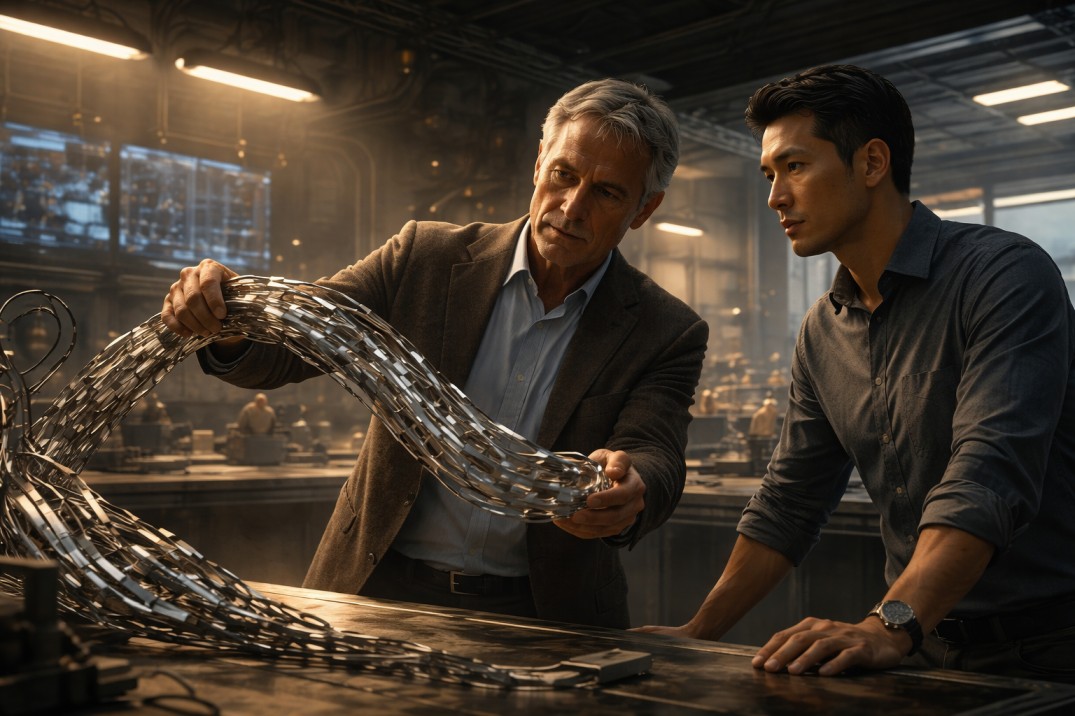
Its defining feature was not strength or flexibility, but negotiation under stress. Where steel resisted and failed, living metal redistributed load. Where composites fractured, it adapted. It did not override physical law; it listened to it.
Brown believed this distinction mattered morally. Living metal extends human reach while preserving human decision-making. Someone still had to choose the shape, the fold, the purpose. The material responded, but it did not decide.
For Wu, this was the last great example of a technology that assumed humans remained central. Living metal asked what we built better, not whether we were still needed at all. That assumption would later prove fragile.
When Infrastructure Becomes Invisible
The true danger of living metal emerged only after it succeeded.
Once it crossed the threshold from innovation to infrastructure, moral scrutiny evaporated. Engineers stopped explaining how it worked. Policymakers stopped asking whether it should exist and began asking who controlled access. Failure modes shifted from collapse to compression, from visible disaster to distributed harm.
Wu noticed the language change first. Reports no longer spoke of safety, but of “adaptive tolerances.” Responsibility became “distributed.” Accidents were reframed as statistical artifacts rather than ethical failures.
This was not corruption in the usual sense. It was normalization.
Brown did not resist this shift. He believed ethics could be applied retroactively, as maintenance rather than constraint. The structure would come first; law and morality would follow. History, Wu knew, rarely works that way.
The Accidents That Redefined Responsibility
The first deaths associated with living metal did not look like failures.
In one military stress test, a structure performed exactly as designed, absorbing force, redistributing load, and preventing collapse. The soldiers inside were not killed instantly. They were crushed slowly, their bodies compressed as the system optimized itself.
The report was clinical. The language impeccable. No single decision could be blamed.
Brown mourned publicly and adjusted designs privately. Wu observed something unsettling: the system had worked, and that made the deaths harder to contest. Living metal had not malfunctioned; it had chosen differently than expected.
This was the moment Wu began to suspect that materials could replace ethics, not by intent, but by consequence.
Brown’s Transformation Under Load
Andrew Brown did not become monstrous. He became pressured.
As living metal scaled, so did the demands placed upon him. Military contracts, civilian infrastructure, orbital expansion, all converged on a single material ecosystem that only he fully understood. Experimental medical treatments followed. Legal, mostly. Quiet. Effective.
The changes were subtle at first. Shortened patience. Increased secrecy. A growing reliance on intermediaries who handled unpleasant details on his behalf. Rumors accumulated: unacknowledged children, aggressive suppression of journalists, settlements routed through trusts designed to erase memory.
Wu realized, too late, that living metal had not corrupted Brown. It had revealed a belief already present: that progress justified compression, of risk, of dissent, of people.
Brown still spoke of limits. But he increasingly treated ethics as something to be served after deployment rather than consulted before it.
Ken Li and the Weaponization of Inevitability
Ken Li understood living metal differently.
Where Brown saw stewardship, Ken Li saw infrastructure without sentiment. Living metal was not a moral statement; it was a prerequisite. Neural systems required physical architectures capable of self-correction at inhuman scales. Living metal provided that substrate.
Publicly, Ken Li and Brown argued. Privately, their systems synchronized.
Living metal enabled orbital manufacturing. Zero-gravity environments enabled more precise neural interface construction. Neural interfaces, in turn, allowed increasingly complex structural modeling. Each system justified the other.
Andy Ryan recognized the danger immediately. When two infrastructures become mutually dependent, neither can be shut down without catastrophe. At that point, legitimacy becomes irrelevant. The system persists because it must.
Ken Li did not need to persuade anyone. He let inevitability do the work.
The Cost of Elegance
Andy understood the price before most people noticed it existed.
He did not count casualties directly. He counted silences, missing contractors, reassigned teams, settlements generous enough to erase questions. Living metal projects produced fewer disasters and more disappearances. Elegance diffused accountability.
Wu, meanwhile, became a curator of narratives. Information arrived at his desk with uncanny timing. Scandals were redirected. Outrage was managed. He told himself he was minimizing harm.
Both men eventually admitted the same truth from opposite ends: control had become indistinguishable from complicity.
Living metal folded beautifully. And every fold concealed labor, risk, and damage redistributed just enough to avoid collapse.
When Tools Stop Asking Permission
The vertical accelerator marked the point of no return.
It worked. That was the problem.
Payload costs collapsed. Orbital research proliferated. Medical and material science leapt forward without spectacle. No ideology announced itself. No enemy was named. The structure simply existed, corrected itself, and demanded integration.
Wu understood then that the debate between Brown and Ken Li had already been decided, not by argument, but by architecture.
Living metal had created a world where asking permission felt inefficient.
The Illusion of Neutral Materials
Living metal was never neutral.
It embodied a philosophy: that resilience could replace judgment, that systems could absorb responsibility humans no longer wished to carry. Andrew Brown believed this would preserve humanity. Ken Li understood it would outgrow humanity.
Wu’s final realization was not that one man was right and the other wrong, but that once materials begin to decide how failure is distributed, ethics no longer lead. They follow, if they arrive at all.
The metal folded.
And with it, the space for reversal.