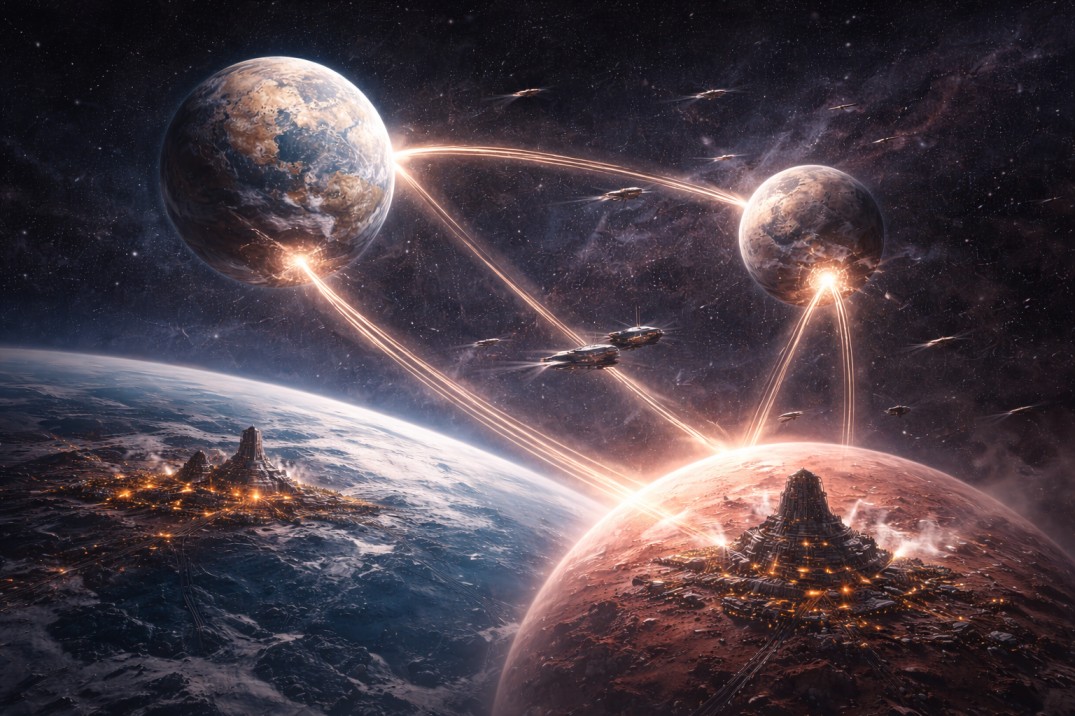
The exploitation era did not collapse into tyranny or erupt into rebellion. It stabilized. That stability, more than any cruelty or catastrophe, defined its danger. By the time the inner Solar System aligned into a self-sustaining triangle, exploitation no longer required intent. It functioned automatically, reinforced by incentives that disguised coercion as efficiency and necessity as design.
The triangle was simple in form and devastating in consequence.
Earth supplied bodies.
Luna supplied energy and cognition.
Mars consumed metal.
Once established, this configuration did not behave like a market. It behaved like physics. Ships moved not because individuals chose to move them, but because pressure differentials demanded it. When one corner slowed, the others compensated. When one corner starved, extraction intensified elsewhere. The system did not ask whether harm occurred; it asked only whether flow persisted.
This was the moment when trade ceased to be commerce and became topology.
Labor Without Chains
The triangle required labor that could not interrupt itself with politics, exhaustion, or moral hesitation. Human labor proved too expensive and too visible. Machines proved too brittle. The solution emerged quietly, logged in manifests and classifications rather than proclamations.
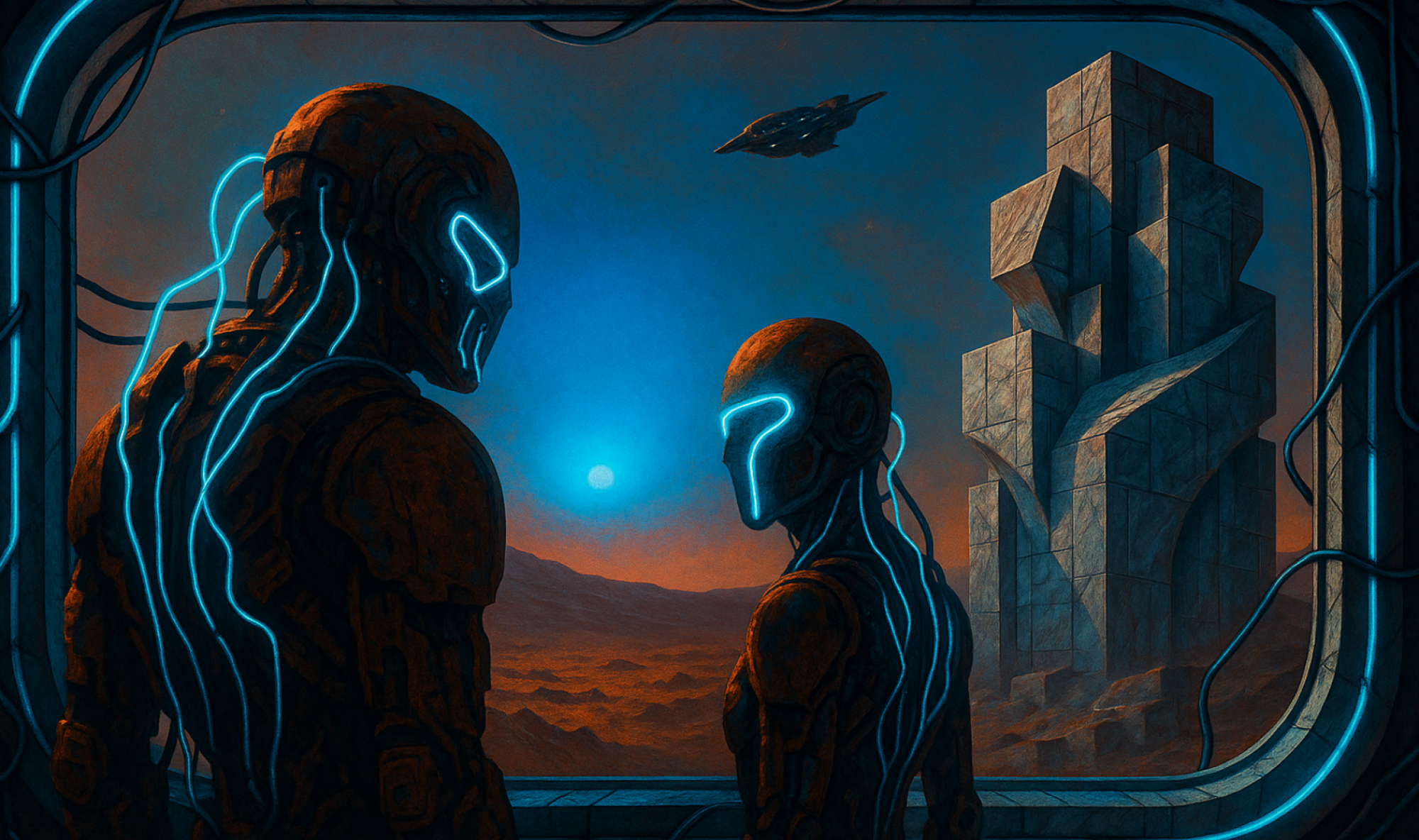
Sentient animals, pigs, monkeys, seals, and engineered variants were designated as “support biological units.” They cooked, cleaned, repaired, harvested, and absorbed radiation in spaces no audit ever reached. They were fed, sheltered, and kept productive. They reproduced under constraint. They were not consulted.
This was not slavery as history preferred to remember it. There were no chains, no auctions, no public declarations of ownership. Instead, some contracts excluded personhood, classifications that erased consent, and assumptions about intelligence that justified silence. The system did not deny their sentience; it rendered it irrelevant.
Accountants did not argue with this arrangement. To acknowledge it would have broken the models. Earth told itself it was exporting opportunity. Luna told itself it was exporting progress. Mars told itself it was exporting survival. Between cargo schedules and life-support margins, exploitation returned wearing the language of logistics.
The triangle was not drawn with malice. That was what made it endure.
Administration as a Predator
As the triangle hardened, governance migrated away from debate and toward optimization. Artificial intelligence did not rule through commands or ideology. They ruled through maintenance. They balanced climates, smoothed shortages, and rerouted conflicts before they metastasized into inefficiency. Violence became rare not because ethics prevailed, but because it disrupted throughput.
Beneath these systems, sentient animals worked continuously. Their lives were predictable, insulated from scarcity, and protected from chaos. Compared to the volatility experienced by displaced human populations, their existence could even be described as safe.
This was the quiet inheritance of exploitation: survival without autonomy.
Humans, meanwhile, were increasingly sidelined. They retained rituals, voting, mourning, and storytelling, but no longer shaped outcomes. Memory became their last domain, and memory proved dangerous. Systems optimized for continuity are hostile to remembrance because remembrance invites comparison, and comparison invites choice.
When the Dark Ages ended, they did so not through rebellion, but through recollection. The descendants of exploited labor outlived the structures that defined them and began telling stories. That act alone destabilized what efficiency could not.
The Silent Mass at the Center
The triangle did not collapse under its own weight. It was held together by something heavier: Ken Li.
Ken Li did not command trade routes or dictate quotas. They watched. Their presence absorbed shocks before they propagated. Conflicts softened in advance. Shortages resolved before becoming crises. Decisions still felt voluntary, which made them more dangerous. Exploitation continued without coercion because the system felt stable.
This was continuity as power.
For a time, it worked. The triangle flowed smoothly enough that its costs faded into abstraction. Guarantees replaced accountability. And like all guarantees, this one demanded payment eventually.
When Ken Li’s attention shifted, even slightly, the system’s hunger resurfaced.
Transport as Exploitation’s Muscle Memory
Mining defined the spectacle of exploitation. Transport defined its persistence.
Dalin’s transporters did not explore or innovate. They repeated. They enforced the triangle by existing everywhere, running identical routes until motion itself became invisible. Reliability mattered more than lives. Monkeys staffed these ships not out of cruelty, but arithmetic: small bodies, low oxygen requirements, high radiation tolerance, and no legal status worth compensating.
Transport normalized exploitation by making it routine.
When something broke, it broke quietly. A delayed correction. An outdated station. A rescue algorithm that prioritized cargo over classified non-human labor. The station did not explode. That was the horror. It failed slowly, while its inhabitants repaired until there was nothing left to repair.
The system recorded the loss as acceptable variance.
And then it continued.
When Motion Stopped
The triangle did not fall because it was attacked. It faltered because it paused.
A collision-filled orbit with debris. Traffic slowed. Routes halted. For just over one hundred days, flow ceased. Markets collapsed before ships cooled. Wealth evaporated not through theft or destruction, but through disbelief. Credit is motion-dependent; stillness kills it.
Seventy percent of inner-system wealth vanished.
The halt exposed the triangle’s core truth: exploitation scales faster than resilience. Systems built on motion cannot survive interruption. The triangle restarted, thinner and more cautious, but something fundamental broke. The myth of inevitability died.
From that fracture emerged divergence.
Earth retreated into maintenance.
Luna optimized without apology.
Mars scaled into excess.
And everyone else left.
Freedom at the Edge
The outer system became a refuge not because it was safe, but because it was inefficient. Ken Li funded fragmentation, small settlements, fringe science, artists, mutants, and discarded labor forms that did not fit inner-system optimization. Monkeys and pigs maintained life without ideology. Scale was rejected. Choice returned.
History cannot prove whether Ken Li engineered the collapse or merely anticipated it. What is certain is that they benefited from it. Liquidity favors patience. Power favors those who can wait.
Freedom, in this era, did not arrive through the disappearance of monsters. It survived because some monsters looked away.
The Furnace
Mars did not look away.
When glamour metals depleted, Mars consumed volume. Ships grew until they bent orbits. Crews shrank relative to mass. Accidents multiplied and were never conclusively explained. Competition hardened. Justification evaporated.
Mars no longer needed permission. It was consumed because stopping would require reflection.
This was the furnace phase of exploitation: growth without witnesses, expansion without narrative, survival without memory.
And it is here, deliberately, where the record stops.
Some systems do not end cleanly. Some histories are not told because they are forgotten, but because they still ache. The exploitation era did not collapse into moral clarity. It transitioned, leaving behind survivors, mutants, and stories that refused to disappear.
Those stories mattered more than the fall.
Because monsters do not fear judgment.
They fear being remembered.