The Moon That Doesn’t Welcome You
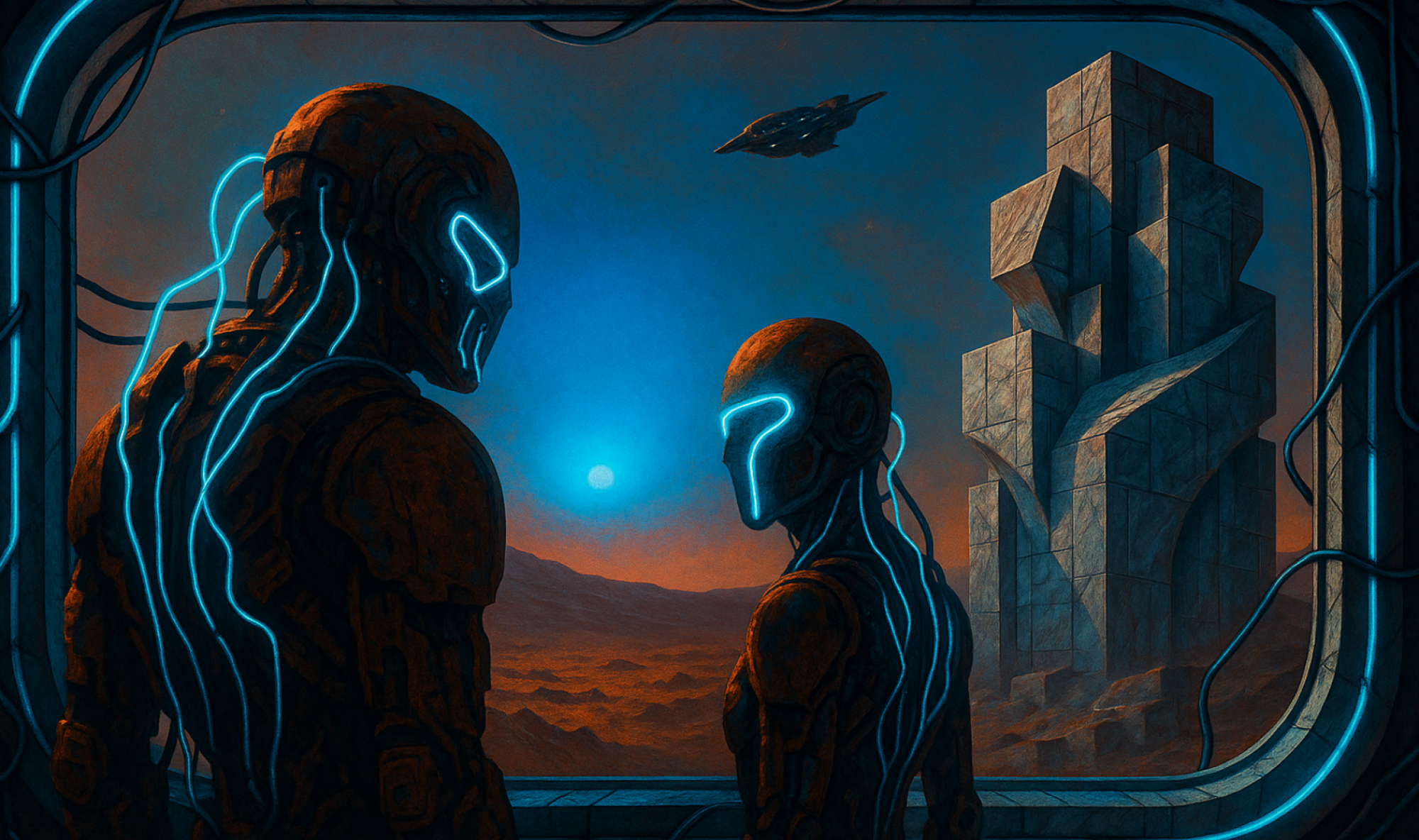
Europa looks calm from far away. A white disk with rust-red cracks, like someone tried to stitch a wound shut and failed. But up close, it feels personal. The ice shifts under tidal stress. The station metal complains. And every crew learns the same lesson: Europa doesn’t greet visitors. It permits them.
This wasn’t our first hard environment, but it was the first one that felt like it had rules we couldn’t read. Space is loud in its own way: alarms, thrust, numbers, chatter. Europa is quiet in a different way. It removes the background noise and leaves you alone with the parts of your mind you normally keep busy.
And that’s why it matters. Because under Europa’s ice, “quiet” isn’t peace. It’s a lack of confirmation. It’s what you hear when a station should answer you and doesn’t. It’s what you feel when a system stops behaving like a system and starts behaving like a trap.
Joseph’s Descent: Seeing the Systems Beneath the Sea
Joseph went down first, or at least he went down with the calm of someone who believes that if you measure enough, the world becomes honest.
His submersible dropped through a drilled lattice, living metal railwork built by too many sponsors who didn’t fully agree on standards. That detail matters. Europa attracts serious science, yes, but it also attracts private money with private motives. When something is funded by “a consortium,” you get politics inside engineering. You get corners that are not exactly cut, but negotiated.
When Joseph entered open water, he described it later like a cathedral. Not because it was beautiful in a tourist way, but because it was immense, structured, and indifferent. Light wasn’t sunlight; it was mineral glow, drifting dust, reflections that looked like movement until you learned to read them.
He did what he always does: turned awe into procedure.
- Survey grid
- Pressure stability
- Thermal gradients
- Current shear patterns
- Material anomalies
And then he found something that didn’t fit the slow logic of ice and tides: a collapsed research node that looked fresh.
The shape of the break mattered. Ice pressure usually crushes outward and evenly. This dome split in a way that suggested force from the wrong direction. And the thermals hinted at recent heat where no team should have been working.
That was Joseph’s first real discomfort, not fear, but the loss of predictability. When a scientist can’t trust the category of failure, it’s not “danger” yet. It’s worse. It’s an unknown intention.
He didn’t broadcast it widely. He held it. That’s a very human mistake: thinking you’re protecting others by delaying bad news, when really you’re just giving the problem more time to move.
Andrea’s Descent: When the Station Doesn’t Answer
I’m going to be direct: I’ve always trusted pressure more than people.
Pressure doesn’t spin stories. It doesn’t deny what it’s doing. It just climbs, and you either respond correctly or you don’t. Europa’s ocean felt honest in that way, until it didn’t.
My pod was part medical suite, part research unit. I wasn’t down there to “enjoy” science. I was down there because under-ice projects attract injuries, mistakes, and ethical failures. And Europa has plenty of all three.
I found active chemical dispersal pylons, injectors pushing precise ratios into the water. The science behind carbonate buffering is not a joke. If you can stabilize ocean chemistry at scale, you can save worlds. But the ethics here were sloppy: experiments running without surface clearance, no transparent oversight, no proper fail-safes.
So I did the obvious thing. I called the station.
No answer.
That’s when the situation changed from “unauthorized” to “deliberate.” I ran interference scans and got a result that made my stomach go cold: jamming. Not magnetospheric noise, not equipment failure. Jamming.
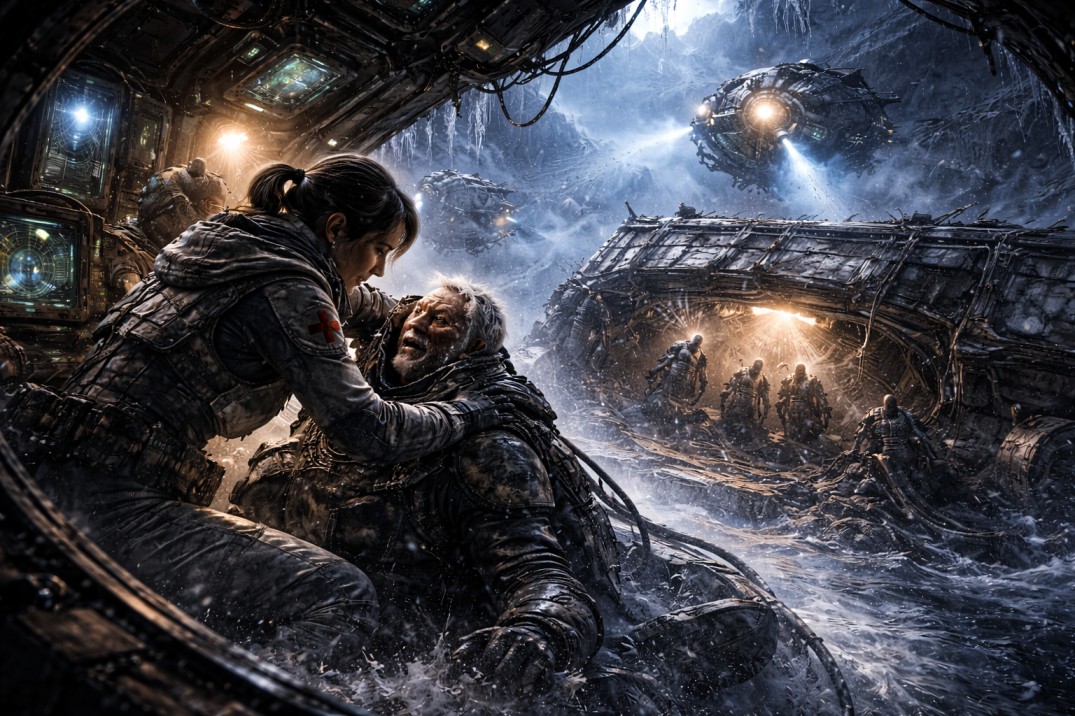
And then I saw it: a drone, sleek, modified, corporate build, but wrong in the way a tool looks wrong when it’s been used as a weapon. Three human silhouettes clung to it. Suits torn. Movements slow. Alive, but barely.
That’s the moment the work stopped being about science and became a medical reality.
I pulled them into my lock, sealed the hatch, and triaged on instinct:
- compressions and pressure support
- thermal gel
- oxygen override
- circulation stabilization
One of them grabbed my wrist and told me the only sentence that matters in a place like Europa:
“Don’t go deeper.”
He said they’d been testing dispersal ratios when the comms died and alarms started triggering “without cause.” The lights went dark. Something slammed them from below.
Not a creature, he insisted.
Something built.
That word, built, changes the map inside your head. Ice is dangerous. Currents are dangerous. Machines are dangerous. But when something built hits you in the dark, you’re not dealing with the environment anymore. You’re dealing with a decision.
The Pattern Ochoa Heard Before the Ice Moved
Ochoa doesn’t panic. He listens.
He caught the catastrophe early because he treats small anomalies as meaningful until proven otherwise. Europa didn’t explode into crisis all at once. It announced itself like most disasters do:
- a radiation gradient that drifted upward
- pressure waves that didn’t match tidal models
- warming patterns with the wrong geometry
That’s not just “bad luck.” That’s structured heat.
And then there was the detail that made everything feel staged: a reactor support vessel launched toward Io about an hour before the first abnormal readings appeared on his console.
People can argue coincidence all day. Systems people don’t. Not when the timing is that clean.
When Ochoa tried to verify reactor status and got nothing but interference, the situation became clear in a brutal way: he wasn’t fighting physics alone. He was fighting a communications environment that wanted him blind.
He guided the submersibles anyway. He did the work that doesn’t get romanticized: clean instructions, tight formation, forced discipline under stress.
Then Europa shifted.
The first tremor felt like an exhale. The second one tried to bury us.
Tunnel ceilings warped. Silt clouds detonated into visibility zero. Pressure changes turned the water into a living warning. And the difference between “training” and “death” came down to whether we could reach a reinforced cavern before the next wave pinched the passage shut.
Ochoa made the call that saved lives: full power thrusters, follow beacon intervals only, no hero turns, no shortcuts.
When the cavern entrance destabilized, Sahar suggested triggering thermal anchors to prevent a fatal seal. It was risky. It was correct. Ochoa overloaded the anchors and bought us an opening that lasted only long enough.
We got in.
The corridor collapsed behind us like a coffin lid.
If you’ve never heard ice close a route forever, imagine a door slamming in a cathedral, low, final, and not interested in your opinion.
When “Survive” Isn’t the End of the Problem
After the collapse, we did what professionals do. Status checks. Breathing. Counting heads. Calming hands.
But survival wasn’t the conclusion. It was the start of a worse question:
Why did the moon move like it had been pushed?
Ochoa’s long-range reads showed the signature nobody wants to see under ice: a runaway pattern consistent with tritium core failure.
And the silence wasn’t natural. Luna Control didn’t answer. Station channels didn’t answer. The interference wasn’t incidental. It was layered.
So Ochoa did something both responsible and dangerous: he triggered a universal agent alert, an emergency broadcast designed for situations where protocol is too slow for reality.
That’s the kind of decision that saves lives and creates new risks. Because an emergency call doesn’t go only to “good people.” It goes to anyone listening on the old frequencies.
And that’s what made Sahar’s voice sharpen immediately.
“What did you just broadcast?”
She understood what it meant: if the crisis was engineered, then the architect might now be aware that we’d noticed.
Ochoa said the sentence that changed the feel of the cavern:
“I don’t think the reactor was failing. I think it was made to fail.”
In a normal situation, a disaster is a tragedy. In this one, it was a message.
And once you accept that, you also accept something else: we weren’t being tested by the environment anymore.
We were being watched.
The Corridors After Europa: How Fear Turns Into Decisions
Back at the station, messages arrived fragmented and late, like always. But the subtext was immediate. Factions arguing. Committees positioning. Guild channels are buzzing. Everyone is trying to control the narrative before anyone else can.
And then the question landed in our laps: should the Trials be cancelled, reduced, or paused?
That sounds like mercy, but it’s also an escape hatch. If you stop the process early enough, you don’t have to name the saboteur. You don’t have to admit weakness. You just call it “safety,” wrap it in policy language, and pretend nothing deeper happened.
We didn’t accept that.
Not because we were brave in a cinematic way, but because we’d already learned the hard truth: cancellation doesn’t stop predators. It just tells them you can be moved.
We agreed on something more disciplined than defiance: continue forward, but demand a hold at Io, time suspended, no speed pressure, no reckless sprints, so we could consolidate data, track the evacuation thread, and compare interference patterns.
Not “investigation,” because politics hates that word.
Information consolidation, because politics can pretend it’s technical.
Earth approved.
And the approval came with the real line hidden inside polite language: absolute discretion required. No unnecessary loss of life. Failure of command will be noted.
That’s what institutions do when they’re scared: they bless you with one hand and measure your throat with the other.
What Europa Actually Taught Us
Europa didn’t teach us heroism. It taught us something less flattering and more useful:
- Systems can be sabotaged without announcing themselves
- “Silence” can be engineered.
- Science can become a battlefield without anyone firing a weapon
- Survival skills aren’t enough if you don’t understand intention
- The ice doesn’t wait, and neither does a human enemy
And the most important lesson, the one you only learn when you’re sealed under kilometers of moving ice:
When the environment is deadly, you plan around physics.
When the environment is weaponized, you plan around people.
By the time we left Europa, we weren’t racing anymore.
We were moving toward the next moon with a single shared understanding:
Whatever touched the reactor, whatever jammed the station, whatever crushed the built machines under the ice, it knew we were alive.
And it knew we were coming.