

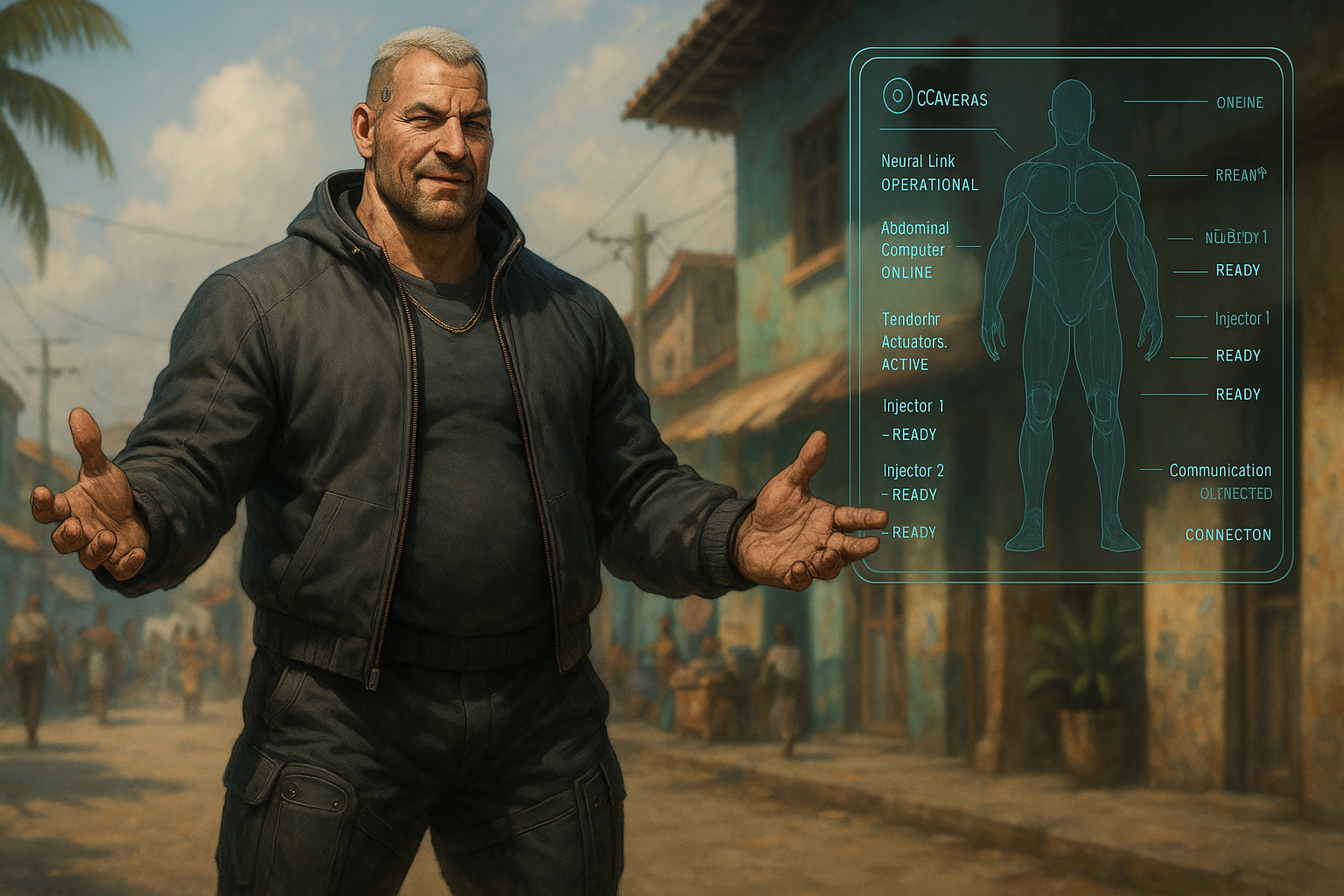
eneath the agent’s skin, every system is designed for survival and rapid intervention. The technology is almost invisible, but it shapes every action and decision.
Neural Link:
The core enhancement is the neural link, anchored at the occipital bone and running in parallel with the agent’s sympathetic nervous system. Microscopic filaments interface with the spinal cord, optic nerve, and vestibular system. This setup allows for direct machine-to-brain communication. The link translates raw sensory data into tactical insight. Peripheral movement, sudden sound, and micro-expressions are flagged and analyzed before conscious thought. Threats are identified, categorized, and projected in real time. When violence erupts, the neural link bypasses hesitation, letting the agent respond with machine-like reflexes.
The neural link’s software can inject tactical overlays into the agent’s field of vision: target outlines, ballistic trajectories, door breach timers. Audio feeds and encrypted messages are routed directly to the auditory cortex, filtered for relevance. The agent’s hands react before a command is fully formed, aim, squeeze, move, reload. The link’s data bandwidth is narrow by civilian standards, but robust against electronic interference. In emergencies, the link can take temporary control of autonomic functions, pushing heart rate and adrenaline to optimal levels for combat or evasion.
Diagnostics HUD:
Projected into the upper right of the agent’s vision, the diagnostics heads-up display is clear, minimalist, and always present. The HUD is divided into sectors:
-
Neural Link: Status and throughput, showing “Operational” or flagging errors in red.
-
Abdominal Computer: Processing load, network connectivity, power reserve.
-
Tendon Actuators: Activation status by limb, heat output, maintenance warnings.
-
Stimulant Injectors: Each labeled with compound, dose remaining, injection log, and readiness.
-
Sensors: Live feed from subdermal cameras (temple, neck), ambient audio monitoring, GPS lock.
-
Biometrics: Pulse, blood oxygen, blood pressure, reaction latency, metabolic warning flags.
If a system is compromised or at risk, the HUD auto-prioritizes alerts, red for critical, amber for caution, green for normal. All data streams are encrypted and ephemeral, with automatic purge routines on detected tampering.
Abdominal Computer:
Nested behind the abdominal wall, this computer is custom-built for fast threat analysis and secure communications. It hosts a compartmentalized operating system, isolating battlefield intelligence from personal neural feedback. Real-time mapping, encrypted shortwave radio, facial recognition, and digital countermeasures run on dedicated cores. The agent can receive mission data, update plans, and communicate with command without speaking a word.
Tendon Actuators:
Integrated along the major tendons of the arms and legs, the actuators are silent, synthetic bundles, flexing only when needed. In bursts, they can double the agent’s sprint speed or deliver inhuman grip strength for a single second. The system automatically manages recharge and thermal load, shutting down to avoid detection or injury. The actuators are slaved to both the neural link and abdominal computer, ensuring no wasted movement and no accidental trigger.
Stimulant Injectors:
Three smart injectors are embedded in the right thigh, each loaded with a different compound:
-
Cognitive enhancer for focus and memory recall.
-
Analgesic for instant pain suppression and wound response.
-
Adrenal stimulant for explosive strength and rapid recovery from shock.
Each injector is voice, gesture, or thought-activated, triple-locked against accidental dose. The system tracks blood chemistry in real time and can cancel or delay an injection if unsafe.
Sensors:
Two micro-cameras, one at the left temple, another at the nape of the neck, are nearly invisible, embedded under a faint patch of discolored skin. They stream video and audio to the abdominal computer, allowing the agent to record and review a scene in real time or send a live feed to command for backup analysis.
Communication:
A bone-conducting microphone, fused to the skull near the jaw, ensures clear, encrypted communication even in a firefight. No external device is visible; the agent can speak or receive instructions without betraying his role.
Integration:
All systems are coordinated through the neural link and HUD. In combat, the agent’s world slows down. Information overlays guide every action, hostiles are outlined, points of cover highlighted, lines of retreat calculated and displayed as faint arcs. In normal operation, most tech is silent, hidden, ready to surge to the forefront when danger is detected.
The result is a human weapon, always one step ahead, always watching, always ready. The agent carries the world’s most advanced counterterror tech beneath an ordinary face and tracksuit, unseen until the moment of action.