
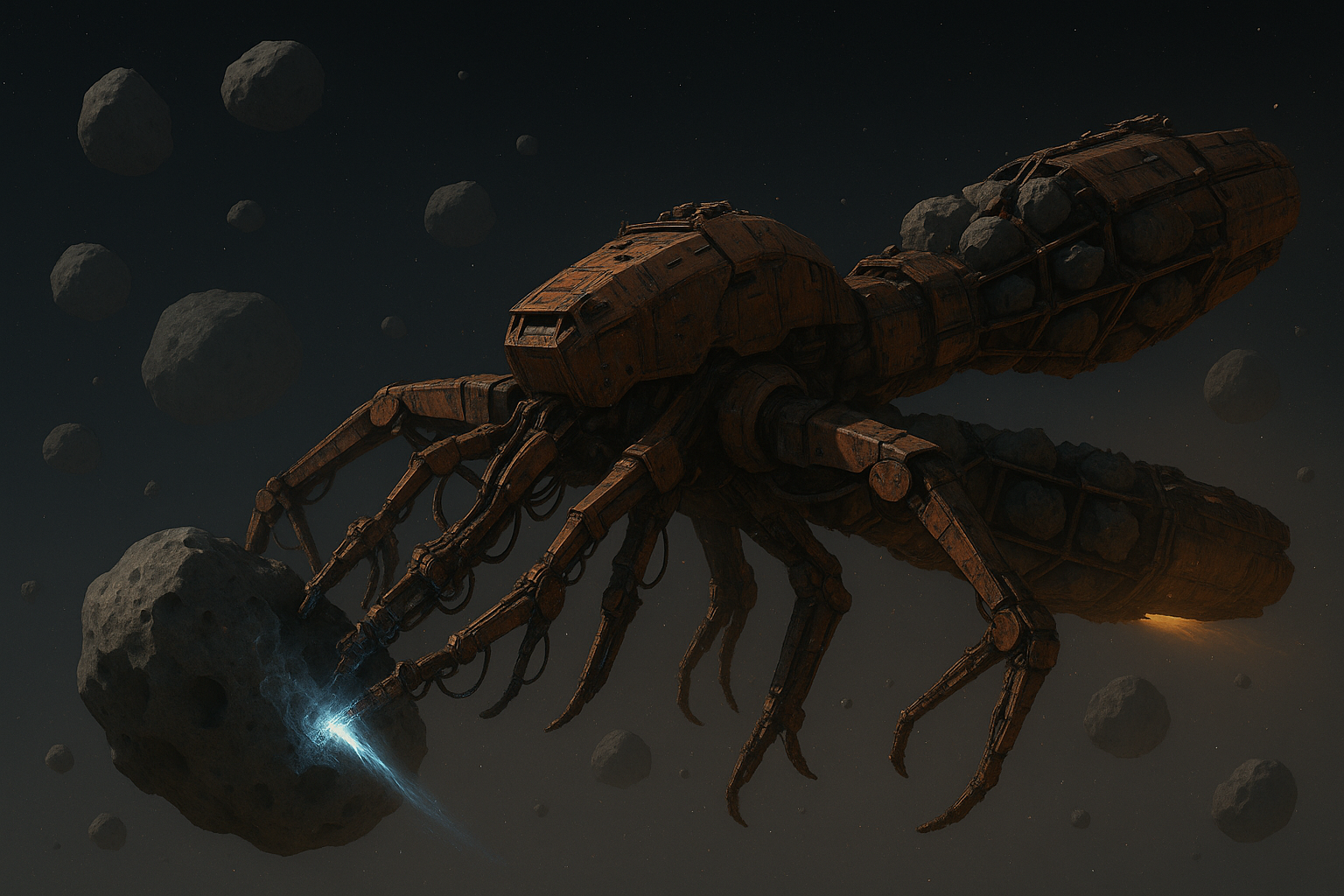
Among the lonely giants of the asteroid belt, the mining ship looms an immense, dragonfly-shaped behemoth rusted by years of collisions and cosmic neglect. The hull, once pristine, is now a testament to the ship’s endurance: pitted, scarred, patched where metal met rock and lost. Streaks of faded orange paint cling to the armored skin. The scars are not just on the surface; every dent tells a story of close calls, quick escapes, and the relentless passage of time far from any drydock or station.
Its segmented body flexes with surprising agility, pivoting as it navigates the vast spaces between asteroids, many of which are larger than city blocks. The ship’s great manipulators hang where wings might have been, reaching down in clusters. They are the tools of survival: claws for gripping, drills for breaking, ion cannons for slicing through stone. Below, a massive asteroid is clutched in the ship’s grasp, a prize destined for the forges buried deep in the segmented tail.
This is no place for the faint-hearted. The miners aboard will spend months adrift, their world reduced to metal corridors, shifting shadows, and the cold mathematics of resource extraction. Like the whaling vessels of an older world, these ships hunt giants and carve their fortunes from the bones of the solar system, moving from one rocky target to the next as opportunities arise.
Every journey is a test. There are no rescue calls answered quickly in this part of the system, and no spare parts delivered by friendly neighbors. Maintenance is a matter of necessity and ingenuity, with whole sections left to wear down until another patch job can be scrounged together from what little is left. The ship creaks and groans as it bends its iron back to the task, trailing a faint haze of dust and dreams through the silence of deep space.
Here, in the slow ballet of ship and stone, the old struggles play out anew: resource and risk, courage and luck, man and the elements, only now, the sea is black, and the prizes are ancient and waiting.