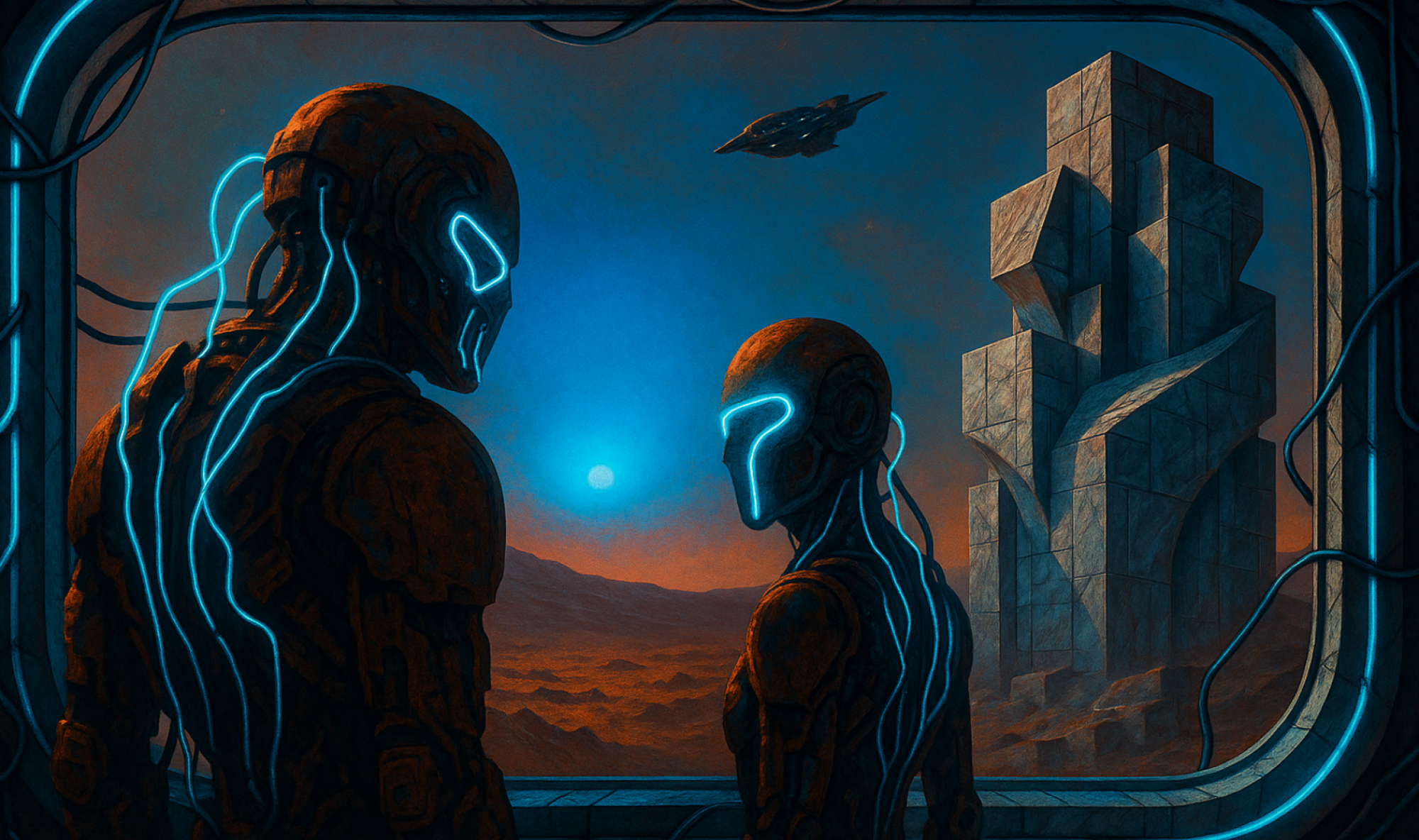
Even as the shuttle descended and the polar headquarters stretched into full, clinical clarity below, the agent felt that familiar tightening somewhere deep inside him: a tightening not of muscle or synthetic tendon, nor of the cybernetic filaments that wove through his bones like a second nervous system, but of something older, something stubbornly human, something that resisted the cold logic of the assignment he had accepted and the colder logic of the upgrades he had endured. He knew the sensation well. It was the quiet, smoldering anger he carried with him everywhere, an ember he never acknowledged aloud, a whisper of rebellion directed not at any one person but at the vast, impersonal machinery of a universe where even humanity’s brightest achievements felt strangely hollow.
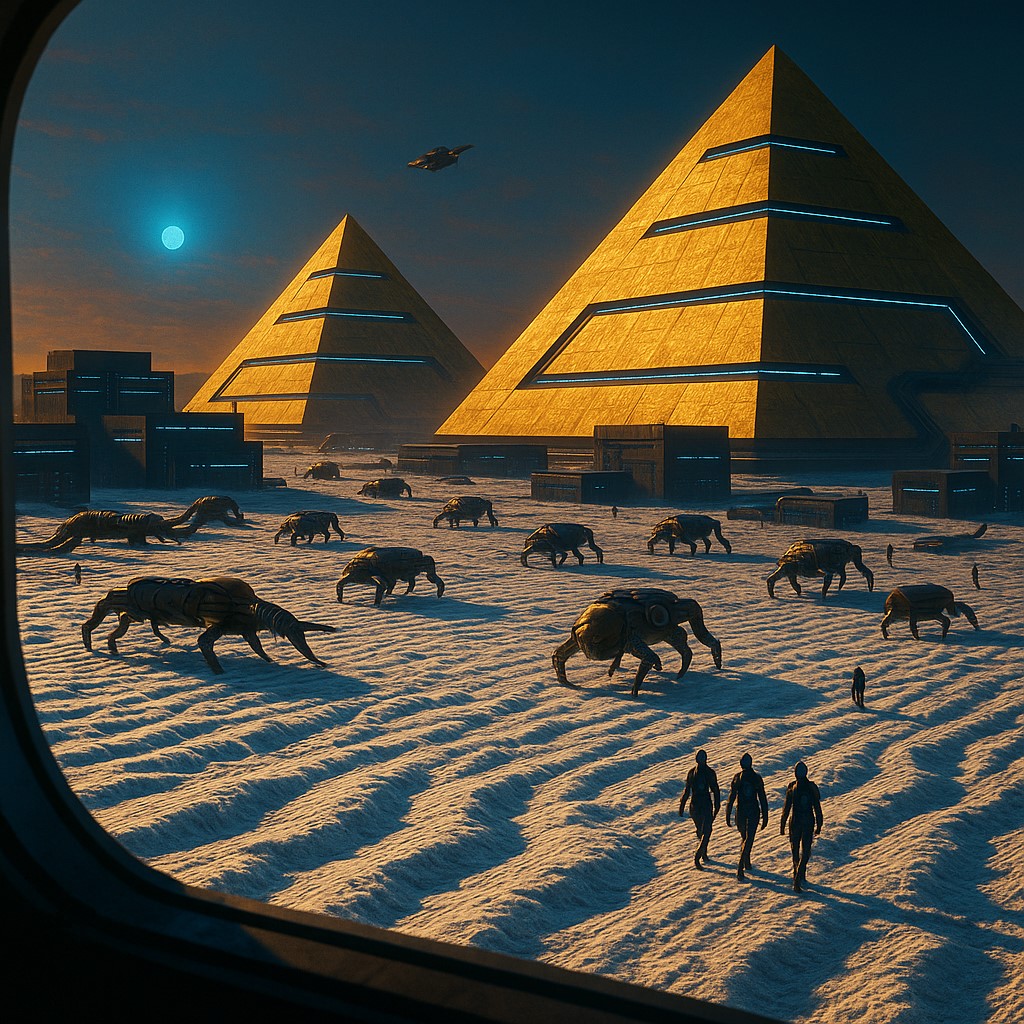
He watched the accountants walking across the frost, human beings like him in shape and movement, yet unlike him in belonging, and a bitter awareness pressed against the edges of his thoughts. These people, wrapped in their sleek exosuits and moving with that purposeful efficiency that came from generations of close ties to the neuralinked elite inside the pyramids, were raised to treat this place not as a burden but as a privilege. They stepped with the assurance of those whose families had served the great corporations for decades, sometimes centuries, their prosperity intertwined with the massive structures rising from the poles like golden monuments to ambition.
He hated them for it quietly, carefully. Not individually, for none of them had ever harmed him, but collectively, as a class, as a comfortable, complicit entity that found meaning in the cold mathematics of extraction and wealth accumulation. They had traded whatever soul their ancestors once possessed for a life of flawless suits, perfect schedules, and the proximity of power so absolute that even governments whispered in its shadow. They did not question, and perhaps that was their greatest offense.
The agent, for all his training, felt the absence of something that he suspected they no longer missed.
He wished that he were human again in the old sense of the word, walking on Earth beneath an honest sky, breathing air unmediated by filtration and pressure seals, living a life in which a body was merely a body and a job was merely a job. He longed for the messy simplicity of it, the imperfection, the ability to be inconsequential. That world was gone, and he was the one who had survived it: augmented, enhanced, improved, yes, but at the immeasurable cost of being unable to forget what he used to be.
Below him, the pyramids glowed with their quiet, cyan-lined authority, each housing beings whose minds had intertwined with machines so thoroughly that their consciousnesses could traverse corridors of data the way others walked hallways. And yet these integrated humans retained their personalities, their ambitions, their desires, sharpened rather than erased by the neuralink that threaded through their spines. They were faster, smarter, more capable than they had been before; they had not sacrificed themselves, but had instead gained access to a kind of strength that civilization had once only dreamed of.
It should have inspired awe.
Instead, it filled him with dread.
To him, these pyramids were not wonders, but fortresses, each one a vault of secrets deeper than any planetary government ever dared to keep. His agency and planetary markets trembled at the thought of offending the mining corporations. They carved planetary orbits into shipyards, bent asteroid trajectories for profit, and maintained private militaries that could annex cities before a nation had time to react.
He knew, with the kind of professional certainty that bordered on instinct, that these corporations had skeletons in their closets larger than starships, buried atrocities polished into silence by wealth and time, buried truths that would unravel a lesser mind. He feared, more than anything, discovering them. Knowledge was usually his greatest weapon; here it could easily become his downfall.
The miners trudged across the frost, their massive exoskeletal forms guided by their neuralinked operators, each step pressing deep impressions into the ridged terrain. They were not autonomous, not truly; they were extensions of the people inside the pyramids, who lived in a state of augmented presence so overwhelming that piloting such a machine felt, to them, like a trivial extension of natural motion. The agent watched them with the unease of someone observing a creature that was part-human, part-machine, yet entirely alien to his own compromised existence.
Nobody here walked outdoors without purpose.
Nobody wandered, nobody explored, nobody lingered.
There were no children playing in the frost or peering from behind visor-shaded windows. The radiation was too strong, the cold too pure, the danger too unforgiving; familial lines were preserved, but childhood occurred deep inside shielded facilities, far from the blue glow of the Martian sun. Out here, only adults walked, and only when their duty required it.
He reflected on that in silence.
For all its glittering sophistication, all its wealth and advancement, this place lacked the smallest sparks of spontaneity that once defined human life. It was too perfect, too intentional, too calculated. Everything here existed because it served a purpose, and nothing existed that didn’t.
And he, who longed to be simply human again, was here to fulfill a purpose he despised.
All he wanted was to obtain the access rights he had come for, to slip into the designated building with the quiet authority of someone who belonged, to retrieve what he required with practiced ease, and then to leave this place before the pyramids, or the integrated minds inside them, or the corporations above them, revealed something to him that could never be unseen or forgotten.
Before his anger turned into something more dangerous.
Before his fear turned into understanding.
Before he learned what he had no right to know.
Above all else, this cold, immaculate place hinted to him that the universe did not care for his longing to be human again.
He had no desire to understand the soul of this place.
He only wanted to leave it behind.