

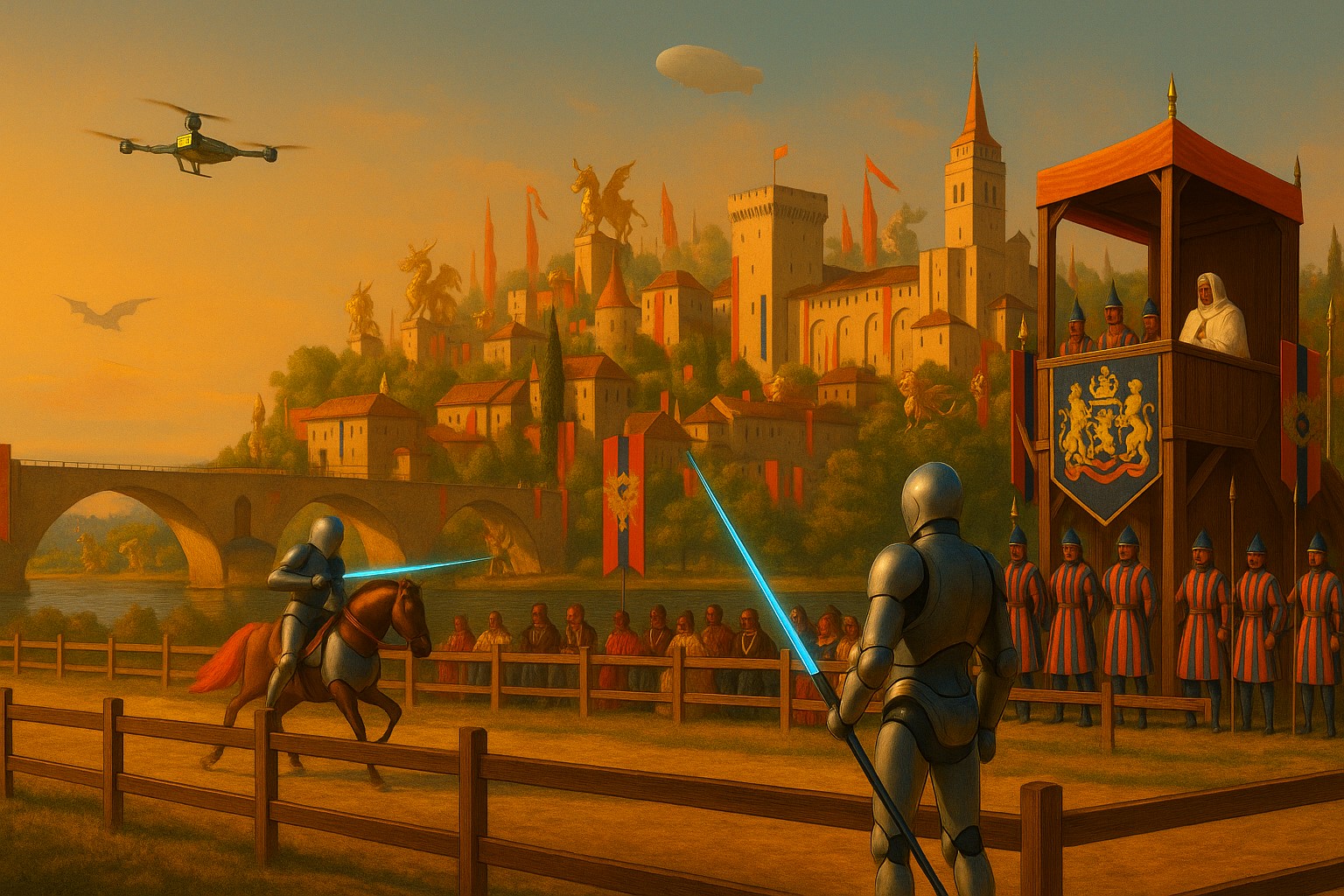
It was upon an evening of such tempered splendour as might have satisfied the most fastidious painter of the golden age, that the lists of Avignon were again prepared for those exercises of arms which, in that singular age of our story, served less for the decision of feuds and questions of honour, than for the pastime of a people who, having deliberately laid aside the engines of their vast and secret power, chose to clothe themselves once more in the panoply and usages of their forefathers.
The sun, declining westward, poured a mellow radiance over the old bridge of Saint-Bénézet and the high ramparts and towers of the Papal palace, softening the stern lines of masonry until they seemed rather the work of some benevolent enchantment than of the hard and toilsome centuries. Above the walls, the newly-gilded effigies of the Unicorn, the Dragon, the Manticore, and the Basilisk caught the rays upon their brazen flanks, so that the four monsters appeared like guardian spirits of fire, solemnly watching the field beneath. Between the towers hung banners of orange, red, and deep blue, which stirred lazily in the light wind that came up the river, bearing with it the mingled perfumes of roasting meats, fresh bread, and the subtler fragrance of roasted coffee, a luxury the knights of King John or Philip the Fair had never so much as dreamed of.
The lists themselves were ordered with a regularity which would have rejoiced the heart of any old marshal of the field. The barriers were neat and new, the ground well sanded, and at one extremity stood the tribune of honour, a tall wooden pavilion, gay with the blazon of the House of Rothschild, which in those latter days had taken upon itself, out of mingled whim and piety, the charge of maintaining these anachronistic solemnities. Under its red canopy sat His Holiness Benoît the Eleventh, no stern Hildebrand he, but a mild and portly successor of Saint Peter, whose dominion extended less over the troubled consciences of mankind than over the festival calendar of this singular reservation.
The Pontiff, robed in white and gold, leaned somewhat heavily upon the carved arm of his chair, and, if truth must be told with that impartiality which history owes alike to princes and to peasants, regarded the preparations in the lists rather with the eye of a man who has seen too many such pageants than of one whose blood was stirred by the trumpet’s call. His gaze strayed often from the poised lances and shining helms to the honey-coloured stone of the palace, the slow river gliding beneath the old bridge, and the distant hills, which the slanting sun touched with faint rose.
Behind and below him, ranged in precise order, stood the Swiss Guards of Avignon, in their parti-coloured habits of blue and vermilion, with steel caps glittering and halberds grounded. Yet even in this company of mailed men, there was one figure which, to the observant eye, must quickly have distinguished itself. At the right of the tribune, somewhat before the others, stood the Captain of the Guard, a young woman whose stately carriage and attentive brow betrayed both noble blood and habits of command.
This was the Lady Isabella di San Michele, niece to His Holiness. The stern lines of discipline could not wholly suppress the thoughtful restlessness of her dark eyes. While her soldiers maintained their ceremonial immobility, Isabella’s mind was far removed from the splintering of lances about to be exhibited for the entertainment of the townsfolk.
Her gaze rose, not to the gallant knight already mounted at the far end of the lists, but to a minute and distant speck that moved across the amber sky with the steady assurance of a bird that knows its nest. This little object, though scarce larger than a dragonfly to the eye, was in truth a vessel of strange power, one of the cargo drones which, hovering between the old world and the new like the very symbol of their age, glided silently above the reservations, bearing those instruments and stores without which even the most deliberate archaism must soon sink into real barbarism.
Within that modest hull lay certain crates and parcels, sealed by engines of art surpassing the dreams of any medieval alchemist, objects destined, as Isabella well knew, for the Witch Distribution Centres that ringed the reservation like hermitages of some curious order. There, wise women, whom bygone superstition would have delivered to flame and faggot, dispensed medicines, charms, and counsellings; half science, half sorcery, according as the recipient’s faith inclined. The Captain’s duty required that she verify the delivery and see that nothing went astray; for though the people of Avignon chose to live in the fashion of the fourteenth century, they were not minded to surrender the longer lives, the safer childbirths, nor the subtler comforts which the new arts provided.
“Your Holiness,” Isabella murmured, inclining her head, “the cargo from the northern depot approaches, as foretold by the schedule.”
The Pope gave a faint nod, not withdrawing his eyes from the river, where the reflection of the bridge shivered in golden fragments.
“Very good, child,” he replied in a tone in which indolence contended with kindness. “See only that our good witches receive their toys in due season. It would be a pity if they lacked their powders and philters; the old women would complain, and the world would imagine us cruel.”
Having thus discharged his conscience, the Holy Father sank again into his contemplative enjoyment of the scene, leaving the cares of administration, as was his amiable habit, to abler hands.
Meanwhile, the populace of Avignon, or such portion of it as had leisure or inclination to attend, set themselves in array along the barriers and upon the nearer slopes. Many were plainly yet richly garbed; their tunics of wool or silk might have deceived a stranger into believing himself among the burgesses of an actual fourteenth-century city, had not the more observant eye detected certain differences, the finer weave of the fabrics, the discreet glimmer of synthetic dyes more durable than those of woad or madder, the neat little devices at belts and wrists that whispered of hidden conveniences. Around the necks of perhaps one in five of these good citizens hung heavy chains of gold, marked with medallions bearing sigils for guild or family; these were the men and women upon whose wagers the afternoon’s interest most securely rested.
For if the knights in the lists were players upon a stage, the true drama lay for many in the reckoning of odds and the quiet shifting of coin. Here, a corpulent baker, whose ovens supplied the palace with its daily bread, argued heatedly that Sir Roland would unhorse his opponent in the second pass. There was a grave-faced matron, gold chains crossing her ample bosom, who chose rather to stake her trust and her florins upon the calm precision of the newcomer from the northern quarter. A group of apprentices whispered eagerly over some device that recorded their wagers with more accuracy than any mere steward. However, it assumed the modest guise of a leather tally-stick.
If we now cast our eyes once more upon the field, we shall recognise in the mounted knight no crusader setting forth to win his spurs in mortal struggle, but something perhaps not less honourable in an age of peace and deliberate play, the professional athlete and entertainer, the master of arms whose livelihood depends as much upon the delight of his audience as upon his skill with lance and shield.
Sir Roland de la Tour, for so was he called in the programme of the day, had been bred to the lists as other men to the counting-house or the scholar’s desk. From childhood, he had studied under masters of motion and balance, fencers who knew the geometry of a charge as well as any mathematician might describe it. Applying the same skills now in heavy armour and on a horse, he was equally graceful. His armour, though shaped in the semblance of steel plate, was in truth a wondrous harness of composite fibres and subtle actuators, designed by artists who honoured the silhouette of the past while employing all the arts of the present to protect the flesh within. The lance he couched beneath his arm held no splintering ashwood, but a core of light material encased in a sheath that flared harmlessly upon impact, its blue glimmer more theatrical than lethal.
To Roland, the festival of that evening differed little from those of the preceding month, save that the light fell more kindly upon palace and river than it sometimes did, and the odour of roasting coffee from the stalls was particularly alluring. He knew that he must perform three passes at full gallop against his fellow-knight, display a selection of controlled blows for the admiring and wagering eyes of the crowd, and accept at the end the wreath of victory or the courteous bow of honourable defeat. Afterward, there would be the customary gathering in the great hall, with cakes of delicate sugar and creams of coffee, and perhaps an extra cup for the champion, if the Pope were in genial humour.
“Sound trumpets!” cried the marshal of the lists.
At that word, a flourish rang out, executed with competent enthusiasm by a little band in livery upon the left. The hum of the crowd subsided, save for some last, breathless mutterings of odds and wagers. Isabella straightened at her post; even the drones of her responsibility could wait until the ritual of the charge was completed.
Roland’s horse, trained by patient arts unknown to the destriers of old, sprang forward at the lightest pressure of his heel. At the opposite end of the barrier, his adversary, Sir Etienne of the Roseraie, so named from the terraced gardens beyond the city, did likewise. The two silver figures rushed together, blue lances levelled, caparisons rippling like flames.
The impact, when it came, might have disappointed the rude appetite of some old baron accustomed to see blood and splintering wood; yet it had a beauty of its own. The lances met with a flare of harmless light, sensor meshes within them registering the contact and transmitting their delicate verdict to a device concealed beneath the tribune. Roland swayed in his saddle with a grace that was half artifice and half genuine correction, while Etienne’s mount checked and rebounded as if struck. From the crowd came a murmur of appreciation; it was good play, and those who had wagered upon Roland permitted themselves a cautious smile.
So the passes continued, three in all, each measured, each a little drama of balance and feigned peril. In the pauses between, squires in simple tunics, who were, in reality, technicians well versed in the mysteries of the harness, adjusted straps and checked the status lights concealed beneath decorative studs. The sun dipped lower; the banners glowed like embers against the stone.
His Holiness, if he stifled a yawn once or twice behind his ringed hand, did so with a good-natured discretion. His thoughts wandered pleasantly along the river, imagining perhaps some cool cloister in which he might later take his coffee in peace. Yet even he could not altogether resist the charm of the final pass, when Roland, bending with extreme precision, allowed Etienne’s lance to glance along his shield while touching his opponent squarely upon the breastplate. The sensors flared agreement; the herald proclaimed the victor; and a modest cheer went up, as much for the completion of the rite as for the individual success.
“Your man rides cleanly, niece,” observed the Pope, turning at last to Isabella.
“He does his office, Holy Father, as we all must,” replied the Captain, though her dark eyes had already strayed once more to the drone, which now descended in the far distance toward its appointed landing court beyond the city.
“Let us hope your witches do theirs,” the Pontiff added with a smile. “For my part, I shall do mine shortly by blessing the cakes.”
The spectators began to flow from the stands like slow water from a basin, some hurrying to settle their accounts, others already discoursing upon the next day’s contests, which would feature, it was rumoured, a demonstration with the lighter tournament blades. Children clamoured for sweetmeats; apprentices jostled their masters, eager to prove that their choice of champion had been the wiser. The chains of gold at many necks shone a little brighter, whether with new winnings or with the contentment of money safely risked and duly returned.
Isabella, having dismissed the guard to their more comfortable quarters, walked for a moment alone by the railing of the tribune, breathing in the mingled scents of trampled grass, horse-sweat, roasting meats and, more enticing than all, the rich, dark aroma that drifted from the palace kitchens, where, at that very moment, clever hands were preparing the little cups and frosted cakes that would soon grace the high table. She allowed herself the indulgence of anticipating the first sip of that glossy, bitter liquor, which no queen of the fourteenth century, however mighty, could have commanded.
She smiled to think how those ancient dames, who had schemed and pined and died without so much as a taste of coffee or cocoa, might look upon this age, where men and women dressed as their ancestors yet consumed delicacies beyond their wildest imaginings, and took potions from kindly witches who healed rather than harmed. Perhaps, she mused, progress and nostalgia, the kettle and the cauldron, the drone and the destrier, could indeed walk together in some uneasy but fruitful peace.
Across the field, Sir Roland had dismounted and removed his helm, revealing a face more cheerful than noble, browned by sun and exercise. A cluster of children beset him with questions; he answered with good humour, demonstrating how the harmless lance flared and folded, how the armour yielded softly at certain joints. To them, he was half knight, half magician; yet when he laughed and ruffled their hair, he seemed also a kindly neighbour, one whose victories brought as much bread to his table as glory to his name.
The sun kissed the horizon; the monuments on the wall flashed one last blaze of gold before sinking into shadow. The blimp, high and far, moved on toward some distant city of lighted glass, indifferent to the small pageant at its feet. The drone settled beyond the trees with the quiet assurance of a messenger that has fulfilled its task. The witches would receive their parcels; the people would drink their coffee and eat their cakes; and tomorrow, if the weather held and life continued in its present favourable course, the lists would be set again, the trumpets blown, the coins wagered.
Thus, in that curious corner of the world where men had chosen to play at the past while guarded by the unseen devices of the future, the day’s small history closed, without bloodshed, without edict, without miracle, only with the quiet blessing of good food, fair weather, and a life which, if it lacked the fierce passions of the chroniclers, possessed perhaps a larger share of that humble and steadfast happiness which sages have ever esteemed above the tumults of ambition.