After survival came violence, and after violence came the structure of the worst kind. When the wave erased governments, infrastructure, and accountability, it did not leave a vacuum. It exposed the underlying mechanics of human behavior under prolonged despair. Power shifted not toward those who could rebuild, but toward those willing to dominate. Hunger became a weapon. Morality fractured into factions. Mutants, gangs, vigilantes, and exhausted relief forces collided across ruined shores where law no longer applied. This was not chaos in motion.
It was a grim reordering of society, where brutality stabilized faster than compassion, and where recovery only began after most of the population was already gone.
When Order Vanishes, Violence Does Not Wait
Power structures do not collapse gradually. They fail suddenly, and what fills the vacuum arrives faster than coordination ever could. When authority disappeared along the devastated shores, violence did not need ideology or leadership. It needed only opportunity.
A predictable fraction of humanity thrives in disorder. When systems function, these people adapt by exploiting loopholes, building cults, dealing substances, or selling obedience. When systems vanish, they stop pretending. They become rulers of whatever territory they can dominate.
The wave did not create brutality. It removed the barriers that restrained it.
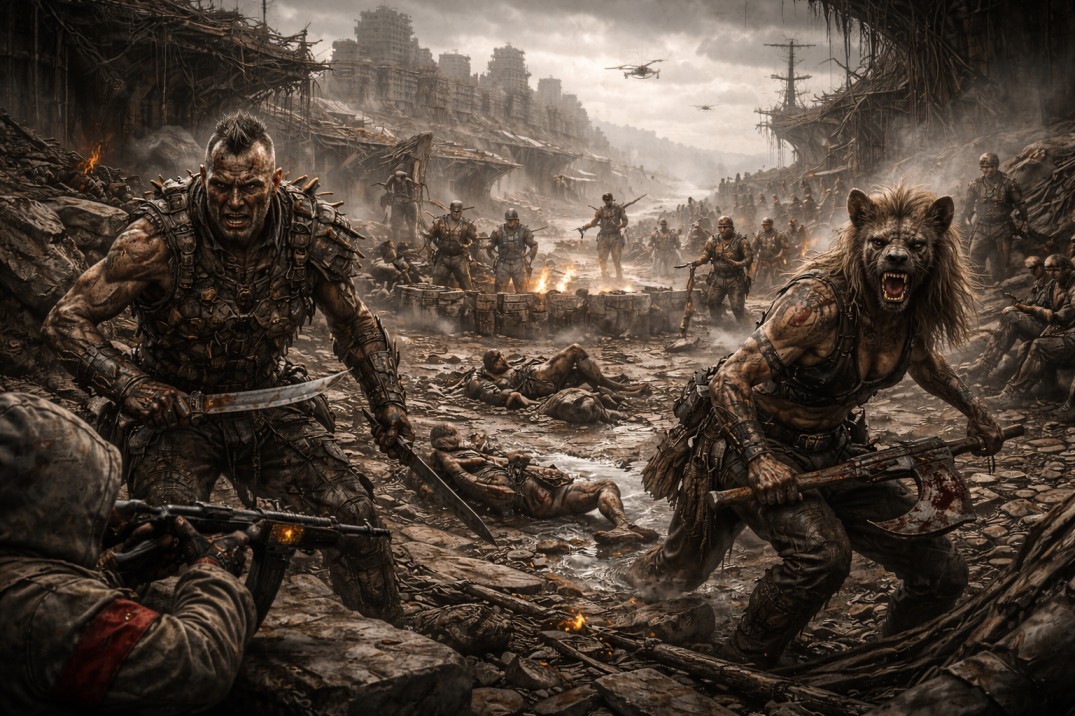
Within days, gangs controlled food, vitamins, tools, and bodies. Armed with crude weapons and backed by loyalty enforced through fear, they turned neighborhoods into fiefdoms. Corpses littered the ground, unburied and uncounted, becoming both resource and warning.
Misery accelerated everything. Hunger sharpened violence. Disease removed hesitation. Where governance failed, cruelty became policy.
Justice Does Not Disappear, It Militarizes
Violence did not go unchallenged.
Another fraction of humanity reacts to collapse not with exploitation, but resistance. These people do not seek power. They seek control over chaos. Vigilante groups formed around buildings, districts, and individuals who symbolized stability. Their ethics were improvised, their enforcement absolute.
History offered a parallel. In Soviet prison camps, authority fractured into competing moral systems. Those who cooperated with power survived by compromise. Those who refused fought until entire camps changed hands. The conflict lasted years, reshaping culture long after the war ended.
The shores did not have years.
Relief forces arrived with precision units. Snipers eliminated gang leaders from a distance. It worked tactically and failed strategically. Killing a leader fractured gangs into smaller, more volatile units. Consolidation favored those willing to cooperate with external power.
Violence did not end. It reorganized.
The Hyenas Were Not a Metaphor
Oceania had long been a laboratory for mutation. Surfers were engineered for endurance, breath control, and radiation tolerance. They were explorers, workers, and carriers of oceanic civilization.
Hyenas were different.
Created by fusing surfer physiology with scavenger genetics, hyenas were optimized for aggression, teamwork, and survival in extreme heat. Early generations were unstable. Inbreeding amplified extremes. Females became dominant, violent, and territorial. Males fractured into extremes of vanity or neglect.
Cannibalism was not taboo to them. It was logistics.
When the wave exposed unburied bodies along the shores, hyena males were the first to exploit them. Fires were lit. Flesh was preserved. What horrified humans was simply protein to hyenas.
When females arrived, they defended the practice with overwhelming force.
Their violence exceeded even gang tolerance. They were too brutal, too unpredictable, and too alien to be assimilated. What they did on the shores became legend, not because it was unprecedented, but because it was unrestrained.
The Myth of the Post-Apocalyptic Gunman
Popular culture had prepared humanity for the wrong apocalypse.
There were no lone gunslingers reclaiming civilization. Ammunition was scarce. Firearms were tools of deterrence, not hunting. The only true gunslingers were exhausted relief forces, stretched thin, undersupplied, and politically constrained.
The world had no incentive to fully intervene. No ideological blocs were competing for loyalty. There was only fatigue. Aid arrived just sufficient to quiet consciences, not to solve hunger.
Fishermen returned home. Volunteers stopped coming. Only professionals remained, bound by contracts or conscience.
Nights belonged to hyenas. Days belonged to gangs. Survivors hid, foraged, or broke.
The most dangerous predators were not animals. They were humans pushed beyond despair.
Starvation as a Behavioral Weapon
Hunger kills slowly, but it reshapes behavior immediately.
In the first days, survivors ate fish thrown inland by the wave. Then birds. Then anything organic. Vitamin pills extended life but transformed into currency. Gratitude vanished. Hoarding replaced cooperation.
After weeks, metabolism slowed. Hair fell. Libido vanished. Apathy and paranoia set in. Violence became easier than trust.
History confirmed the pattern. Famine destroys infrastructure in years, but it destroys humanity in months.
Food existed. It sat on carriers. It floated in the oceans. It grew in forests. What was missing was will. Feeding people without economic return was undesirable. Dangerous. Psychologically draining.
Starvation was not accidental. It was tolerated.
When the Surfers Finally Entered
Relief efforts stalled. Death continued. Then the demographics shifted.
Once population density collapsed to survivable levels, intervention became economical. The survivors had already paid the cost.
Surfers entered cautiously. Radiation was tolerable to them. They had ships, capital, and trade networks. They restored reactors and factories, not roads. The ocean became the supply line. Land became secondary.
Ownership followed restoration. Legal frameworks favored those with capital and logistics. Surfers became the wealthiest population on Terra without inheriting its trauma.
Hyenas were eliminated or expelled. Some fled to outer colonies. Others dispersed into deserts far from power.
Hunger receded. Not because compassion grew, but because stability returned profit.
The Quiet Evacuation of the Best
Amid the chaos, another extraction occurred.
Top performers, professionals, accountants, nurses, and technicians were quietly relocated. Some joined relief teams briefly, then left. Others never returned. Their skills were too valuable to waste in ruin.
This was not new. After previous global wars, intellectual elites migrated, draining devastated regions of recovery potential. The shores suffered the same fate.
Surfers did not invite human elites back. They had their own professionals. Radiation-tolerant. Implant-free. Loyal.
Terra fractured further.
Life Inside the Citadels
Survivors clustered into fortified citadels. Hill farms. City blocks. Ruins with walls.
Life was discipline, not hope.
Guard duty dominated existence. Every second day, four-hour shifts. Sleep with weapons. Expect attacks. Trust nothing.
Foraging parties ventured into no man’s land wearing red armbands and coded tattoos. Thieves mimicked them. Some foragers defected. Identity blurred.
Workshops ran continuously. Former nurses became fabricators. Former engineers pedaled generators. Electricity came from muscle. Water was rationed. Space was scarce. Stench was constant.
Citadels traded essentials and luxuries. Relief drops favored those deemed trustworthy. Inequality deepened.
Eventually, almost all survivors lived inside citadels. Only surfers’ pressure forced expansion beyond walls.
United by Hate, Not Hope
The survivors hated the inland dwellers who lived safer lives. The inland dwellers feared the shores. Both resented those who escaped entirely.
The carriers resented all of them.
Officially, there were reconciliations. Fundraisers. Ceremonies. Privately, resentment hardened. Pain isolates people more effectively than borders ever could.
Humanity fractured into three groups, each convinced the others had failed them.
This collective bitterness demanded release.
That release arrived through art.
Why Tanya’s Wave Mattered
Tanya’s commission did not succeed because it was beautiful.
It succeeded because it gave shape to shared rage, grief, and accusation without demanding resolution. It allowed humanity to experience catharsis without violence.
Her Wave did not explain the disaster. It absorbed it.
In a world united by hate, that was enough to make her indispensable.
.