When Resilience Becomes a Map for Predators
The shift did not announce itself with doctrine or disaster. It arrived the way structural failures often do: as an accounting detail that repeats until it becomes a pattern. Andy Ryan first noticed it in shipping manifests, redundancy where optimization once demanded singularity, human sign-offs where automated verification would have been faster, slower corridors chosen on purpose. The world, after the ocean’s hesitation and the week of cascading error, had begun to mistrust perfection. Not as ideology, but as practice. Brown’s quiet correction, reintroducing people into the seams of machine-run civilization, was meant to restore resilience. Yet resilience has a price: it adds friction, and friction creates traceable routes. A system designed to survive disruption also becomes easier to surveil, infiltrate, and threaten, because it depends on bodies moving through predictable chokepoints.
That is the core tension of this part: as human agency returns, so does the human attack surface. The same “human layer” that prevents catastrophic automation failures also invites every intelligence service, opportunist, and ideological actor to test it. Infrastructure becomes readable again. Security becomes social again. And when a high-value figure like Ken Li retreats to the Greek islands, spaces built for light and breath rather than defense, every shoreline turns into a question: how close is too close, and how long before caution becomes a lifestyle?
In Andy’s world, security is not an ethic. It is a discipline that either remains proportional or curdles into paranoia. The island’s force that questions daily. They are linked by cables and power loops, but also by habits: supply rhythms, patrol timing, visitor procedures. And habits, Andy knows, are what predators study first.
The Human Variable Returns, and So Does Proximity
Brown’s global correction made neuralink privilege insufficient rather than illegal. That distinction matters. The elite still had speed, cognition, and private compute, but they could not “bandwidth” their way through mud, ice, dredging, and contested corridors. Human crews reappeared because the world had learned an ugly truth: models fail subtly before they fail catastrophically, and no algorithm can fully supervise another algorithm at a planetary scale without eventually inheriting its blind spots.
The benefit was real. Redundant supply lines reduced cascade risk. New canals, widened channels, and manual override protocols made the system survivable. But in practice, survivability produces legibility. When the world runs perfectly, attackers have few stable targets because the system is opaque and self-adjusting. When the world runs resiliently, attackers gain something better than vulnerability: predictability.
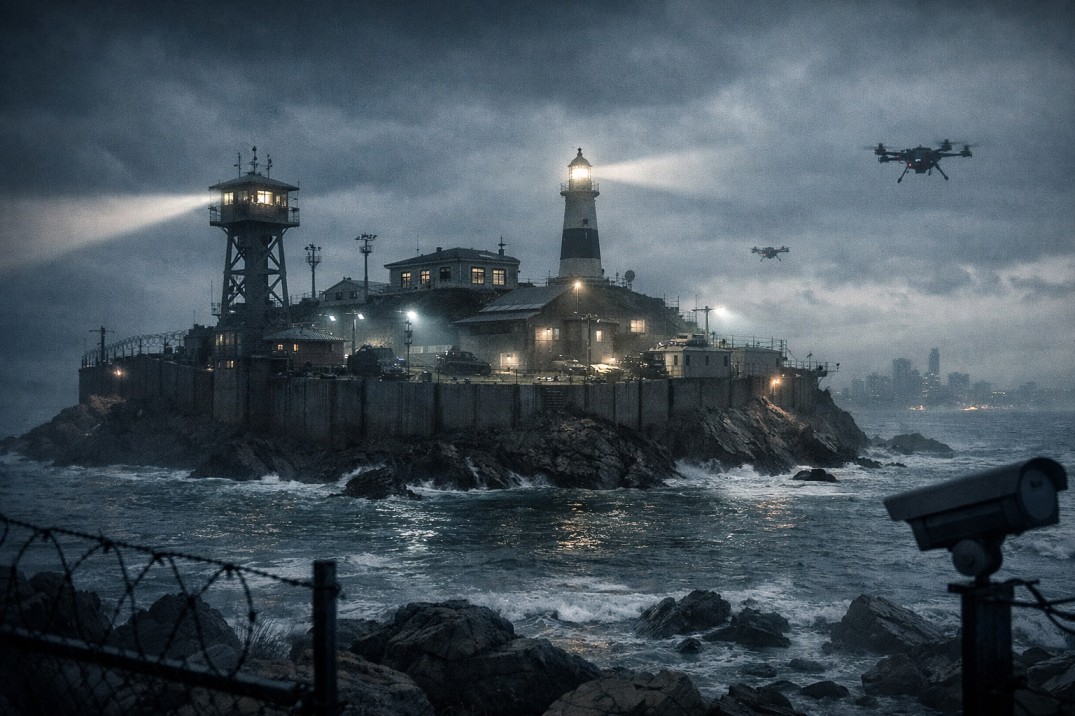
On the islands, Andy watches this happen in miniature. Maintenance crews develop routines. Support vessels arrive at intervals. Coastal sensors learn normal waveforms. Patrol drones settle into flight patterns. The system becomes robust and therefore patterned. That is why the migrants matter even before they become a threat. A boat that lingers too long at the boundary is not merely “at risk.” It is reconnaissance. Hungry people are not reliable enemies, but they are excellent noise, and noise is how proximity tests your patience until it breaks.
Ken Li dismisses the boats as statistical background. Andy doesn’t. He has lived through enough empires to understand that “background” is where history hides its knives. The islands are too close to leisure routes, too visible to bored yachts and camera drones masquerading as hobbies. You cannot build indestructibility next to champagne, Ken Li says, and for once, Andy agrees. But agreement does not create space. It only creates friction between what is defensible and what is livable.
Seo Serin’s design choices sharpen that conflict. Her architecture expected guests: open lines, sea-facing rooms, light that travels. It is a fortress that refuses to look like one. After her death, the beauty becomes dishonest, like a room prepared for someone who will never arrive. And dishonesty is dangerous in security work, because it tempts you to compensate. When you feel exposed, you overcorrect.
Fragmented Shores: When Safety Becomes an Interpretation Problem
The islands demonstrate a hard principle: security isn’t just barriers; it is narrative management. If a place looks too fortified, it invites challenge. If it looks too open, it invites intrusion. The EU lobbyist Marcus Feld understands this better than Ken Li wants to admit. “Absence is more suspicious than excess,” Marcus warns later, because Europe doesn’t only enforce threats, it enforces pretexts.
That is why Ken Li’s irritation is telling. He doesn’t hate the islands because they are weak; he hates them because they are human. They contain leisure in their peripheral vision. They contain the possibility of being seen by people who don’t understand stakes and don’t respect boundaries. That kind of visibility cannot be optimized away.
Andy, meanwhile, reads proximity like an old soldier reads weather. He increases patrols, then hides the increase inside maintenance schedules to avoid marking the moment paranoia begins. But paranoia doesn’t require paperwork. It requires repetition. And repetition is already here: boats drifting “off course,” drones hovering “accidentally,” curious visitors with plausible credentials. None of it is a single event. It is a pattern of patience.
This is how Andy frames the chapter’s thesis without stating it as a slogan: an island is not safety; it is a shoreline with better excuses. The more Ken Li tries to become an island, self-contained, sealed, silent, the more the shore fractures. Because the world does not respect isolation. It treats it as a challenge.
Blindfold Protocol: Trust Becomes Procedural
Ken Li grows tired of secret agents long before he grows afraid of them. That line matters because it distinguishes paranoia from fatigue. Fear implies uncertainty. Ken’s problem is not uncertainty; it is repetition. Every intelligence service needs neuralinks now; “slow” analysts become liabilities. So agencies arrive under polite skins: trade delegations, academic exchanges, humanitarian inspections, venture diligence. They don’t storm the walls. They attempt to live inside them.
Andy sweeps rather than moralizes. He removes devices without ceremony, reassigns people quietly, and dissolves intrusions into routine. This is competent counterintelligence: don’t escalate unless you want the confrontation you’re escalating toward. But competence does not solve Ken Li’s deeper irritation; privacy at this scale is no longer a condition; it is a negotiation. Every intrusion leaves residue: proof that your boundaries are an invitation.
So Ken simplifies. Visitors are blindfolded. Not theatrically, procedurally. Polarization layers disrupt spatial memory. Transit routes loop gently to induce disorientation without panic. Truth serums appear not because they are perfect but because they reveal what visitors are prepared to resist. Polygraphs become stressors rather than judges. The guiding idea is brutal and elegant: you can’t leverage what you can’t remember.
This is where security tips into paranoia, because “trust becomes procedural” is not only a method, it is a worldview. You are not believed; you are processed. Dignity becomes collateral. Memory becomes optional. And once memory is treated as a liability, human relationships stop forming naturally. Conversations become access events. Friendship becomes a risk.
Andy recognizes the danger because he has seen systems harden into ritual. Ritual is what you get when you keep performing defense after the original threat has changed shape. It feels like discipline. It is often grief in uniform.
The Stroke That Should Not Happen: When Opposition Dies Offline
Brown’s death is the wrong kind of event: it arrives without the data artifacts that “important” events normally produce. Ken Li’s neuralink doesn’t route the alert. It comes through an auxiliary human channel, something old, blunt, and offensive to a world that believes it has abolished surprise. That is the first error.
Ken’s reaction is precise: “That’s not possible. He monitored himself.” But Brown refused implants. Ken had always treated that refusal as stubborn theater. Now it becomes the cause of a structural truth: Brown carried mediation, legitimacy, and resistance on a body that never accepted reinforcement. His death is not mysterious; it is inevitable.
What disturbs Ken Li is not grief but displacement. Brown was an adversary and a reference frame. He provided friction that made the debate real. Without him, the edges dissolve. Ken reads the autopsy obsessively because he is looking for a flaw that would allow responsibility to be assigned retroactively, some defect that could justify intervention after the fact. Andy tells him plainly: you didn’t kill him. Ken answers with the only admission that matters: “I didn’t save him either.”
The world reacts incorrectly, reverently, and shallowly. No panic, no collapse, no demand for a replacement face. The systems continue. The committees speak in rehearsed language. It is as if humanity had already practiced moving on. Ken Li realizes what Brown’s absence means historically: not the end of progress, but the end of balance. Pompey’s death didn’t end Rome; it ended the Republic’s friction. Brown’s death doesn’t stop the machine age; it removes the last equal voice that could slow it at the moment it mattered.
Defense as Lifestyle: Automation Replaces Staff, Silence Replaces Debate
After Brown, Ken Li’s security posture stops being a department and becomes an atmosphere. Staff contracts simply expire. Humans vanish politely. Drones replace guards, not as deterrents but as constants. Doors don’t lock; they refuse. Corridors guide movement with light, not commands. Surveillance becomes so complete that it fades into the background.
Marcus Feld warns him: you are creating a vacuum. Vacuums invite force, or law. Ken counters that the law requires access. Marcus replies with the sharper truth: they won’t come for you; they’ll come to prove they still can. That sentence defines Europe’s psychology: enforcement as a demonstration of sovereignty, not just ethics.
Logistics becomes the weak point. A runway too short. Deliveries are constrained by paperwork and visibility. That’s when Lucky re-enters as a lifeline, with hydroplane landings, unregistered components, and medical supplies. Each delivery tightens dependency. Ken tolerates him because utility replaces trust. Andy trusts him because history and debt still mean something to soldiers, even in a world trying to delete memory.
This is the turning point: when defense becomes lifestyle, every convenience becomes a threat vector, and every human becomes noise. Silence replaces debate not because debate is dangerous, but because it is inefficient. And efficiency, in the wrong hands, becomes a moral theory.
Chambers of Continuity: Inspection as a Form of Violence
The cloning chambers are the most honest room in this entire part because they strip away rhetoric. Six cradles. A “harvest.” Failures removed without ceremony. A viable infant producing no applause because applause would admit what is happening emotionally. The horror isn’t death; it’s normalization, metrics, tolerances, and yield improving annually.
Ken Li’s message to investors is the true declaration: participation is optional, but irrelevance is not. He will proceed alone. The clones will receive neural links; they will not inherit his will, they will project it. Continuity becomes an engineering problem rather than a human story. And once continuity is engineered, the natural limits that once enforced humility disappear.
This is why “what survives inspection is not always what survives memory” matters. Systems can certify viability while deleting meaning. The process can succeed while civilization quietly loses the language to object.
Seo Serin Paints the Sea: Grief as Permission
Marcus warns that European agencies are coming, due process as a soft attack. Ken Li doesn’t negotiate. He punctuates. Before warrants arrive, he relocates. Not a retreat, a statement: you cannot inspect what has removed itself from your frame.
But the emotional hinge is Seo’s final work, light rising through water, not as an image but as a narrative, built to resist archiving. Art that collapses once perceived. It forces presence. It restores the one thing Ken Li has been deleting: unrepeatable human experience. And it breaks him, not theatrically, but structurally.
“I cannot stay here,” he says. Everything reminds him of her, even the things she never touched. Andy understands: this is not a loss of power. It is a loss of anchoring. And once anchoring is gone, the move to the Indian Ocean becomes more than a strategy. It becomes permission to leave the human scale behind.
Ken’s plan is not secrecy, it is environment: vertical layers, nuclear core, submarine access, cloning chambers, minimal surface footprint, “less human every year.” Andy records the sequence because he knows it will be misremembered as paranoia or evasion. In truth, it is conversion: vulnerability turned into architecture. A man building an island not asa refuge, but as a thesis.
The Shoreline That Keeps Breaking
Part VII is not a story about a fortress. It is a story about the psychology of fortresses: how safety, once pursued as an absolute, turns into a hunger that cannot be satisfied. Brown’s correction made civilization survivable by reintroducing the human variable. Ken Li’s response makes survivability governable by reducing the human variable. Both are rational. That is why the conflict is dangerous.
Andy Ryan stands between them as the only character who treats security as a proportional craft rather than a moral identity. He knows that too little security invites intrusion, but too much security invites interpretation, law, and eventually force. He also knows that paranoia doesn’t begin when you fear. It begins when you refuse to be seen.
“No man is an island” is not a slogan here; it is a warning about systems. Every attempt to isolate creates a new perimeter. Every perimeter creates a new pattern. Every pattern teaches an adversary where to stand. The shore keeps breaking, not because the sea is angry, but because the human desire for control is recursive.
And now, with Brown gone and Seo’s last light fading under the water, the future has fewer voices arguing over its direction. That silence will not remain empty. It will be filled, by procedure, by law, by cultic meaning, by markets, by machines.
Andy’s fear is not that Ken Li will fail.
It is that Ken Li will succeed, calmly, efficiently, and leave humanity without anyone left to disagree in public.