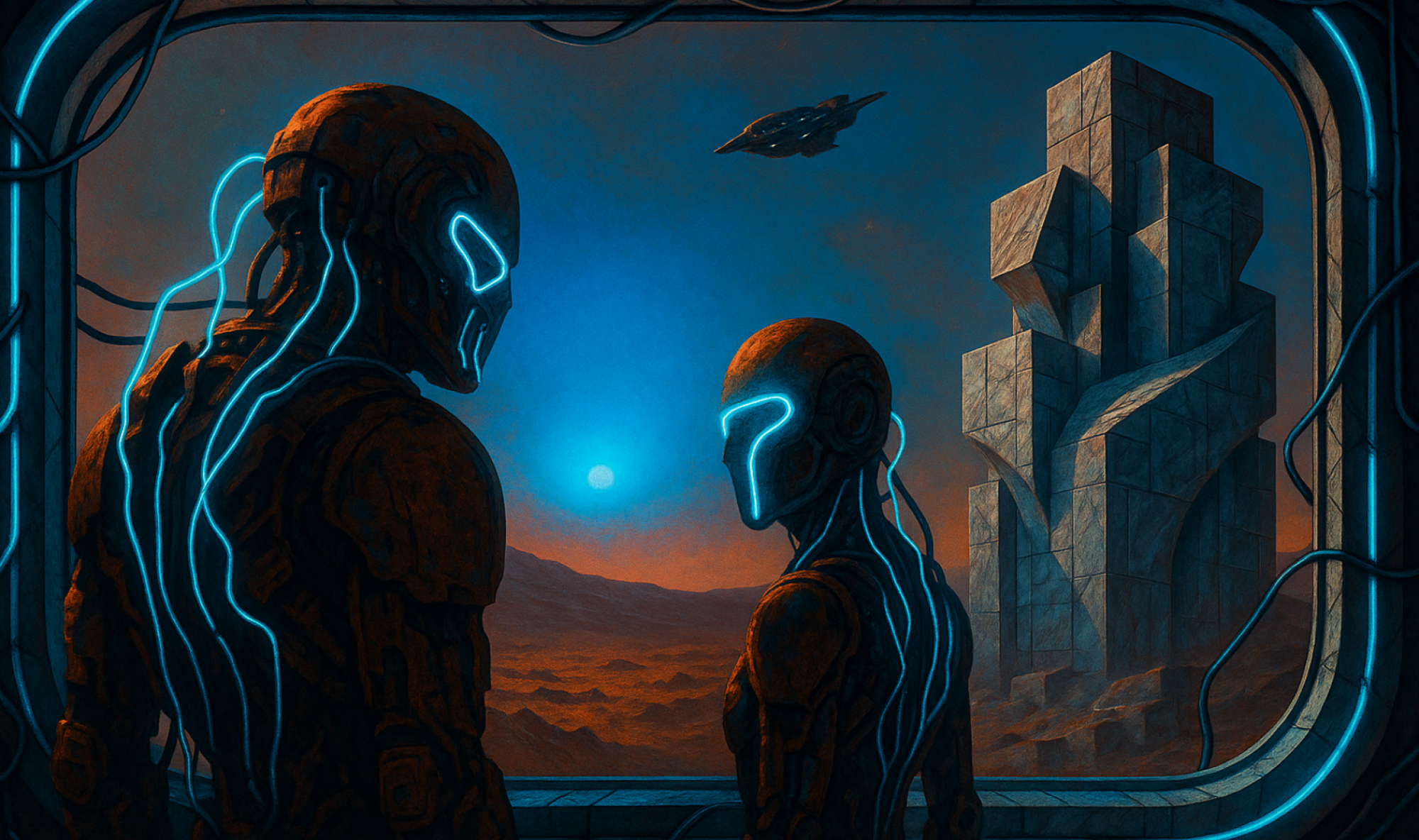

The first world had tried to kill me with beauty, polished manners, delicate pastries, and the quiet terror of a minor cut. This one tried to kill me with absence. It offered no fragrance, no softness, no ornate lies. It gave me air that tasted recycled, rooms designed to be endured, and streets built like diagrams rather than places. The shift was not merely aesthetic; it was moral. In the refined city, danger hid beneath lace. Here, danger sat in plain sight, embedded in quotas, in particulate alerts, in the way people rationed attention as if attention itself were fuel. I woke inside a life already running on rails, expected to become useful without asking why. And somewhere under the ventilation stutter, beneath the endless mechanical hum, I felt the old rhythm return, steady as a heartbeat, stubborn as a vow, reminding me that even in a world engineered to drain color, something in me still insisted on noticing.
The Synthetic Morning and the Discipline of Gray
I knew this universe before I opened my eyes. Not by memory, by texture. The sheets had that cheap, enduring roughness that never improves with time. The air carried a flat chemical clean, the scent of systems pretending to be hygiene. Even my tongue seemed to anticipate disappointment, as if it had learned the flavor of instant coffee the way skin learns the shape of an old bruise.
When I sat up, the room confirmed what my senses had already guessed: gray walls, gray floor, gray bedding, all chosen not for comfort but for compliance. Nothing personal was allowed to accumulate. No books. No photos. No evidence of anyone’s inner life. The apartment felt less like a home and more like a slot in a larger machine, an allocated space where a human could be stored between shifts.
The bathroom offered antiseptic and repetition: identical toothbrushes, identical hooks, identical silence. And then the first voice, practical as a warning label, leaked down the hall: Mask up. In this world, air was not an invisible gift; it was a managed resource that could be revoked or “adjusted” overnight.
Outside, the city looked like it had been designed by someone who hated improvisation. Buildings marched in blunt rectangles. Pipes clung to facades like exposed nerves. Fog drifted through the streets, but it wasn’t romantic; it was industrial residue, stirred by constant work. People moved with minimal curiosity, conserving their glances and their words. Even before I understood the rules, I understood the mood: here, joy was suspicious because joy might distract you from function.
A City That Runs on Invisible Rails
Walking to work meant passing through infrastructure that never asked to be admired. Ventilation chimneys rose like confessionals for machines. Transport rails hissed above me. Cargo drones cut through the air with frantic precision, each one a small obedient instinct with rotors. They didn’t wander, didn’t hesitate, didn’t look down.
Commerce had been sterilized into simulation. Instead of markets, there were augmented-reality storefronts where people queued to browse holograms, touchless, scentless versions of goods that would later arrive through chutes. One physical sample per product, sealed in resin like an artifact. Even desire had been contained, displayed, and controlled.
I overheard a man complaining that the system froze his account for “excess spending.” The woman behind him answered as if he’d mentioned rain: better to be protected from yourself. That sentence stayed with me. Not because it was cruel, but because it was accepted. In this place, people feared their own impulses the way they feared dust storms. Deviating from the algorithm’s idea of health was treated as a threat.
Screens mounted on steel columns reported “morale within acceptable thresholds.” I felt the emptiness of that phrasing like a thin draft through a sealed window. Not happiness. Not meaning. Just tolerable stability, measured by someone else’s metric.
And yet beneath the monotony, I sensed strain, like a machine running slightly off alignment. The city functioned, but it did so with a tightness that suggested it had begun to depend on denial.
The Grease Station and the Strange Intimacy of Repair
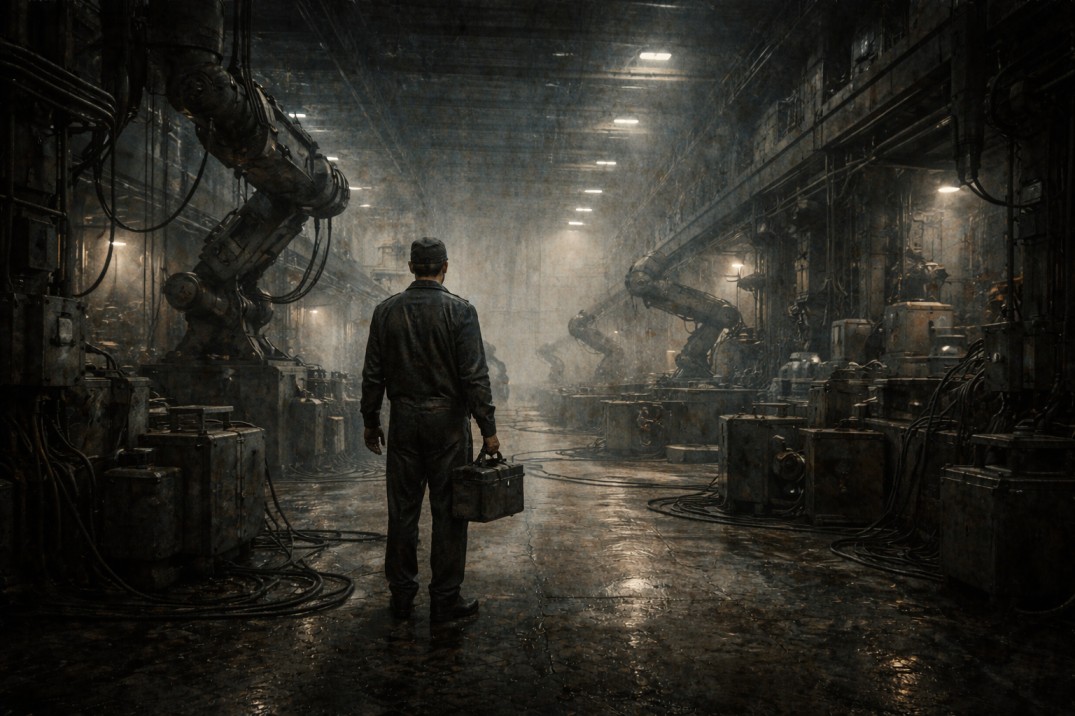
My workplace was a hybrid: warehouse bones, server-farm temperament, factory lungs. Conveyor belts carried parts like arteries carry blood. Insulation panels tried and failed to smother noise. Everything throbbed, clanked, hissed, and exhaled.
The work itself was not heroic. It was maintenance: jammed servos, dried lubricant, clogged filters, minor malfunctions that, if ignored, became accidents no one wanted to report. Machines here rarely died dramatically. They failed politely, stuttering, blinking, presenting logs with quiet precision.
Yet when I opened the first manipulator unit and felt my hands move with familiarity I didn’t earn, I understood something unsettling: another version of me had lived here long enough for the work to become muscle memory. My fingers knew the sequence: unlatch, retract, wipe, clear debris, check conduits, pump fresh grease, before my mind fully named it. In this gray world, the only intimacy that remained was between human hands and the machines that still required them.
A technician told me, almost kindly, not to let the grayness creep in. The warning wasn’t dramatic; it was resigned. Like advice about a slow illness, everyone expects to catch it eventually.
And the truth was: the repair demanded presence. Grease had texture. Metal had a temperature. Tools had weight. For a few minutes at a time, I could be fully here, because the work punished distraction. In a society that tried to smooth everything into numbness, the stubborn physicality of maintenance became a kind of grounding prayer.
Human Indispensability at the Edges of Automation
The city liked to pretend it had replaced the messy parts of human life with systems. But reality has edges, and edges require touch. Dust infiltrates housing. Weather shifts tolerances. Debris collides with the chassis. Predictive models miss the one variable that matters.
I watched a municipal hauler arrive damaged, wiring exposed like bright nerves. No one treated it as an emergency. Failure was routine here, absorbed and reallocated. A supervisor appeared only to tell me I was behind quota, his voice smooth, expressionless, practiced in never being surprised.
“The city relies on us,” he said.
Us. The word felt almost ironic. Machines scaled endlessly. Humans wore down. Yet the system still leaned on human adaptability, where the world refused to behave like a closed equation. That reliance wasn’t respect; it was convenience. But I held onto it anyway, because even convenience implies a remaining thread of necessity.
When the shift ended, I touched cooled metal and felt warmth fading beneath my palm. It was nothing mystical, just thermodynamics. And yet it felt like proof that something had been sustained by my attention.
The Hidden Purpose: Orchids in an Apartment That Refuses to Be a Home
Back in the apartment, the grayness tried to reclaim me. The furniture folded into itself. The walls offered no story. Schedules and allotments replaced the open space where ambition used to live.
And then I found the plants.
Not many, just a small shelf near the thermal panel that passed for a window. Orchids and bromeliads in repurposed containers, their leaves arched with quiet elegance. They looked almost impossible here, like a whispered joke smuggled into a bureaucratic memo.
A spray bottle waited under the sink. A handwritten note in my own script gave instructions with a tenderness the rest of the room lacked: Tuesdays. Only when the roots look thirsty.
Someone, me, but not me, had refused total surrender. The act wasn’t loud. It wasn’t political. It wasn’t even particularly risky. But it was intentional, and in this world, intention was contraband.
When I misted the orchids, the response was immediate: roots swelling faintly, droplets held like small chalices. It startled me how much I needed that small exchange, action and reaction, care and consequence. Machines here received maintenance because the system demanded it. The orchids received care because a human chose them.
That difference mattered.
Rumors, Blackouts, and the First Hairline Crack
In the corridors, people lived too close to one another and too far from one another at the same time. Walls were thin enough to transmit arguments, yet thick enough to prevent actual intimacy. Grief echoed as background noise. Couples fought about missed deliveries as if missing a delivery were a moral failure. The city trained people to treat inconvenience as guilt.
VR stores replaced markets, and “awe” was sold in packages. If you lingered, a holographic attendant would greet you, read your biometrics, and suggest what kind of wonder might keep you compliant. I avoided these places instinctively. Manufactured exhilaration felt like another way to drain whatever authentic hunger remained.
Then the city speakers announced “social health guidelines” limiting feed consumption. People accepted it without protest. They were used to being nudged, corrected, and managed.
At the grease station, the rumor arrived the way real rumors always arrive: in the quiet space between tasks, whispered beside a dispenser, carried with a tremor. Another blackout. Fourth this month.
Blackouts should have been impossible. The grid was automated, redundant, and audited. “Software drift,” they said, but machines don’t drift unless something is changing underneath them.
That was the first moment I felt my role shift. Not because I became powerful, but because I became attentive in a world that trained people not to be.
The Data Unit and the Return of the Unwelcome Skill
A supervisor, usually as neutral as the walls, pulled me into a cold alcove near coolant reservoirs. He pressed a small data unit into my palm as if passing a forbidden relic.
Not drift, he said. A sector controller failed, and before it failed, it sent a warning: excess resource draw, power pulled outside the machine registry, something that shouldn’t exist.
Why tell me?
Because I still looked around. Because I still questioned.
Walking home, the city felt the same, but I no longer believed its calm. The masks, the screens, the choreographed routines, all of it began to look like a varnish stretched thin over a crack.
In my room, neighbors argued. Someone cried upstairs. The building carried human fractures through its cheap panels like water carries sound through pipes.
I sat with the data unit and listened to the hum of the city merge with the rhythm in my head. Eighty beats. Strings and shaker, faint but persistent, an anchor that didn’t solve anything, but kept me from dissolving into numbness.
This was the pattern, I realized, across worlds: the hinge moment when a day stops being merely endured and becomes a test. A device in the hand. A rumor with teeth. A system revealing its seam.
And the worst part, also the only useful part, was simple:
I notice things.
The Dear-Joe Letter: Grief as the One Object That Won’t Stay Behind
The letter was hidden in a cheap box, tucked in a drawer like a secret nobody else cared to steal. The paper was worn, the ink slightly smudged, cursive looping with the intimacy of a world that still believed handwriting mattered.
She called me Joe here.
That detail, small and inexplicable, hurt more than it should have. Because it implied a relationship I couldn’t fully access. A tenderness I inherited without earning. A loss that belonged to another version of me, and yet still found my throat when I read.
The letter did what it always did: it reassembled a person out of sentences. It carried apology, fatigue, fear, and love spoken too late. In this world where death had become a statistic, the letter made death personal again, one voice, one body, one absence.
I folded it back carefully, not because paper is sacred, but because meaning is.
And I understood something about my own resistance: the orchids were not merely plants. They were a reply. A refusal to let the system define what mattered. A quiet insistence that beauty without purpose is still worth tending if it keeps the self from going hollow.
When I stepped back into the corridor, the gray world swallowed me again. But it did not fully win.
Not yet.