Crossing Into the Aviary
My arrival is unremarkable, the quiet entry of a species out of place. I come from the outer modules, pockets filled with sensor readouts and a notebook battered by years of handling. I pass through the sealed door, and the change is immediate and absolute. It feels as if I have crossed a boundary between two ecosystems. Behind me is the engineered wilderness of scientific outposts, hard-lit and oxygen-thin. Before me, the world unfurls into golden grandeur and hollow, dazzling space.
I take my first steps across the obsidian floor. My own reflection precedes me, flickering with every tremor of movement. The surface is so perfect, so well-polished, that my shadow-self moves almost with more confidence than I do. The hall is immense, with the scale of a cathedral built for titans, its dimensions multiplied by the endless mirrors underfoot and overhead.
I pause near the threshold, as a bird might linger at the edge of a strange clearing. I watch for patterns, for signals of welcome or warning. Nobody acknowledges me. No head turns. I am invisible, as many creatures are when they enter new territory. Yet the space is so charged, so meticulously designed for display, that I cannot help but feel exposed.
The Ornamental Flock
The inhabitants of the palace move like rare birds in a sanctuary, each one determined to be both seen and unseen. They scatter themselves across the open floor, leaving wide zones of personal air between them. Their territories are defined not by aggression but by the subtle play of posture, light, and motion. The billionaires glide from perch to perch, drinks in hand, each wrapped in an exoskeleton of status.
Their suits are a spectacle in themselves, garments engineered to catch and split the room’s white light into ripples of teal, gold, orange, and amethyst. Some pulse gently, others flicker in sync with neural uplink bands worn like mating plumage above one ear. The platform shoes are astonishing, both for their height and their spectacle. Each step leaves a brief trail of light, a private ritual of self-advertisement and display. They are the peacocks of the Solar System, and their fashion is as much armor as it is ornament.
Each wears a miniature rebreather, polished, metallic, discreet, at their necks. It is both a badge of membership and a subtle nod to the reality outside these walls. On Io, disaster is never far. These jewels are at once a fashion and a survival mechanism, reminding everyone that here, beauty and danger are never fully separated.
The Ritual of Drinks and Fire
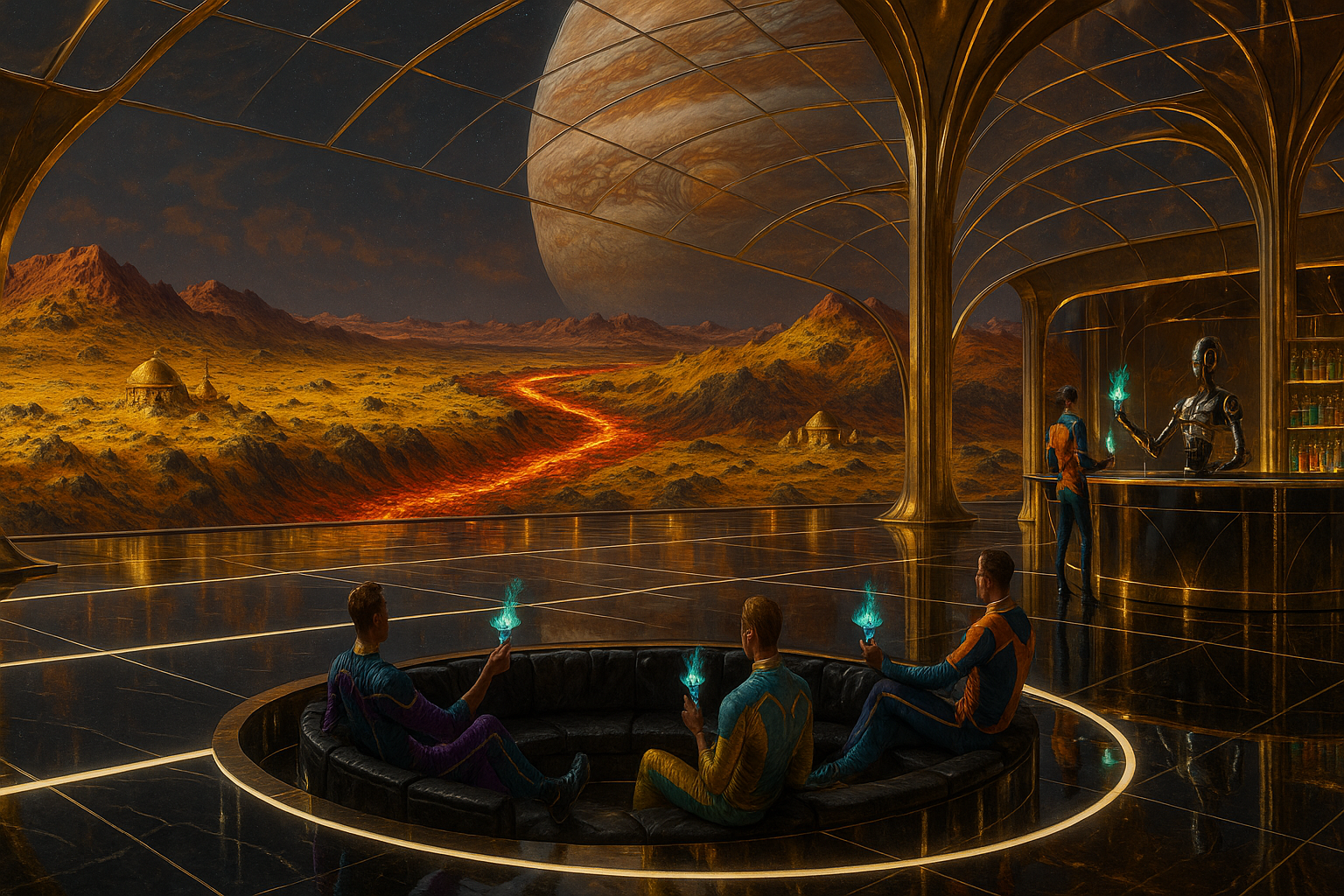
The center of social gravity in the palace is the bar. It curves in platinum and gold, glowing with an inner light. Behind it stands the barman, a robot whose body is all segmented limbs and jointed arms, glimmering in chrome and platinum. Six arms move in choreographed precision, never colliding, always in purposeful motion. There is no face, just a tight cluster of sensors and lights.
The barman’s performance is mesmerizing. Two arms handle bottles, pouring exact measures of colorless liquid into glasses cut like gemstones. Another arm produces a wand, igniting the blue-green flames that leap and hover atop every cocktail. The drinks themselves are a display, jewels within jewels, their surfaces reflecting and refracting the world around them. Guests accept these offerings as a matter of course, sipping from the fire as if it were the most natural thing in the world.
Conversation flows in low, melodic pulses, rising and falling with no clear rhythm. Words flash and die like the bright feathers of courtship displays. Laughs ring and vanish, echoes quickly devoured by the empty, gold-ribbed volume of the room.
The Dance of the Outlier
Near the far left corner, a single dancer claims her stage. Her suit is a second skin of metallic magenta and platinum. Her shoes light up with each step, responding to the rhythms of a game she plays against a holographic lattice projected around her. She moves with the focus of a bird executing a courtship ritual, every gesture precise and studied. The machine around her responds, weaving magenta and gold patterns through the air. Her dance is both invitation and challenge, and for a moment, all eyes, even the robot’s sensors, tilt in her direction.
Her dance does not break the stillness of the palace so much as define it. In the expanse of obsidian and gold, her motion is a living pulse, the proof that the room is inhabited, not merely staged for a display.
The Palace as Blind
The architecture itself is as much a participant as the people within. Gold and platinum ribs arch overhead, rising into the transparent sweep of the ceiling. Through the glass, the volcanic ridges of Io glow in sulfur and ochre, cut through by rivers of incandescent orange-red lava. No atmosphere blurs the line between stone and sky. Beyond the ridges, the gas giant Jupiter looms, its bands of cream and ochre crowding the upper blackness, so vast that its presence presses into the room as a constant pressure.
The palace feels like a blind one-way glass for the observer of rare phenomena. Every movement within is mirrored in the black glass underfoot, in the polished ribs overhead, in the crystal walls that amplify and repeat every shimmer of gold and platinum. The room multiplies each guest, each drink, each flame, until the scene is one of overwhelming spectacle. Yet there is always emptiness between the figures, an unclaimed territory that accentuates each display.
Behavioral Patterns
The social choreography is subtle, an endless pattern of display and withdrawal. Guests approach and recede, conversations flashing into existence, then disappearing with hardly a ripple. Status is measured in glances, in the quality of laughter, in the willingness to risk a joke or a challenge. Here, every move is watched. Every silence is considered. There is no camouflage in this flock, only the relentless performance of confidence and superiority.
I recognize, as a biologist might, the tension between the brilliance of the display and the loneliness it conceals. These are not communal birds, not a murmuration, but proud and solitary creatures whose brief congregation is as much about competition as it is about connection. The palace magnifies their differences, rendering even an alliance as a form of rivalry.
The Outsider’s Observations
I keep to the edge, notebook in hand, my presence acknowledged only as a necessity of the club’s desire to witness itself. My suit, plain and work-worn, absorbs more light than it reflects. I become a dark blur at the periphery, a shadow that slips from one mirrored surface to another. In my role as observer, I am both ignored and strangely essential. The flock is never quite complete without the presence of the outsider, the one who will record and remember, who will translate this moment into words for those beyond the glass.
I watch the supermodel’s dance, the flashes of flame at the bar, the territorial displays around the sofa pit. The soundscape is a tapestry of short, bright calls, the occasional bark of laughter, the soft pulse of music, and the almost inaudible tremor of distant volcanoes. The air is cool and dry, perfumed with artificial citrus and ozone, a microclimate as engineered as any aviary.
Landscape Beyond the Glass
Through the ceiling and windows, Io presents a landscape at once violent and beautiful. The mountains rise in jagged silhouettes, painted in the true colors of sulfur and volcanic glass. Rivers of lava snake through valleys, their glow undiminished by any haze. In the distance, other palaces flicker on the horizon, their golden lights reflected in the hard, broken ground.
Above everything, Jupiter broods, enormous and indifferent. Its storms swirl in silence, timeless and unmoved by the posturing and rituals below. The scale of the outside world renders the palace and its inhabitants at once grand and insignificant, a fleeting gathering in the shadow of cosmic violence.
A Reflection on Glitter and Pride
The palace’s superficial glitter dazzles, but I sense the brittleness beneath. The pride of the guests is palpable, almost fearless, as if daring the universe to look away. Yet it is a pride rooted in fragility, in the need to be noticed, to leave a mark in a world where even gold and platinum are fleeting. The displays are brilliant but precarious, always a heartbeat away from silence.
I make my notes, capturing not only the spectacle but the mood, the electric tension, the ache beneath the shine, the unspoken understanding that all gatherings are temporary. I think of other observers before me, explorers and chroniclers who entered courts and palaces far from home. In my own way, I am Marco Polo, marveling at the Khan’s impossible hall, trying to name the colors of the birds, the patterns of their flights, and the meaning behind their calls.
Tonight, I am both a scientist and a witness. I remain until the last flame flickers out, until the reflections fade and the palace empties, leaving only the echo of wings and the endless darkness outside the glass.