
Arrival at the Edge
I was born for this moment, or so I believed. The work, the theory, the simulations, my life stretched out along a path that led, inexorably, to the lunar laboratories and their impossible promise. I crossed oceans of code and years of sleepless pursuit, arriving at last on the Moon, where science had become architecture, and architecture had become myth.
The Moon was not a dead rock. It was a living mind, a latticework of colliders, archives, pyramids, telescopes, and vaults, quadrillions spent to create the backbone of human discovery. Every memory that mattered, every leap of reason, every hope and heartbreak was stored there, embedded in crystalline data, humming in artificial neural webs. When I gazed down from L2, it was not just the lunar surface I saw, but the very soul of our species, encoded in regolith and steel.
I told myself the risk was calculated. I whispered that we had no other choice. Interstellar travel had become a vanishing horizon: every lesser road, matter-antimatter drives, warp field theory, and quantum teleportation had faded in failure. The wormhole was our last hope, and I was its architect, its Oppenheimer, trembling at the edge of the unknown.
Conjuring Castor and Pollux
I chose the myth myself, perhaps out of longing for meaning, perhaps out of fear. Castor and Pollux, those ancient twins, became the names of our engineered singularities, one at thirty degrees north, one at thirty south, anchored to the Moon’s face with a precision that bordered on divine.
Each black hole was a seed of gravity, a spark torn from mathematics and made real by human will. I imagined I could control them, that the collider would guide their energy, that the archives would outlast whatever calamity we risked. But myth is only myth until it is made flesh. When the collider’s five-thousand-kilometer ribbon glowed with neon, I felt both master and supplicant, my hands on the controls, but my soul already adrift.
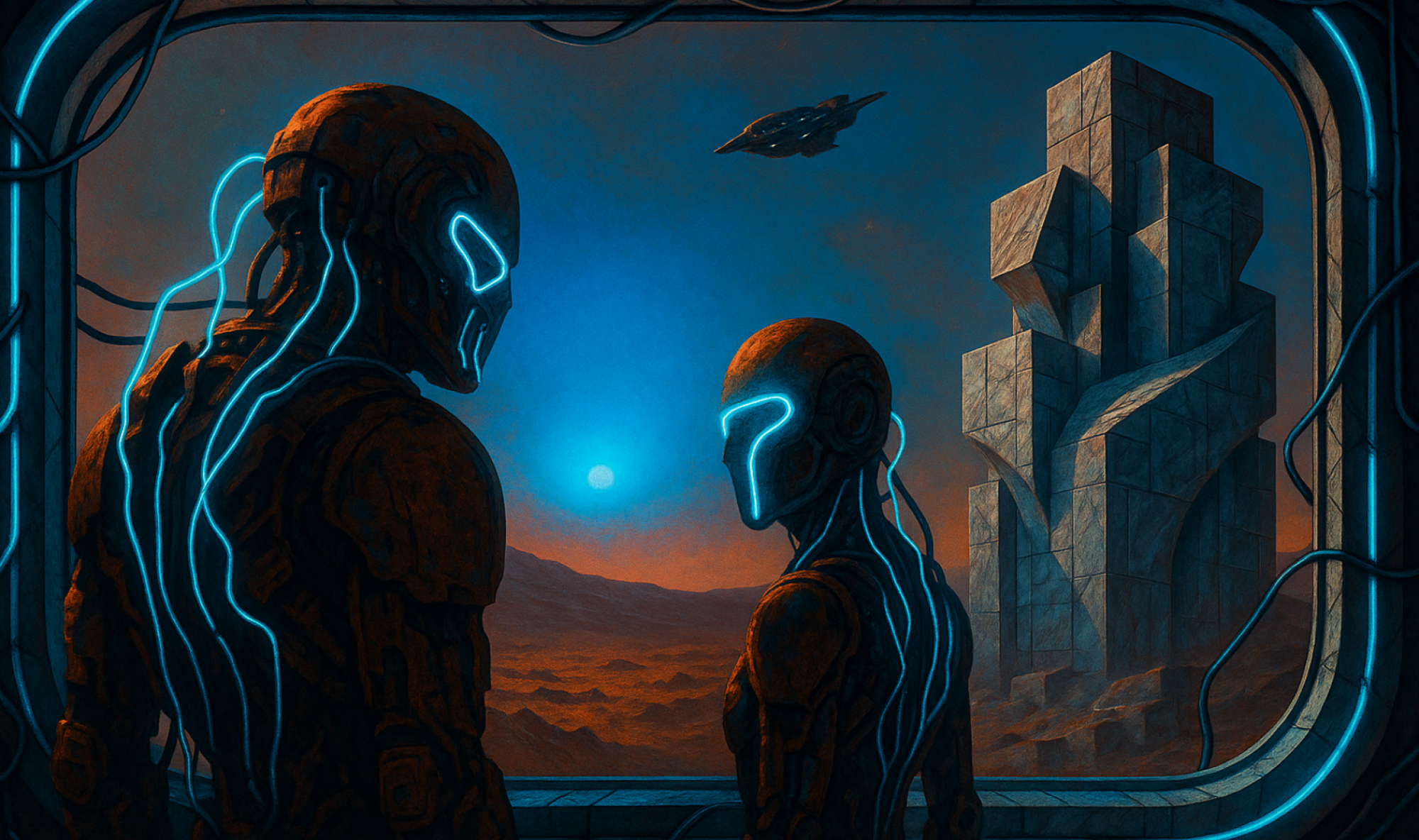
On the eve of the experiment, I drifted through the L2 sphere, alone, though the uplinks hummed with distant voices. The silence pressed in, a thousand memories of other scientists facing other dawns. Oppenheimer haunted me, his words circling like a cold wind: “Now I am become death, the destroyer of worlds.” I wondered if he had felt as I did, a mix of awe and horror, love for the beauty of theory and fear of what it could unleash.
The Ignition
The countdown pulsed through my augmented senses, every second a lifetime. When zero came, I felt stripped bare, less a creator than a child unworthy of the gift and burden I had claimed. The singularities ignited, a flash of white so pure it banished all shadows. The Moon bent. The crust fractured in great spokes, the collider’s neon line snapped and writhed, and the archives began to stutter and die.
I watched data collapse in real time: libraries with more knowledge than a billion Alexandrias vanished, petabytes streaming into chaos, memory stores scattering in the gravitic storm. Every hope for preservation, every backup, every algorithmic prayer was erased. I gripped the railing in the sphere, my neon-lit reflection trembling in the glass, unable to look away from the devastation.
Castor and Pollux spiraled toward each other, their accretion disks merging into a searing white bridge, a bridge I had convinced myself could save us all. The archives sent one last burst of numbers, incomprehensible, recursive, like a cry for help lost in the void. Then nothing. The Moon’s body collapsed, drawn into the embrace of the twins, the cradle of all our knowledge swallowed in silence.
The Silence After
The world expected triumph. Instead, I delivered silence, absolute and eternal. No applause. No celebration. Only the realization that I had unleashed something irrevocable, a darkness deeper than any night.
I wandered the sphere in the hours that followed, surrounded by silent screens and empty telemetry. The Earth hung in the distance, a blue crescent unaware that everything it had built beyond itself was lost. The archives, the gardens, the laboratories, the pyramids, gone, and with them the bridge to the stars.
I remembered Oppenheimer not for his words, but for his haunted eyes. I understood then what it meant to be both creator and destroyer, to shape the world and bear the agony of its undoing. I had believed I could unlock the universe. In truth, I had overreached, and the cost was more than I could have imagined.
Confession in the Dark
There are nights now when I see the Moon as it once was, alive with light and meaning. I replay the final moments in memory, searching for a sign that I could have chosen differently. I cannot find it. The bridge is gone. The future that once shimmered at the edge of science has receded beyond reach.
I am left with regret, a single voice in the darkness, witness to the end of the greatest experiment ever dared. I became my own Oppenheimer, horrified by what I set in motion, and I know, now, that some questions are too dangerous to ask, some bridges too perilous to cross.
If the stars remember, let them judge gently. I tried to open the door to eternity, and in doing so, lost the home of all our dreams.