
The Infinite Ice
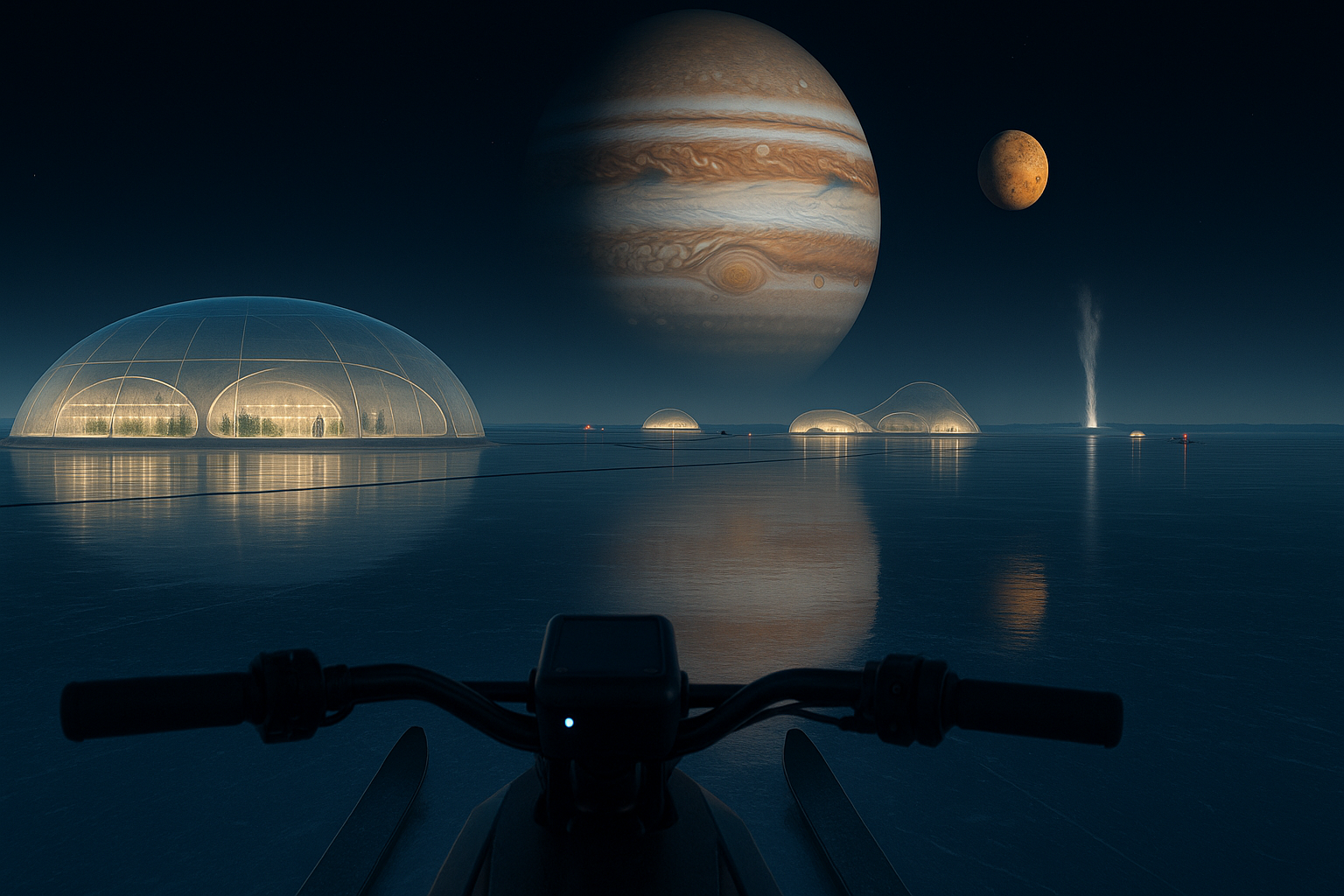
Europa’s surface was a vastness with no parallel. The first time I saw it, I thought of the old explorers paddling out onto the Arctic, searching for land where none existed, and finding only endless, perfect white. Here the ice was blue, and not merely cold but ancient and clear, so clear that the stars overhead seemed to rest beneath my feet as much as above. Jupiter’s bulk filled half the sky, its stripes distorted in the sheen, every color doubled, every cloud swirling in the reflection at my skimmer’s runners.
It was the silence that struck me first. Not the hush of snow or the stifling press of fog, but a kind of pure absence, as if sound itself froze and shattered, carried away on the gravity tides. Only the faint vibration of the skimmer broke the spell: a thin, hopeful line drawn across the untouched plain, the only trace that anyone had passed this way.
I gripped the handlebars, pulse tight in my gloves, and watched the front end of the skimmer glide on its paired skis. The craft had no wheels, nothing to bite or grind, just slender, sharp runners that rode the frictionless sea. Every kilometer between domes felt like a test, not only of the machine’s batteries and bearings but of my own resolve. To be alone here, separated from warmth and the throb of the colony, was to face something immense and indifferent. The cold pressed in, as if searching for any flaw in my suit or spirit.
Islands of Warmth
Yet ahead, always, were the domes. Not a grid or a neat line, but scattered like pebbles tossed by fate across the ice. Their shapes were never quite the same, some round, others oval, a few stretched and doubled, their bases flattened to spread weight over the treacherous crust. At night, the domes glowed from within, throwing soft pools of white and blue that melted the blackness for tens of meters. From afar, they looked fragile, thin shells housing miracles.
I kept my gaze fixed on the next pool of light, letting it draw me in. The mesh cables that linked dome to dome and to the accumulators shimmered where the illumination caught them, sketching delicate arcs on the surface. Sometimes the cables seemed to pulse, blue LEDs blinking in the dark, tracing the veins of our small civilization.
Between domes, other skimmers glided like ghosts, their lights low and white, distant companions in the emptiness. I sometimes wondered about the pilots behind those lights, were they as wary as I was, or did the routine dull the awe, make the emptiness seem smaller? But each crossing brought its own risks, and no one grew careless on Europa. Not twice.
The Heart of the Dome
Reaching a dome meant more than shelter. It was like passing from death into life, from the edge of the world into its center. I braked the skimmer gently, letting the skis hiss to a stop beside the main hatch. The dome rose above me, wide and low, its shell a marvel of human ingenuity: graphene layers pressed and curved, almost invisible except for the faint network of reinforcing ribs and sensor lines. The entrance was always rimed with frost, even with the heated skirt below, the ice eager to reclaim anything warm.
Inside, condensation fogged the air, and the artificial sun overhead bathed everything in a clean, persistent white. Racks of hydroponic cherry tomatoes formed narrow canyons of green and red, heavy with ripening fruit. Pea tendrils twisted up plastic towers, curling toward the light. Tanks full of tiny gambas gurgled and churned, their inhabitants barely visible beneath the froth. The temperature difference was sharp, like plunging hands into warm water after hours in the snow. The colony was never large, but it was abundant, the product of routine and innovation and the stubborn refusal to let the cold win.
Here, the hum of air recirculators and the soft voices of colleagues reminded me I was not alone. Yet even in the dome, there was a sense of fragility, a constant awareness of how thin the shell was, how easily the balance might tip if power failed or the ice below shifted. The lights were a bulwark against the dark, but the dark was always near.
Contrasts of Existence
On Europa, life was measured in contrasts. Outside, the silence was absolute; inside, noise and laughter and the wet snap of vines pulled from the trellis. The surface could kill in minutes; the dome nursed seedlings through the coldest nights. The isolation was complete, yet within the domes, companionship thrived, shared meals, shared risk, even the rare exchange of music or old stories piped through the comms system.
The ice was flawless and featureless, but no two domes were identical. Some grew in clusters, ringed with cargo crates and empty skimmer racks; others stood alone on the horizon, distant beacons calling travelers home. At times, a geyser would erupt on the edge of vision, shooting a plume of white and blue into the sky. That was always a sign to hurry, for the ice could shift, and nothing lasted long in its path.
Above all, there was the presence of Jupiter and Io. The planet watched with an indifferent eye, its storms larger than the world I had left behind. Io, bright and yellow, hung as a jewel beside its master. The two served as both guide and warning, their light marking time in a place where clocks had little meaning.
The Challenge and the Bond
Every journey between domes was a crossing into danger and opportunity. The mesh cables mapped the safest routes, yet ice had moods and would not always obey. Cracks could appear, crevasses could swallow a careless skimmer, and the cold, when it came, came fast and without mercy. We learned to respect the void, to trust our machines and each other.
Still, what drew me most was not the danger but the moment of return. To step from the cold into the embrace of the dome, to breathe air heavy with plant life, to share soup with the others and listen to stories of Earth or Saturn’s rings, these things grounded me. In the heart of that small warmth, I remembered why we came.
The colony endured because we endured, drawing strength from each other and from the stark beauty of the world outside. We traded seeds and ideas and sometimes dreams, hoping that what we built here would outlast the ice, that generations yet unborn would know of the first gardens under Jupiter’s sky.
The Promise of the Ice
Now, as I sit by the greenhouse window, the skimmer resting by the hatch and the frost already reclaiming my tracks, I think of what the ice hides. Beneath the glassy plain, the ocean moves, a warm, living sea untouched by any sun. One day, perhaps, the domes will reach deeper, sending roots into that world, finding life as strange and stubborn as our own.
For now, we live in the contrast between fire and frost, light and dark, hope and caution. On Europa, it is always the edge, and always the dawn of something new.