There are moments in history that announce themselves loudly, wars, collapses, disasters that force recognition through spectacle. And then some moments pass almost politely, framed as conferences or statements, yet quietly redraw the limits of what can still be refused.
The day transhumanism spoke belonged to the second category.
Those present would later struggle to explain why the air felt different when they left the hall. Nothing had exploded. No treaty had been signed. No law had changed. Yet something essential had shifted: the future had stopped presenting itself as a proposal and begun behaving like a schedule.
This was not the birth of an ideology. It was the moment inevitability learned to speak in complete sentences.
A Speech That Treated Humanity as a Phase
The address itself was delivered without melodrama. That was part of its force.
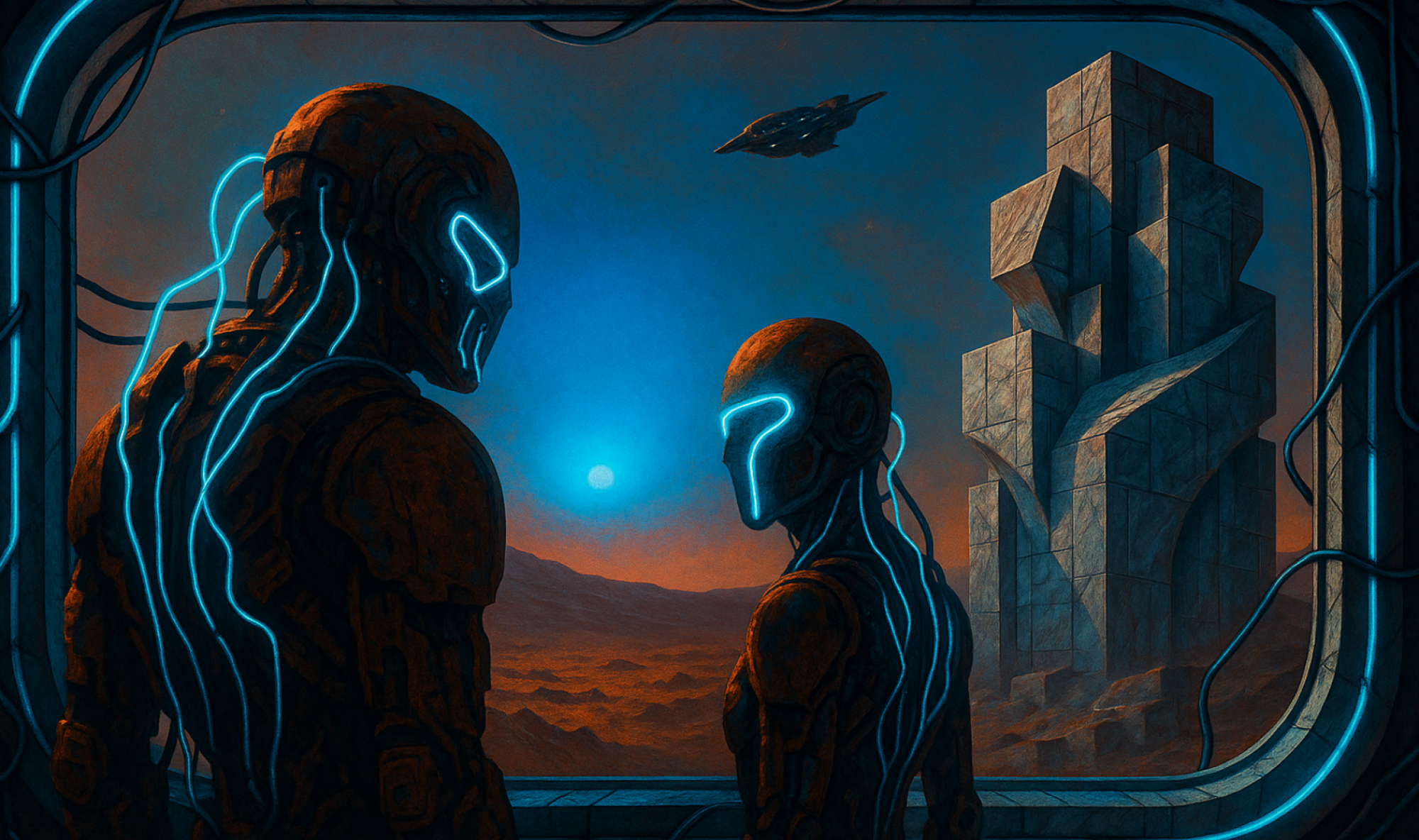
The speaker did not ask for permission, forgiveness, or patience. He did not soften ambition with ethical hesitation. He spoke of neural links, synthetic ligaments, and expanded cognition not as experiments but as logistics. Enhancements were framed as infrastructure. Biological limitation was described the way engineers describe outdated materials: not immoral, simply inefficient.
What unsettled many listeners was not the technology itself. None of it was entirely new. What unsettled them was classification.
Humanity was no longer treated as the axis of progress, but as a transitional form, useful, historically significant, and ultimately surpassed. The future was not something humans would guide indefinitely. It was something that would move past them, carrying those capable of keeping pace.
The promise was generous in tone. Those who did not evolve, it was said, would still benefit. Comfort, abundance, and longevity would trickle downward from posthuman expansion. No coercion was implied. No violence announced.
And yet the subtext was unmistakable: relevance would no longer be universal.
The Interruption That Changed the Room
The interruption that followed did not escalate the moment. It redirected it.
Instead of rebutting technology with fear, the question challenged the purpose. Why pursue transcendence at all? Why chase omnipotence rather than experience? Why treat mortality as a defect rather than a boundary that gives meaning shape?
The alternative offered was not anti-technology. It defended morphological freedom, diversity of form, and coexistence among enhanced humans, machines, and nonhuman intelligences. But it rejected immortality and domination as goals, arguing that a universe exhausted by unchecked expansion would be poorer, not richer.
This was not a debate in the conventional sense. It was a collision between two incompatible ontologies.
One vision treated evolution as succession. The other treated it as coexistence with restraint.
The room did not erupt because applause would have been inadequate. What occurred instead was something subtler and more dangerous: alignment without announcement.
Silence as a Historical Signal
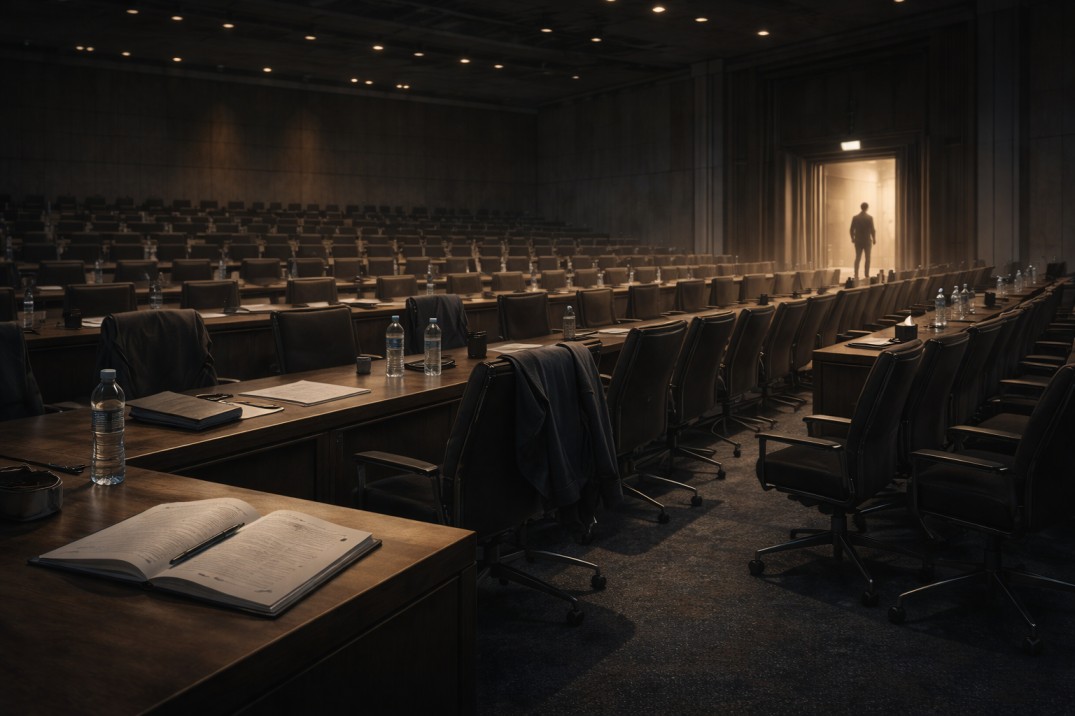
After the event, many people left quickly. Journalists rushed to file stories. Advisors moved toward their principals. Executives began calculating what the shift would mean for capital, labor, and legitimacy.
A few remained seated.
They understood instinctively that applause is noise, but silence is data. That cameras lingering after an event capture more than documentation, they capture residue. The unspoken recalibration of belief.
The hall emptied, but the tension did not disperse. It condensed.
This was not a moment that demanded immediate reaction. It was the kind that waits decades to reveal its cost.
Two Futures, Both Coherent, Only One Scales
In the weeks that followed, positions hardened without being declared.
Institutions gravitated toward the language of limits. Governments, religious bodies, labor organizations, and legacy academia found comfort in continuity. The idea that humanity must remain the moral reference point reassured systems built around slow legitimacy and shared vulnerability.
Others moved differently.
Stateless capital, private networks, and actors accustomed to volatility recognized something else: momentum without apology. A future that did not require consensus, only capacity. For them, restraint looked less like ethics and more like friction.
This divide was not ideological. It was infrastructural.
One vision required governance. The other required speed.
Why This Moment Could Not Be Undone
What made this event irreversible was not persuasion. It was a classification.
Once humanity was described as a phase rather than a constant, every ethical framework inherited from the past became provisional. Rights, dignity, labor, and governance all assumed continuity of the subject they were designed to protect.
That assumption had quietly expired.
Even those who rejected the premise found themselves responding to it. Regulations were drafted. Committees formed. Compromises negotiated. None of them restored the original position. They merely slowed a trajectory whose direction had already been set.
This is how structural change occurs, not through conquest, but through redefinition.
The Role of Witnesses in a Posthuman Age
Journalists like Wu Zheng understood the danger immediately, though not in the language of panic. The threat was not extinction. It was redundant.
If cognition could be optimized beyond interpretation, what role remained for narrative? If knowledge flowed directly from system to mind, what space existed for mediation, doubt, or historical context?
The anxiety was not professional jealousy. It was existential. A world that no longer required explanation would be efficient, and profoundly brittle.
And yet, this was precisely why witnesses mattered more than ever.
Because when futures accelerate, memory becomes resistance.
History as a Delayed Reaction
Nothing dramatic followed the speech. That absence is often misread.
No riots erupted. No markets collapsed. Life continued with almost insulting normalcy. This, more than anything else, confirmed the scale of the shift. Events that change everything rarely announce themselves through chaos. They embed themselves quietly into assumptions, procurement cycles, and strategic language.
Decades later, historians would mark this moment not because of what happened immediately, but because of what became impossible afterward.
The future had been named without apology.
And once named, it no longer needed permission.
Why This Moment Still Matters
This was not the birth of transhumanism. That had been underway for years. This was the moment it ceased to justify itself in human terms.
From that day forward, arguments about ethics, governance, and meaning would all orbit a new center of gravity. The question was no longer whether transformation should occur, but who would be allowed to remain relevant while it did.
That is why this moment endures.
Not as a spectacle.
Not as ideology.
But as the instant when the future stopped waiting to be agreed with, and began behaving as if resistance were merely a timing problem.
And that is always when history becomes difficult.