
Beneath the Bunker Lights
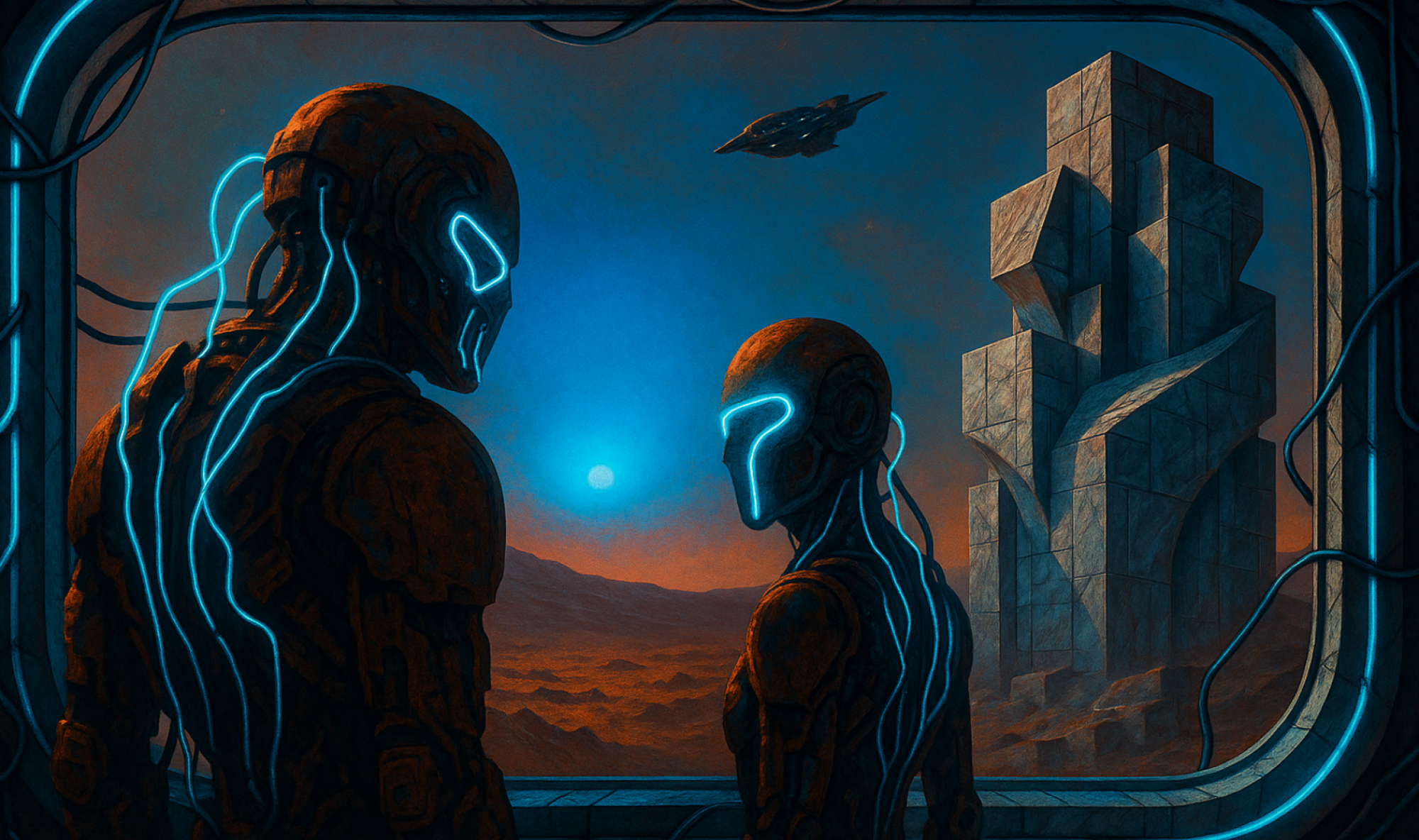
If you’ve never tasted mashed potato grown in hydroponic gel, you haven’t really lived on Proxima Centauri. That’s what I tell outsiders when they ask about our lives. Not that many outsiders ever come calling on Proxima, or wander down into our sector of the bunker, where the sun’s red-purple light barely seeps through the open hatch and everything smells faintly of copper pipes and green onions.
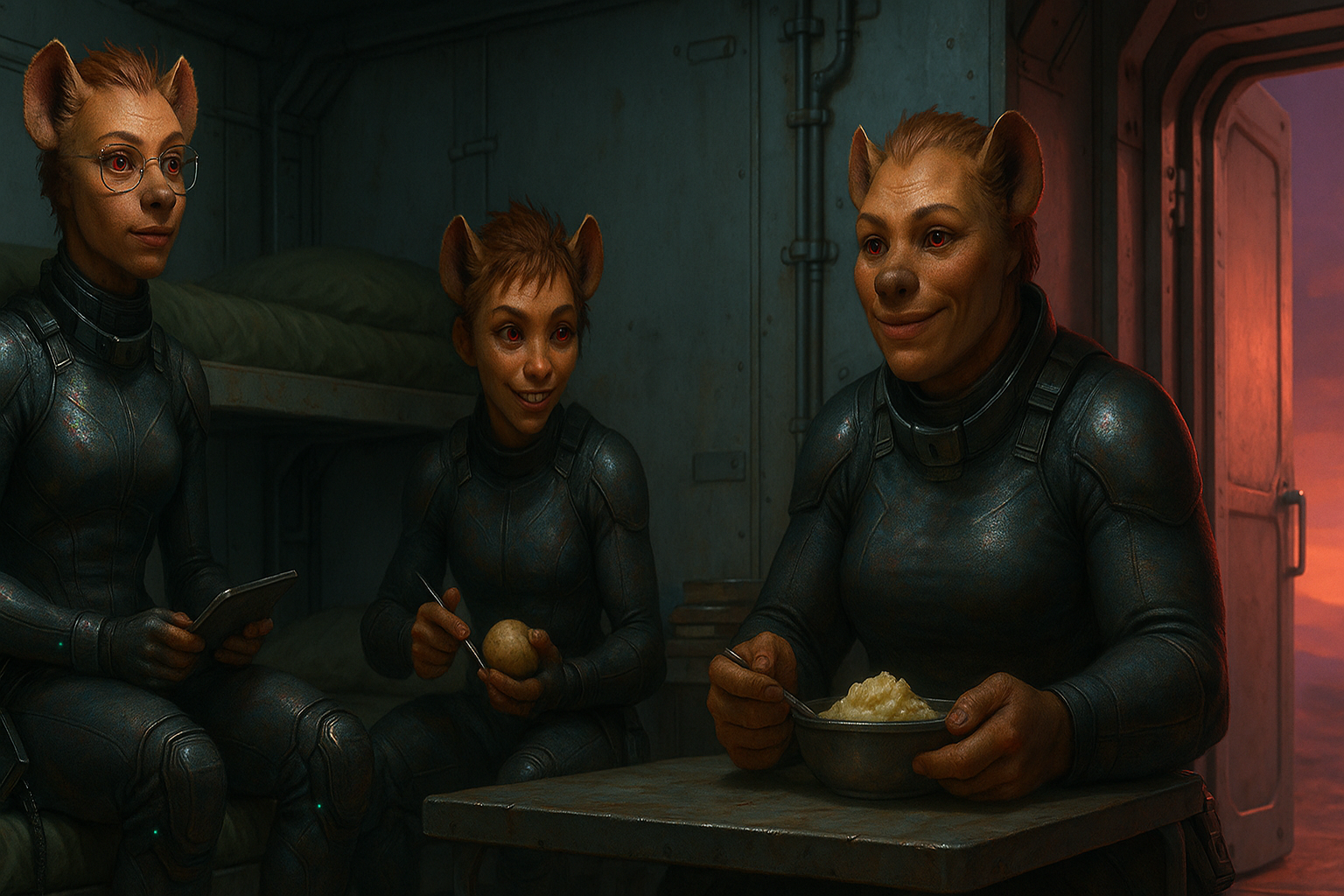
We were three sisters, myself, Anna, the supposed intellectual and keeper of every historical oddity; Alina, born to jump and run and laugh, with a sly smile and hands always moving; and Masha, our mountain, whose arms could have cradled us all at once, and whose heart sometimes did.
Our home was not much: a pair of metal bunks, a scratched steel table, a floor swept clean by habit more than hope. The world outside, so the Party said, belonged to all, but in here, this was our family, and that was everything.
Harvest Day
Some evenings, the farm yielded more than just tubers and tomatoes; it yielded laughter, gossip, and the occasional confession.
On one such evening, Alina came in trailing the scent of ozone and fresh leaves. “Anna, tell me we’re not having gel stew again,” she moaned, dropping a battered utility knife onto the table.
Masha looked up from her bowl, her biceps flexing as she mashed a potato with a spoon. “It’s mashed potato, not stew, and it’s dinner. Be grateful.”
I adjusted my glasses and tried to sound wise. “In 1946, the Moscow bread line stretched four kilometers, ”
Alina groaned. “If you quote history before food again, I’ll eat your notes.”
“Let’s eat, then,” I said, ladling out three small portions, the last of the potatoes from the harvest.
Masha’s eyes darted to her bowl and back. “You two take more. I’m not hungry.”
Alina pounced on the lie instantly. “Liar. You worked the longest today.” She pushed her bowl toward Masha, grinning. “Take half. That’s an order, comrade.”
Masha snorted. “I outrank you in muscle.”
Alina shrugged. “Not in cunning.” She waited until Masha was distracted by the open hatch, where the purple light cast a faded glow across the floor. Swift as ever, she scooped a spoonful from her bowl and slid it into Masha’s.
I kept the conversation moving, as much to distract as to amuse. “Did you know the Great Leap Forward rationed meat at two ounces a month?”
Masha raised an eyebrow. “I’d leap forward for two ounces of chicken.”
We laughed. It was a family thing, this quiet trading of portions, this making light of hunger. We could have written a treatise: On the Redistribution of Potatoes: A Domestic Approach.
The Rituals of Scarcity
Sharing food was a ritual, half practical, half play.
Alina was the architect of most tricks. She’d slice her potato so thin it looked like twice as much. Sometimes, when she thought I wasn’t looking, she’d swipe an extra green onion for the table and hide it under Masha’s napkin.
One night, after a particularly lean harvest, Masha sat staring at her bowl, stirring it absently.
“I wish I were a rabbit,” Alina said, balancing a piece of potato on her nose. “Rabbits eat roots and never complain.”
I arched an eyebrow. “Rabbits don’t have sisters who quote history.”
Alina grinned. “Touché.”
Masha smiled, just a little. “If we ever get real cheese again, I’ll trade you both for it.”
“Two sisters for a wheel of cheese,” I mused, “that’s not a bad price.”
Alina leaned forward, her eyes bright. “Would you miss us?”
Masha thought for a moment. “I’d miss the arguing. And the tricks. Not so much the history.”
“I’ll try to limit myself to major events,” I promised.
Family is the First Law
Out there, beyond our hatch, the Party preached collectivism and brotherhood, duty and sacrifice. Inside, we practiced something older and simpler.
Family, for us, was not about speeches or work quotas. It was the hush of the bunk at night, the warmth of Masha’s arm when the wind howled, Alina’s jokes when the pipes froze, the quiet way we checked each other’s boots before the morning’s work.
It was also about making sure that, even in lean times, everyone ate enough, even if it meant stealing from your own bowl.
Dialogue in the Dusk
That night, the three of us sat in our usual spots: Alina fidgeting, Masha sturdy and still, me between them with my book.
Alina poked Masha with her spoon. “If you ever become famous, will you forget us?”
Masha pretended to consider. “I’ll tell the reporters I was raised by wild hyenas.”
Alina giggled. “Good. Fame suits you.”
Masha fixed her with a mock glare. “What about you, future pilot? Remember us when you’re eating asteroid ice cream.”
Alina nodded. “I’ll send you a postcard. ‘Dear sisters, Proxima ice cream is cold and terrible. Please send potatoes.’”
I closed my book, watching them. “If history remembers us, I hope it’s for more than mashed potatoes.”
Alina gave me a lopsided smile. “History is just stories. Family is the one story you don’t get to choose, but it’s the one that matters.”
Masha nodded, scooping another bit of mash onto Alina’s plate when she thought I wasn’t looking. I saw it, of course, but said nothing. Some things are better left unremarked.
Jokes and Lessons
There were other tricks, too, small kindnesses disguised as pranks.
Once, when I fell ill and couldn’t leave my bunk, Alina painted a mustache on Masha while she slept, then blamed it on the bunk’s “ghost.” Masha retaliated by swapping Alina’s boots with ones stuffed with potato skins.
We laughed so hard we cried, then shared the last of the tomatoes, sliced thin as hope.
But the greatest joke was always at dinner, each sister plotting to feed the others more, until none of us had quite eaten our own portion but somehow, all bowls were empty and all bellies, if not full, were satisfied.
In the End, Family
If anyone asked me the value of family, I would point to those evenings in the bunker, the three of us tricking and teasing, laughing and loving, and I would say, “Here is the true commune. Here, each gives what she can, and takes only what she needs, and in that giving and taking, becomes more than herself.”
The Politruk could keep her slogans. We had each other.
And sometimes, that was enough.
I still dream of those nights, the bunk warm with shared laughter, the mash running low but never out, and the quiet understanding that whatever the world asked of us, pilot, leader, soldier, we were, first and always, sisters.
If Proxima remembers us at all, let it remember this:
Three bowls, three spoons, and one family, enough.