The ocean did not announce itself.
No countdown mattered, no final argument to be won, no authority left to appeal to. Somewhere beyond shipping lanes and predictive dashboards, a mass of water gathered momentum faster than comprehension. By the time the instruments agreed on what they were seeing, the wave had already decided where it was going.
People later argued about height. About velocity. About whether it qualified as an impact or a consequence. None of it mattered to those who were asleep when it arrived.
On the islands, death came quietly. Sunburned skin. Open windows. Half-packed luggage. The fortunate never woke. Those higher up, on volcanic spines and stone ridges, watched the water climb, stall, and retreat, leaving behind a silence so complete that many of them did not survive it.
Cities had sirens. Cities always believe in warning systems. Panic climbed faster than people did. A hundred meters meant nothing. Concrete meant nothing. History meant nothing. When the water finally slowed, it did so only because there was nothing left to push against.
Later, the questions came. Which ocean. Which fault. Which model failed? Whether it was an accident or an inevitability, I finally lost patience. The questions circulated briefly, then sank under the weight of something simpler: one of humanity’s oldest cradles was gone. Not damaged. Gone.
Survivors appeared where no planners had expected them. On hilltops. On broken rigs. On the skeletons of ports that no longer touched water. Without grids, supply chains, or coordination, civilization shed its outer layers quickly. Hunting replaced commerce. Violence replaced language. The tools were improvised. The instincts were not.
Bodies accumulated where infrastructure used to be. Some swelled. Some burst. Human and animal loss blurred together. There was no place to land relief, and fewer people left who knew how to give it.
This was not war. It was not a disease. It was subtraction on a scale too large for mourning. More than half of humanity removed from relevance in a single sequence of physics.
Tanya learned about the wave while standing perfectly balanced.
Her body was mid-motion, calibrated down to the millisecond. Bone reinforced. Nerves accelerated. Hormones are released on schedule. The empathetic amplifier beneath her skin did what it had always done, translated intention into something audiences could feel before they understood it.
The audience did not respond.
The performance stopped. Applause failed to arrive. The room was filled with an announcement that did not try to sound gentle.
Five billion casualties. Estimates only. Identification ongoing. Rescue robots are overwhelmed.
Tanya had known about near misses. Everyone had. The news systems filtered fear into something consumable, something compatible with productivity and sleep. She rarely tuned in. Her sponsors granted access to uncompressed information, but referendums about mining thresholds and shield budgets felt abstract compared to the precision of movement.
This time she listened.
She did not cry. Not yet. Her first instinct was to work.
The wave stripped the Indian Ocean rim clean.
Indonesia vanished. India folded inward. Southern China lost soil that had taken millennia to arrive. The Red Sea filled beyond its memory. Boats with animals ended up on hills that had never planned for them. Herbivores died first. Carnivores adapted faster. Humans adapted fastest of all.
Data centers collapsed alongside villages. Reactors steamed unattended. A third of Earth’s computers failed in minutes. Two-thirds of global exports dissolved into debris.
Some institutions proved too large to fall. Some disasters proved too large to insure.
Waivers were issued. Responsibility was suspended. The same systems that had enabled the catastrophe stepped forward to manage its aftermath. Food appeared at new prices. Storage units opened selectively. Survival became transactional.
For thousands of years, humans had built where the ocean offered convenience. Transport. Cooling. Waste removal. The ocean had provided patiently.
This time, it collected.
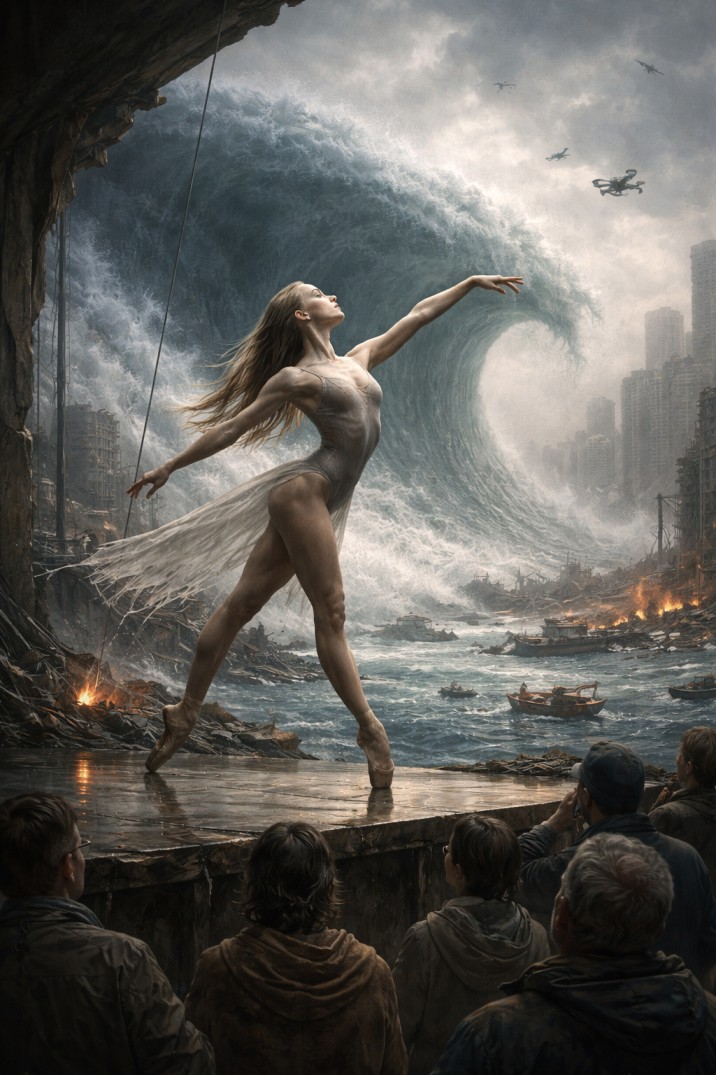
Tanya tried to make the wave visible.
Her body could move faster than any dancer in history. Nano-shrouds carried a signal where biology once hesitated. Reinforced bones tolerated forces that would have shattered the past. She trained among bodies shaped by low gravity, long, pale, straight-backed, tuned for arenas beyond Earth.
But she was still on Earth.
New York remained. Stable ground. Deep water access. No tectonic betrayal. No cultist scars. The largest city left standing, old enough to remember being smaller than its ambition.
She studied the New York Bight the way others studied charts. She tried to embody tenacity. Momentum. Indifference. Sensors fed her corrections in real time. It was not enough.
Gravity interfered.
So she cheated.
A stand. A chord. Levitation approximated. Critics noticed. Critics always did. Her rival Ravan could have done it cleanly in orbit with half the effort. That was not the point.
Money was moving. Bonds were selling. Fleets were forming slowly out of pressure and guilt. Earth did not have Martian reserves, but it still had people. Still had machines. Still had time, if used aggressively.
Tanya danced the wave because she could not yet dance the dead.
Blame arrived late and left early.
Mining had shifted orbits before. Shields had intercepted worse. Models placed the probability once in a million years. It happened anyway, during a rare alignment that left response fragmented and distances uncooperative.
Chunks were deflected. The core was not.
Arguments bloomed briefly. About greed. About mass. About scanning errors and underpowered defenses. About luck mistaken for safety.
Then the waivers were finalized.
No individual. No system. No algorithm would be held responsible. Crimes committed during the delay would be absorbed into necessity. Guilt became private again, where it had always been most manageable.
Everyone was responsible. No one would answer.
The images came slowly.
Ships could not dock, so drones filmed instead. Fact and fiction mixed freely until filters restored coherence. The devastation was too large to frame. Too many cities. Too many losses. Too many equally impossible choices about what deserved attention.
Tanya added a second act.
She stripped down, as dancers did when authenticity mattered. She showed heat without flame. Pressure without explosion. Trees fell where the soil no longer existed. Whales ruptured by time and gas. Reactors waiting patiently to fail.
The bonds matured. The first aircraft was adapted. Hospital ships accepted the earliest survivors, dehydrated, injured, speaking in fragments about resilience.
It was not enough.
But it was movement.
And movement, for now, was the only thing keeping humanity from standing still in the aftermath of its own scale.