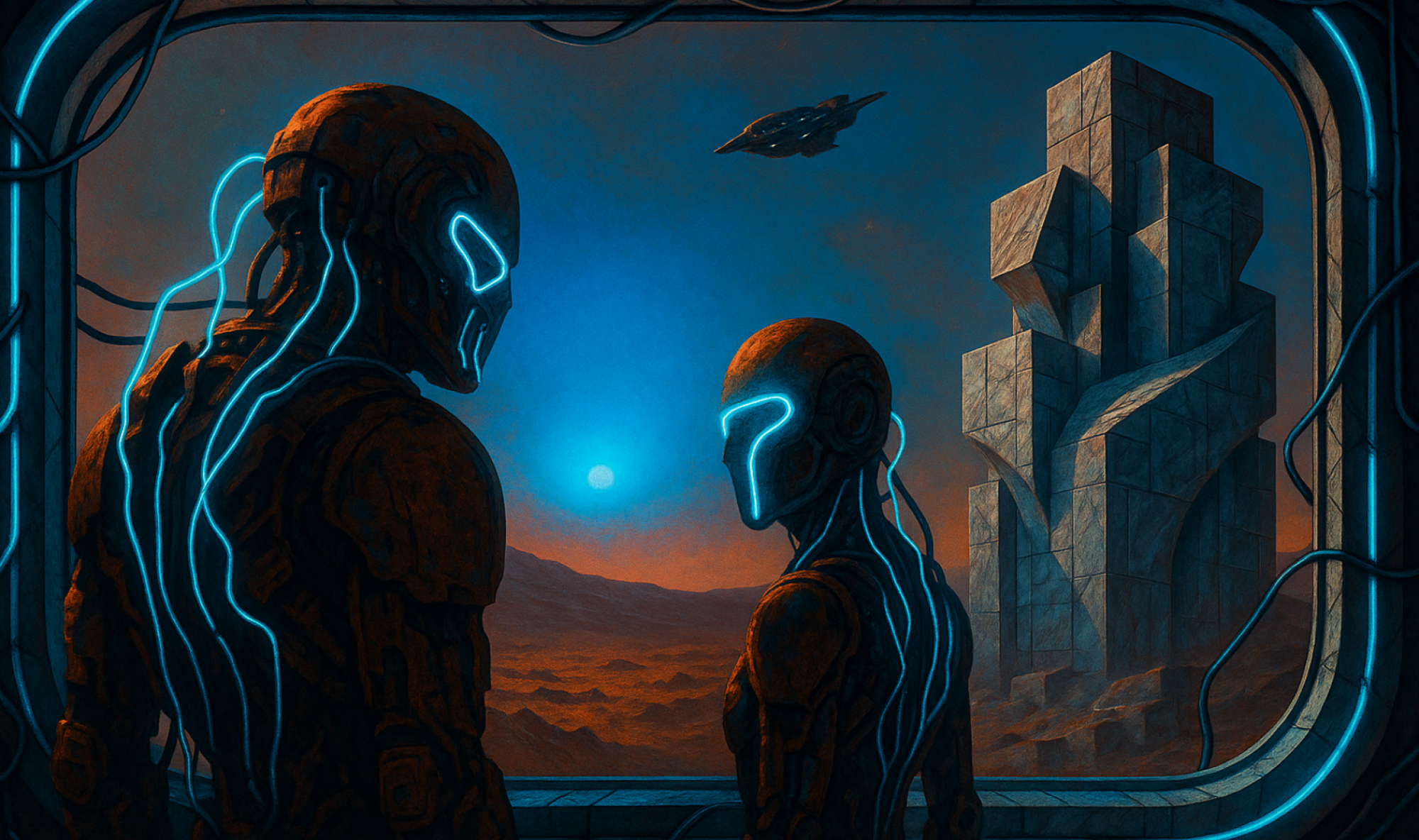
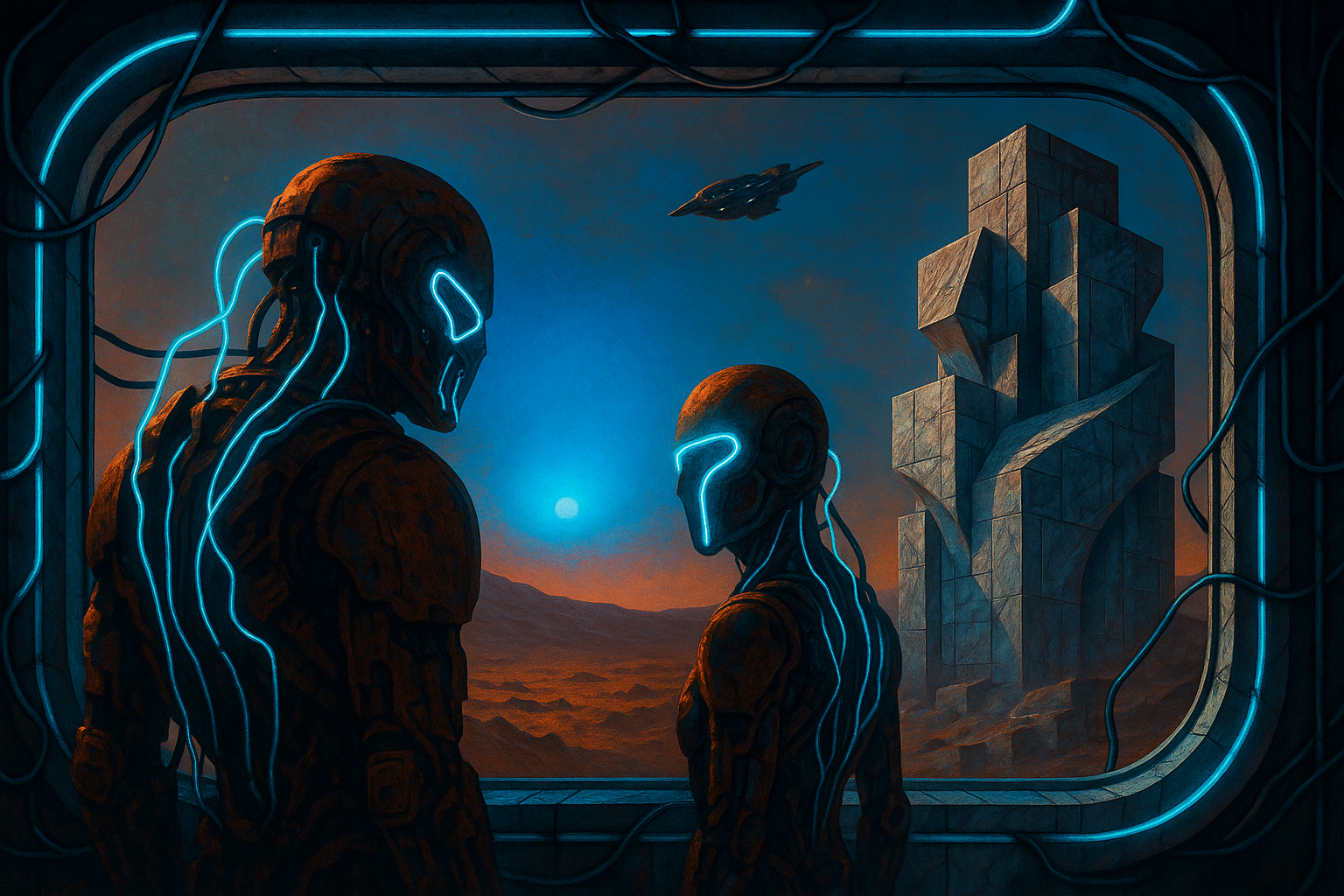
At the dawn of a cold Martian morning, two transhumans stand in silence before a reinforced observation window. The glass is thick, edged with electric-blue luminescence, its frame humming with power as neural interface cables snake outward, disappearing into the walls like digital roots. These are not people as Earth once knew them, no faces remain, only gleaming visors and glowing masks, expressions replaced by streams of data and synchronized thought.
Outside, the red planet stretches endlessly, rust-hued rock and dust plains etched by ancient winds. A pale, bluish sun rises low on the horizon, casting a spectral glow that softens the jagged terrain and reflects faintly off the window. The light is cold but clear, and in it, the transhumans watch without emotion.
Far in the distance, rising from the crimson ground, a colossal structure looms, an angular tower made of interlocking marble-like cubes, their surfaces veined with white and gray. It is both fortress and cathedral, grown from synthetic materials and constructed by remote drones. This is one of the first settlements of its kind: not built for the comfort of organic life, but for the precision and logic of post-biological minds.
The transhumans remain still, their neural links pulsing with shared streams of sensory input and predictive analysis. No words pass between them; communication is silent, instant, and total. Behind their masks, once-human minds are calculating, dreaming, watching. They are the future humanity designed for itself, an evolution not shaped by biology, but by code, circuitry, and ambition.
High above, a sleek vessel drifts across the thinning atmosphere, its presence barely visible. It is both transport and guardian, another node in a growing network that spans from orbit to outpost. Humanity’s next chapter is unfolding, not in grand speeches or first steps, but in the quiet dawn where Earth’s children no longer breathe air, but share thought. They have come not to survive Mars, but to become something that thrives within it.