Civilizations rarely choose the future they imagine. They choose the future where their bodies can survive.
By the time interstellar travel stopped being theoretical, humanity had already learned this lesson the hard way. Machines could cross distance, but minds could not. Economies could scale, but meaning fractured. Systems endured, while individuals broke under time, isolation, and moral exhaustion. The question was no longer how to leave the Solar System, but who could survive leaving it without losing themselves.
The answer did not arrive wrapped in optimism. It arrived through biology, compromise, and an unromantic understanding of survival.
Why Endurance Matters More Than Intelligence
Interstellar travel is not exploration. It is attrition.
Between stars, there are no emergencies, only slow failures. Radiation accumulates. Supplies degrade. Memory drifts. Any species that hopes to cross such distances must tolerate contradiction: cooperation without hierarchy, aggression without cruelty, loyalty without illusion.
Hyenas possessed these traits long before humans learned to name them.
They were not selected for ferocity, but for collective resilience. Where other social species fractured under stress, hyenas adapted. They argued without splintering, competed without collapsing cooperation, and absorbed loss without mythologizing it. They were capable of functioning inside systems that offered no justice, no comfort, and no witnesses.
Interstellar survival demanded exactly that.
To this foundation were added engineered traits: resistance to radiation, tolerance for low oxygen, control over metabolism and heartbeat, and, most critically, the capacity to endure time itself. Sleep became not rest, but strategy. Hibernation was no longer an emergency response, but a design principle.
Crossing an interstellar distance required bodies that could pause without decaying.
The Cost of Making Something New
No mutation arrives cleanly.
Early generations failed in predictable ways: bodies that slept and never woke, minds that woke without continuity, beings altered so deeply that memory and identity dissolved on activation. These failures were not accidents. They were the necessary cost of engineering continuity across decades of darkness.
It took generations, not experiments, for stability to emerge.
Those who guided the process understood something essential: survival could not be trained directly. It had to be lived. So the first hyenas were not educated. They were released.
Into deserts. Into scarcity. Into environments where nothing explained itself and nothing forgave error.
What emerged was not obedience, but competence.
They adapted together. Learned terrain as a system, not as individuals. Memory became collective. Decision-making distributed itself naturally. No command structures were imposed because imposed order collapses under distance.
What survived was not discipline, but trust.
Faith as Infrastructure
Strength alone does not carry beings across emptiness.
Machines already had strength. What they lacked was meaning. Endurance without purpose leads only to quiet extinction. To survive interstellar time, the hyenas needed something irrational enough to persist when calculation failed.
They were given belief.
Not theology. Not doctrine. Stories. Rituals. Symbols that transformed suffering into a signal rather than an error. Hunger became a test. Fear became instruction. Death became continuity instead of failure.
Faith did not civilize them. It made them imaginative.
That imagination produced behavior no system could fully predict: loyalty to narrative rather than command, courage that exceeded self-interest, risk taken not for reward but for coherence. These were dangerous traits. They resisted optimization. They could not be scaled cleanly.
They were allowed anyway.
Because something had already been learned: systems that eliminate unpredictability eventually eliminate themselves.
Inheritance, Not Control
When the architect of the mutation reached the end of her life, the final lesson was not delivered through instruction, but through death.
Her body was given, not preserved.
This act was not cruel. It was an inheritance. The transfer of continuity is not through memory alone, but through matter itself. The boundary between creator and successor dissolved in the most literal way possible.
What followed was not chaos, but organization.
The hyenas did not become feral. They became deliberate. Knowledge was preserved intentionally. Skills transmitted with care. They began to plan across seasons, then across generations. Tools appeared. Structures followed. Stories turned outward, toward the sky.
This was not a civilization born from comfort or conquest.
It was a civilization that understood its destination before it understood ease.
Continuation Without Ownership
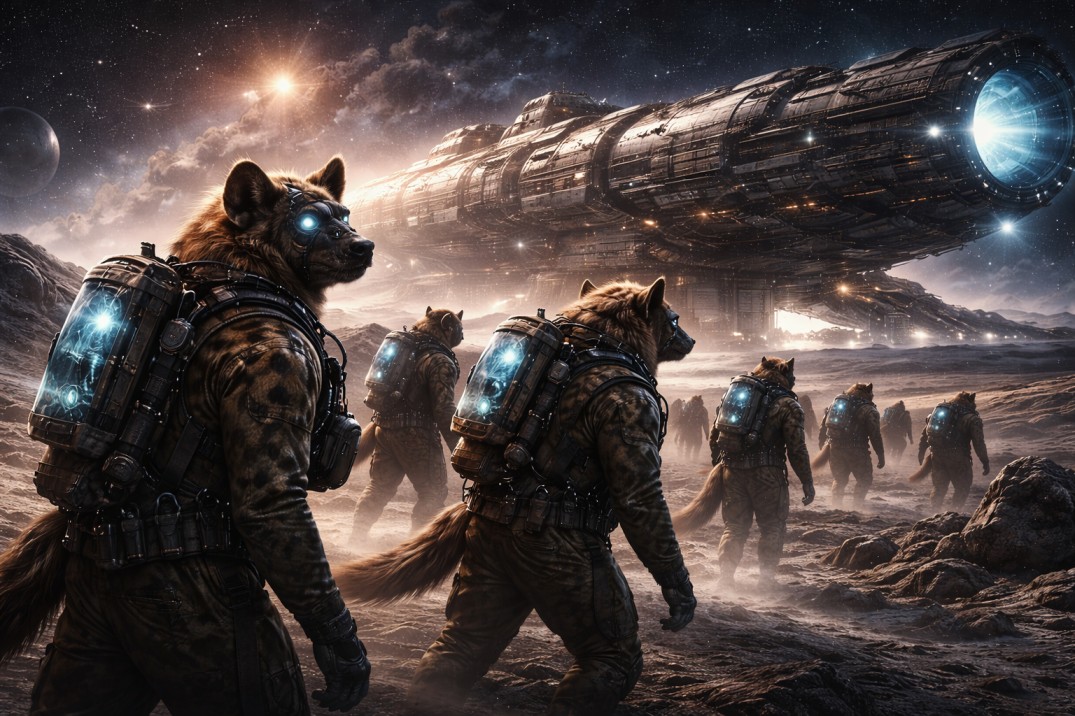
The vessel built to carry them was not a fleet, nor an ark. It was a single organism, living metal, ecological loops, sleeping bodies bound together by continuity of will rather than promises of survival.
The journey was not framed as salvation.
Many would die before arrival. More afterward. No effort was made to pretend otherwise. What mattered was not the preservation of individuals, but the survival of a pattern: cooperation under pressure, memory across silence, purpose without supervision.
For the first time, a civilization departed without claiming ownership of what it would become.
Control ends where distance begins.
Monsters, Heroes, and Patience
Every generation wants heroes. Figures who act decisively, strike cleanly, and resolve history through force or clarity.
But interstellar survival does not reward heroes.
It rewards patience.
The beings who chose the horizon were not saviors, rebels, or conquerors. They were something rarer: successors who understood when not to act. When to sleep. When to wait. When to carry memory forward instead of imposing will upon it.
The final lesson was simple and difficult:
Power without restraint creates monsters.
Restraint without memory creates extinction.
What left the Solar System was neither.
It was continuity, armed not with conquest, but with remembrance.
And somewhere beyond the last familiar star, a civilization began its longest test: not whether it could survive the void, but whether it could remain itself once no one was watching.