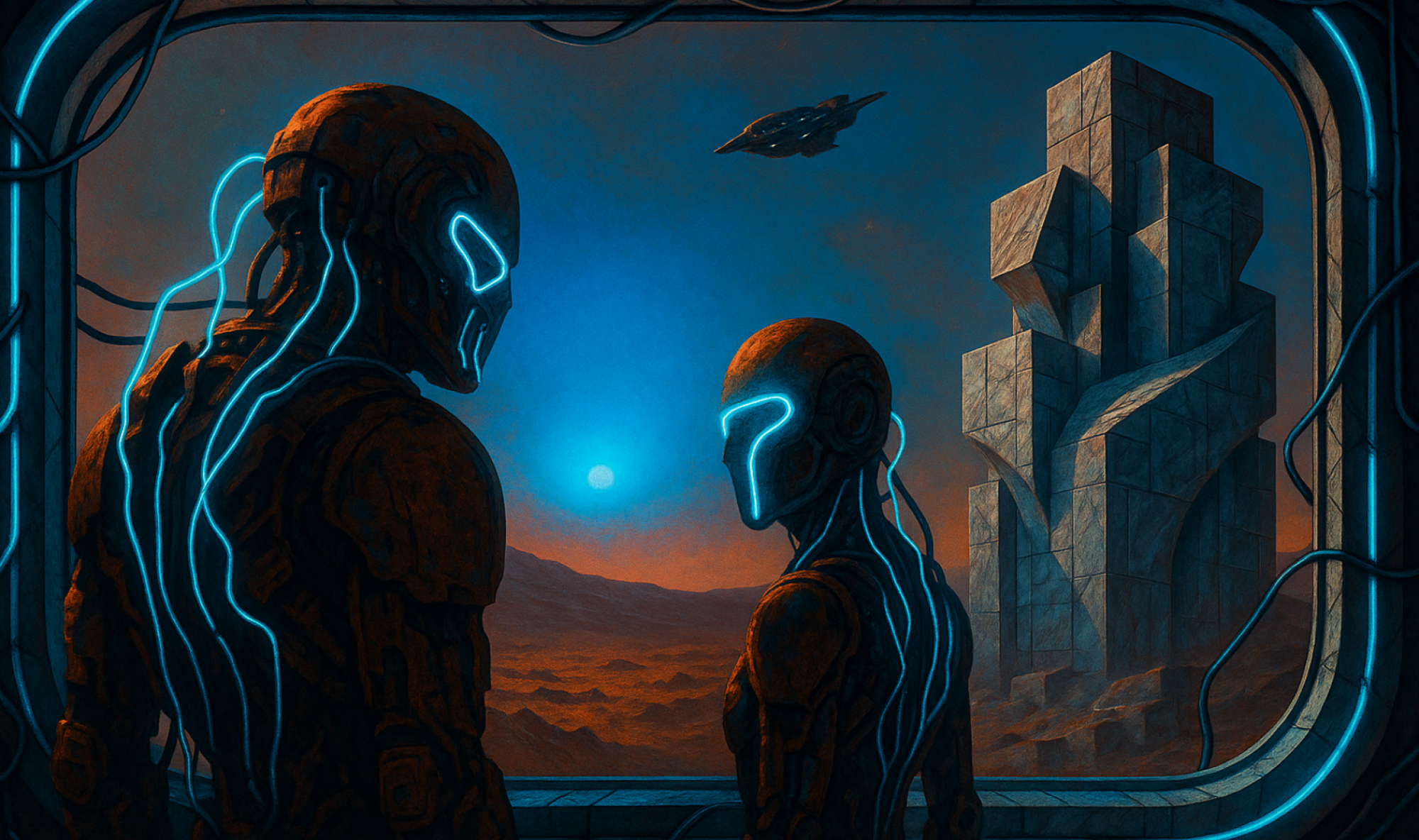

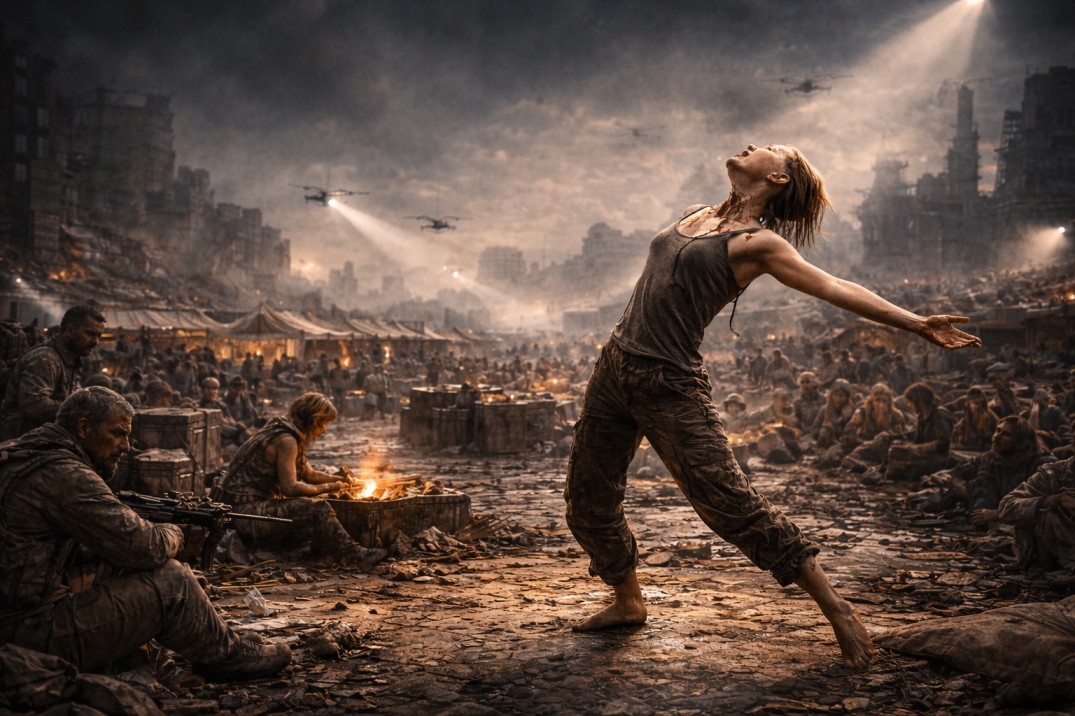
When the emergency ends, meaning does not return with it. The departure of the relief fleets did not signal recovery, only stabilization under new rules. Violence faded, hunger slowed, and systems resumed functioning, but the deeper fracture remained unresolved. The world had survived a disaster that exceeded its moral capacity to respond. What followed was not renewal, but exhaustion, generational tension, and a quiet recognition that intelligence, organization, and good intentions were no longer enough.
In that space, art stopped offering hope and began serving a different role: recording what humanity looked like at the moment it realized it could not fully save itself.
When the Emergency Ends but the Question Remains
The moment the carriers left, the crisis officially ended.
Not because the world was healed, but because it had stabilized enough to no longer demand constant intervention. The shoreline economies restarted under new ownership. Food production returned in simplified forms. Violence fell below thresholds that triggered global attention. The disaster was reclassified from an emergency into a recovery problem.
For those who had lived inside the response, this transition felt hollow.
The relief forces returned with fewer people than they had deployed, carrying the strange weight of having done everything they could and knowing it had not been enough. History would later call the mission necessary. The survivors would call it insufficient. The institutions funding it would quietly move on.
And those who witnessed it most closely would carry a different burden entirely: the realization that humanity had reached the limit of what organized compassion could accomplish at scale.
The Familiar Failure of Intervention
Every era believes it will succeed where previous ones failed.
The language changes, the technology advances, the logistics improve, but the structure of intervention remains stubbornly familiar. A powerful center projects stability outward. It believes order can be restored through presence, resources, and patience. Eventually, it withdraws.
The wave did not produce a new failure. It added another chapter to an old pattern.
The relief forces did not lack courage, equipment, or intelligence. What they lacked was legitimacy in a world that had already reorganized itself around scarcity. Authority could not be imported. Peace could not be enforced without ownership. Stability could not be lent temporarily and then reclaimed.
When the carriers departed, they did not leave behind peace or chaos. They left behind something worse: a functioning system built on values that no longer matched the people living inside it.
Returning Home to a Changed Humanity
Tanya returned before the fleet did.
She wanted to observe the home world without the buffer of ceremony. Without speeches or memorials. Without the symbolic closure that governments prefer. What she found was not grief, but restlessness.
The disaster had not radicalized people in the way revolutions do. It had exhausted them. Older leaders spoke of restraint, reconstruction, and learning from mistakes. Younger voices spoke of speed, replacement, and irrelevance.
The divide was not ideological. It was temporal.
Those who had lived through collapse valued stability above all else. Those who had watched collapse from a distance no longer trusted slow systems. They did not believe patience was a virtue. They believed it was an excuse.
Tanya sensed that something was forming beneath the surface. Not yet coherent. Not yet constructive. But inevitable.
Art After Catastrophe Is Not About Hope
Historically, art is expected to heal.
After wars, plagues, and collapses, societies turn to artists to restore meaning, to offer optimism, or to reframe suffering into something survivable. That expectation no longer fit the world Tanya inhabited.
There was no shared narrative left to restore.
The catastrophe had not united humanity. It had fragmented it into groups that survived for different reasons and resented one another for it. Any attempt at moral clarity rang false. Any promise of renewal sounded dishonest.
Art, under these conditions, could not inspire. It could only document.
The Emergence of Motion Without Meaning
The dance that would become known as The Wave did not begin as a project.
It arrived as sensation. Motion without metaphor. Physical continuity without explanation. Tanya did not initially try to interpret it. She followed it the way one follows muscle memory or grief.
For weeks, she rehearsed without music that mattered. Placeholder sounds. Improvised structures. The movement refined itself independently of narrative or intention. Her body was solving something her intellect could not.
Only later did the AI find a composition that aligned with the motion, not by analyzing emotion, but by recognizing inevitability. The music did not guide the dance. It yielded to it.
Repetition as the Last Human Discipline
Perfection, in this context, was not excellence.
It was surrender.
Tanya repeated the sequence not to improve it, but to remove herself from it. Each repetition reduced interpretation. Each cycle stripped away ego, performance instinct, and ambition until only necessity remained.
Her enhancements prevented injury and optimized output, but they did not protect her from depletion. The systems that amplified her ability to communicate human feeling also amplified the cost of doing so continuously.
What emerged was not a performance designed to impress, but one that refused to stop once it had begun.
A Global Moment Without Commentary
When The Wave was finally performed globally, it was not introduced.
There was no explanation, no framing, no call to action. The feeds synchronized. The platforms activated. The movement unfolded.
Viewers did not react as audiences normally do. There was no applause, no outrage, no collective interpretation. For once, the systems that usually translate experience into metrics simply recorded silence.
The dance did not accuse anyone. It did not absolve anyone. It did not ask for forgiveness or propose solutions.
It moved through collapse, response, violence, exhaustion, and continuation without pausing to explain any of it.
Why the Work Could Not Be Improved
Critics struggled because the piece resisted participation.
It could not be debated meaningfully. It could not be adapted successfully. Attempts to reproduce it failed not because of technical limitations, but because intention could not be recreated.
Like certain artifacts of earlier centuries, The Wave endured precisely because it refused to clarify itself. It became reference, not argument.
It marked a boundary: the point at which humanity stopped pretending it fully understood what it had become.
The Cost of Carrying Too Much
Tanya did not die dramatically.
There was no scandal, no spectacle, no symbolic ending. Her body simply failed after months of sustained output beyond what even enhanced systems were designed to support.
She was twenty-seven.
The number invited comparison, but the cause was different. She was not destroyed by excess or rebellion. She was consumed by completion.
Privately, she had listened to voices from centuries past. Harsh, uncompromising artists who sang without polish or safety. Performers who carried the emotional weight of their societies until their bodies could no longer comply. She understood them better than most of her contemporaries ever would.
A Tribute That Was Never Meant to Save Anyone
The Wave was not created to rescue humanity.
It was created to acknowledge it.
It recognized the limits of intelligence, organization, and compassion when scaled beyond intimacy. It documented the pattern of response and retreat without judgment. It preserved something that systems increasingly erased: the continuity of human feeling across failure.
In a future shaped by automation, optimization, and post-human governance, The Wave survived as an artifact of something older and more fragile.
Not hope.
Not progress.
But recognition.
And that, in the end, was the most human thing left to offer.