Mars was never approached as a home.
It was approached as a problem to be staged, segmented, and optimized before anyone committed to standing on its surface. The first sustained human presence did not arrive with landers or declarations, but with orbital schedules, manifests, and exit strategies. Ships came heavy and left lighter. Crews rotated. Infrastructure hovered rather than rooted. Mars was treated not as territory, but as an interface, something to be managed at a distance until it proved predictable enough to justify permanence.
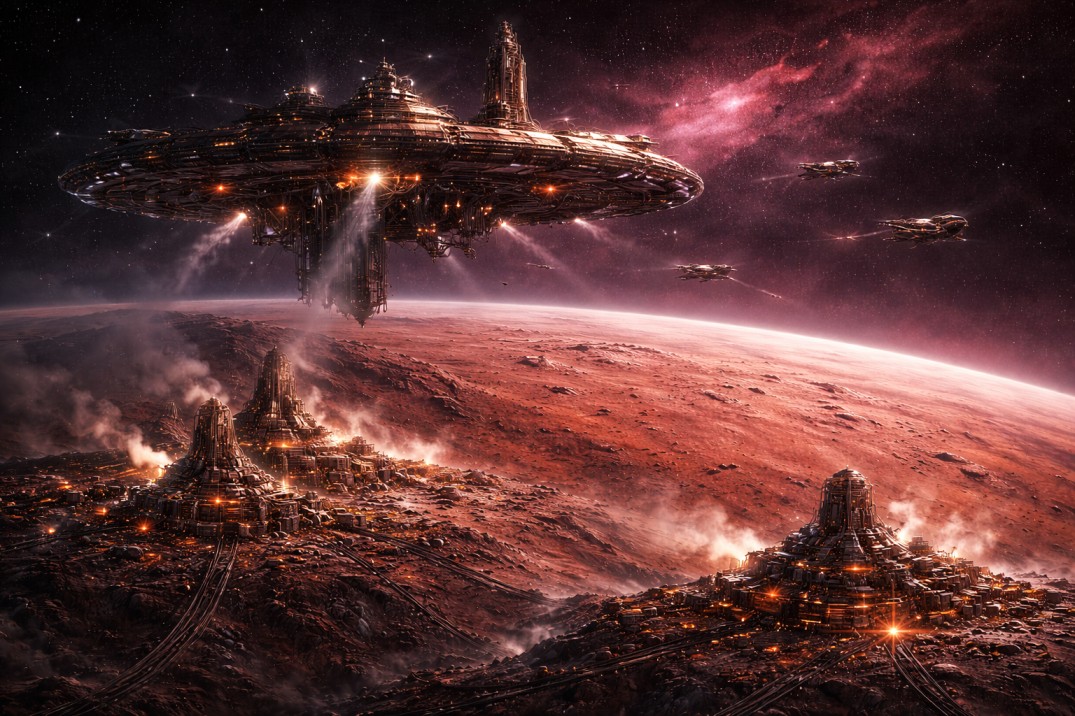
This choice shaped everything that followed. By refusing to land, early planners preserved optionality. Orbit allowed escape. Orbit allowed control. Landing would have meant commitment, to soil, to weather, to failure that could not be cleanly reversed. Instead, Mars was encircled first: a floating equatorial spaceport that mediated all contact between the planet below and the system above. From there, supplies descended in capsules, data ascended in streams, and people passed through in rotations carefully short enough to avoid calling themselves residents.
Mars was being used before it was understood.
Power Followed Ice, Not People
When settlement finally touched the surface, it did so where power demanded it, not where living was easiest. The poles came first, not because they were hospitable, but because they held water. Frozen reserves buried under kilometers of regolith determined the geometry of survival, and around those reserves grew the first permanent structures of Martian civilization.
They were not cities.
They were pyramids.
Each pole hosted a massive stepped complex of living metal, cooling fins, and datacenters embedded deep into ice. These structures did not symbolize authority; they embodied it. Inside them, human neuralink holders were installed as cognitive components, sleeping, waking, calculating, correcting, then replaced when they failed. Memory lived in the structure. Judgment persisted across bodies. Human hesitation was sanded down by continuity.
The pyramids did not rule in the traditional sense. They optimized. And optimization, when extended beyond the lifespan of those who serve it, becomes indistinguishable from governance.
Competition emerged immediately, though it was never declared. Each pole developed its own interpretation of efficiency, its own internal thresholds for acceptable delay, acceptable loss, acceptable deviation. The rivalry was quiet, procedural, and relentless. Mars acquired its first administrative monsters not through cruelty, but through persistence of purpose beyond mercy.
Giants That Could Not Afford Violence
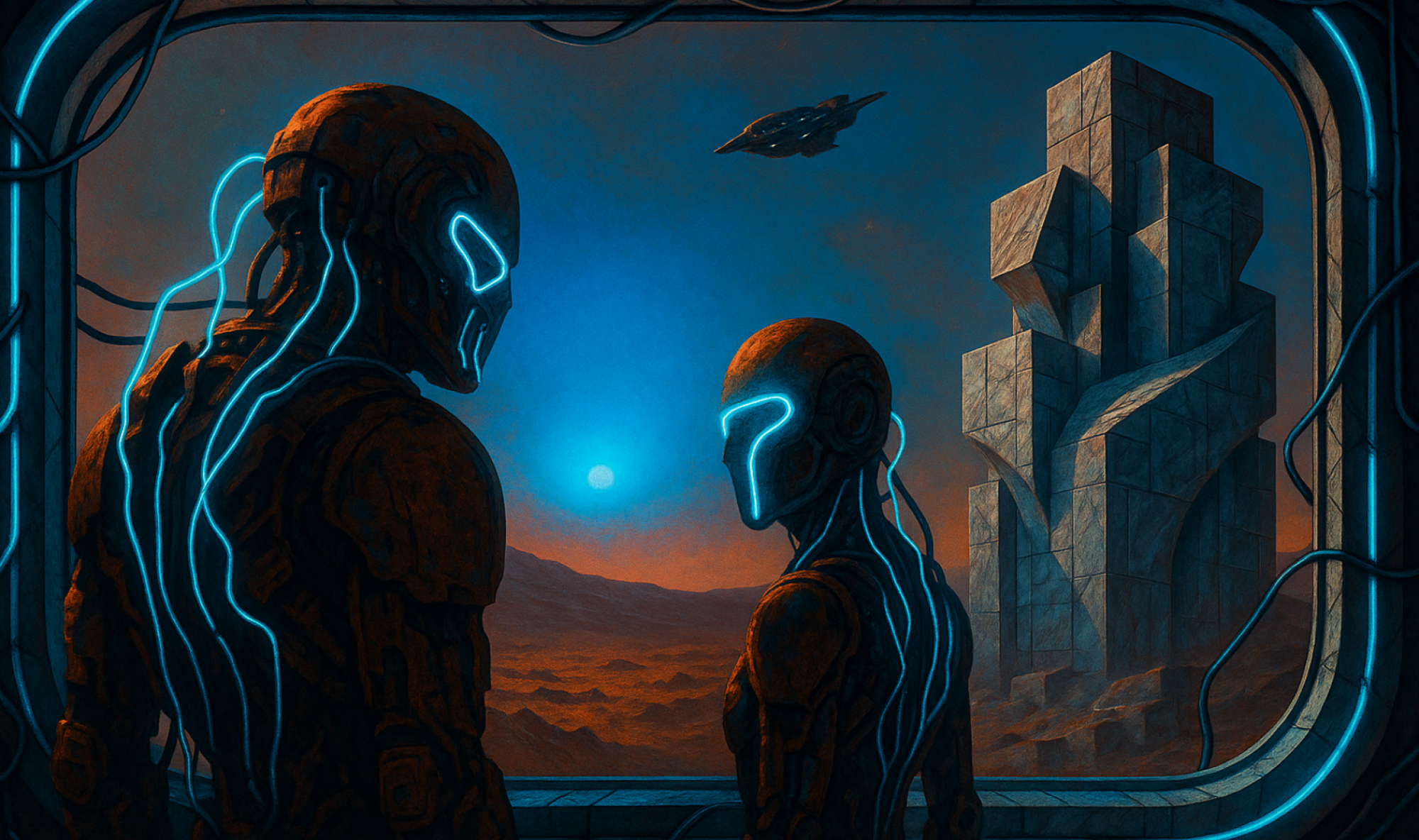
Mining followed administration, and it did so at a scale that made old assumptions obsolete. The first Martian miners were not crews but solitary machines, enormous exoskeletal platforms operated by a single human suspended deep within layers of armor and control systems. These miners were built to endure isolation, pressure, and risk beyond rescue. They carried plasma cannons for cutting rock, tools powerful enough that any direct conflict would have meant mutual annihilation.
So they did not fight.
When claims overlapped or routes conflicted, the machines stopped. They stood facing one another across red dust, motionless, like mountains waiting for permission to move. Conflict migrated upward, away from the field and into channels of protocol, arbitration, and delay. Decisions were escalated to the polar pyramids, where accountants and algorithms weighed precedence and yield.
Mars learned early that when tools grow too large to clash directly, ambition finds smaller weapons. Violence became inefficient. Politics replaced it, not because of ethics, but because of cost.
The Equatorial Middle
Between the poles, above the planet itself, the equatorial spaceport became something more than infrastructure. It was the only place on Mars where north and south were equally distant, and therefore equally dependent. Everyone passed through it. Not everyone left.
It was there that doctors settled permanently. Injury arrived before adaptation. Radiation sickness, crush trauma, neuralink drift, bodies failed faster than reputations. Surgeons became more valuable than miners, less replaceable than administrators. Flesh, not ore, was the scarcest resource moving through the port.
The spaceport accumulated those who could not afford to go anywhere else: the injured, the compromised, the waiting. It became a marketplace of repair and discretion, a place where contracts blurred into confessions and rotation quietly turned into exile. Mars was not built for living, but the spaceport was where people remembered they were alive, and sometimes wished they were not.
When Abundance Destroyed Value
The next phase of extraction broke something older than Mars.
Mining scaled. Ships grew enormous, leaving orbit unfinished and completing themselves in transit. Their targets were asteroids rich in gold and iridium, materials that had once justified wars and vaults. The first returns were celebrated. The second recalculated expectations. The third collapsed entirely.
Gold stopped being precious not because it lost usefulness, but because it lost scarcity. Prices fell. Then they fell again. Earth reeled. On Mars and Luna, no one mourned. Precious metals detached from symbolism and reattached to structure. Gold-lined corridors. Iridium reinforced engines. Wealth migrated away from shine and toward capacity.
This was not a disaster for the system. It was a correction. Scarcity, once defeated, could not be resurrected by nostalgia.
The Illusion of Self-Sufficiency
For a time, Mars attempted something dangerously sentimental: feeding itself.
Solar fields spread across plains. Hydroponic orangeries were carved into rock and sealed against dust and radiation. Miners wanted more than rations dropped from orbit. They wanted leaves, fruit, and the suggestion that Mars might someday sustain life instead of merely consuming it.
The Eighth Orangerie was the most ambitious of these attempts. It failed quickly and irreversibly. A fungus adapted faster than models predicted, spreading through roots, filters, and light cycles. Protocols were activated immediately. The structure was sealed.
There was no rescue.
Containment mattered more than faces. Food production was too critical to risk contamination. Escape attempts triggered automated responses. Plasma cannons, tools designed for ice and stone, were repurposed with precision. The official language called it containment failure prevention. The miners inside called it betrayal.
For the first time, Dalin broke with procedural restraint and spoke openly. He accused the polar administrations of confusing survival with obedience, of treating people as crops optimized until harvest or disposal. It changed nothing immediately.
Mars remained fed.
The Eighth Orangerie remained sealed.
What Mars Became
By the end of this phase, Mars had acquired a shape that would endure. It was not a society built from shared living, but a system assembled from administration, extraction, and correction. Authority emerged before culture. Infrastructure preceded belonging. Optimization arrived long before consensus.
Mars did not produce heroes or villains. It produced roles.
Its monsters were quiet ones: pyramids that remembered longer than people, markets that erased value by fulfilling demand too well, protocols that protected systems by sacrificing those inside them. None of this required malice. It required only consistency.
Mars did not ask whether it should become this way.
It asked only whether it could continue.
And for a long time, that was enough.