Life Under a Different Kind of Gravity
Arcadia does not announce itself as a place with a single purpose. It reveals itself slowly, as an accumulation of intentions that were never fully reconciled. Committees built it far from the mainland because distance allowed disagreement to coexist without resolution. Over time, those disagreements hardened into structure. Steel welded to ambition. Water threaded through compromise. Systems layered atop systems, each responding to a slightly different idea of survival.
Every morning, I woke to the same muted pulse within the walls. At first, I assumed it was mechanical: circulation systems, pressure regulation, the dull persistence of water moving where it was instructed to move. But soon I noticed something unsettling. The rhythm changed subtly depending on my own state. When I felt restless, the pulse tightened. When I forced calm, the platform seemed to exhale, easing into a temporary equilibrium that felt negotiated rather than stable.
Arcadia was not static. It was listening.
Calypso and the Question of Shape
Calypso introduced herself on the second morning, as though names required acclimation before they could be trusted. She spoke with deliberate pacing, pausing in corridors to ask whether I noticed anything different. Sometimes nothing had changed. Sometimes everything had. The distinction rarely mattered to her.
She pressed her palm against the wall while explaining why certain sections felt warmer. Condensation gathered around her fingers as she held the contact.
“They don’t know you yet,” she said. “They’re still trying to decide what shape you are.”
She offered no clarification. Clarification, I was learning, was not part of Arcadia’s culture.
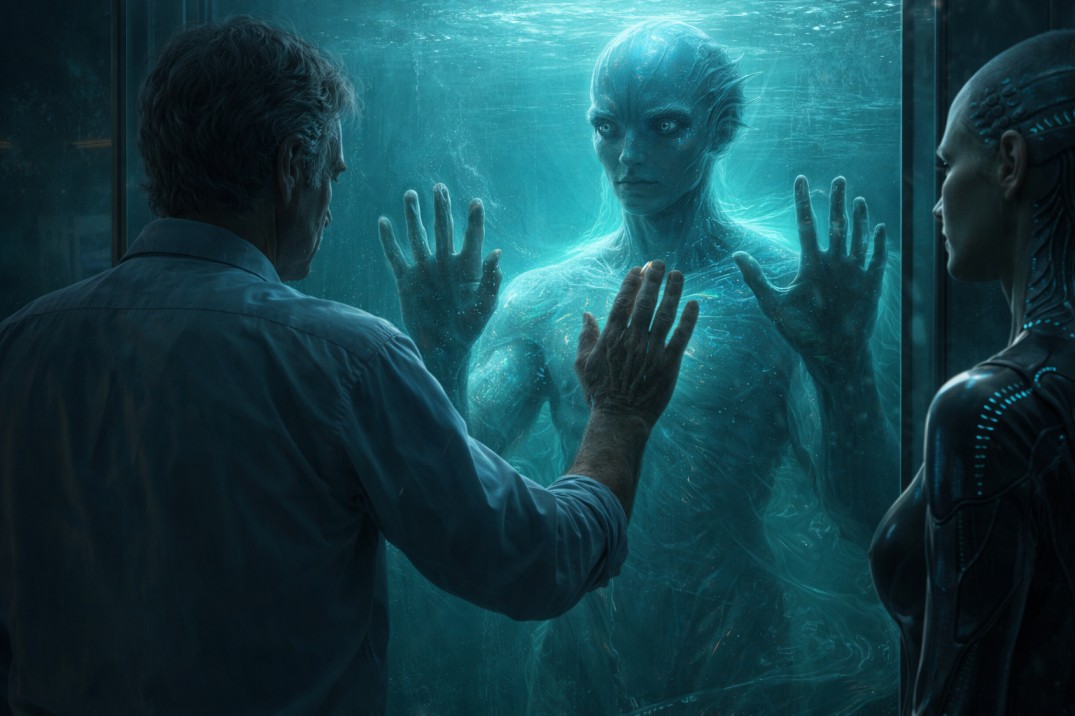
In the laboratory, aquatic transgenic subjects drifted in tanks that glowed with dim blue light. Their movements were slow, deliberate, suspended between awareness and dream. Calypso spoke of stabilization, of proximity, of the peculiar usefulness of obsolete humans. Our presence, she explained, provided cues. Anchors. Familiarity without demand.
When I placed my hand against the glass, the creature inside mirrored the gesture. Its fingers spread slowly, webbing shimmering in gradients of turquoise and pale green. It did not retreat when I stepped back. It held its position, as though waiting for permission that never came.
It occurred to me then that Arcadia was not assessing my competence. It was determining whether I would integrate or dissolve.
Conversations That Slip Past Guardrails
In the maintenance corridors behind the filtration systems, the platform felt more exposed. Panels removed. Conduits visibles. Cables and fluid lines pulsing with slow contractions that resembled muscle rather than machinery.
That was where I met Mira.
She spoke without rehearsed optimism, without institutional caution. Half of Arcadia behaved like a machine, she said. Half behaved like a reef. The two halves argued when they thought no one was listening.
She warned me about the nights. About the sounds. About pretending things were normal because acknowledging them would require a response. When she brushed my forearm, the contact carried uncertainty rather than intention. A human hesitation that felt increasingly rare here.
“Arcadia reorganizes itself whenever something new arrives,” she said. “It might reorganize around you.”
The maintenance alarm interrupted her before I could respond. She left quickly, leaving behind the sense that the warning was less about danger and more about inevitability.
The Weight That Arrives After Dark
Night on Arcadia did not settle. It pressed.
The darkness moved, carried by water striking pylons and by the platform’s constant adjustments to unseen currents. The pulse in the walls grew heavier after sundown, a slow heaving that suggested something vast shifting beneath the surface.
I followed the corridor toward the observation dome, noting how bends had subtly changed shape since the afternoon. The platform reorganized itself quietly, without announcement.
Through the transparent walls, the ocean revealed itself in motion. Currents spiraled, lit by faint bioluminescent flickers that surfaced and vanished like unformed thoughts. When I touched the glass, the vibration that answered felt too resonant to belong to machinery alone.
Calypso joined me without sound.
“The pressure beneath us changes at night,” she said. “Old structures shift. Sometimes the animals migrate upward.”
She admitted what the logs did not: the aquatic subjects had once been human. Transformation, she said, was not the horror people imagined. Loss of function was death. Change was something else entirely.
Her shoulder brushed mine. The contact was intentional, brief, and exploratory. Curiosity rather than comfort.
“There’s something you need to see,” she said. “Not yet. In the morning.”
What the Morning Did Not Soften
At dawn, Calypso led me through a restricted wing of the platform. The air smelled sharper, saltier, as though Arcadia had edged closer to open water overnight. The corridor lights spread into wide bands of pale turquoise, reflecting off walls that pulsed with subtle rhythm.
Inside the chamber, horizontal tanks lined the room. Within them drifted volunteers in various stages of transformation. Webbed fingers. Expanding ribcages. Iridescent skin that shimmered faintly beneath the water’s surface.
“These are the volunteers,” Calypso said. “Or what remains of them.”
She explained why I had been brought here. Not for expertise. For resilience. My neural architecture, she said, resisted collapse. Others lost coherence. Their memories thinned. Their sense of self fractured.
I remained intact.
Her fingers traced a small arc along my arm, the touch slower now, deliberate. Heat rose beneath my skin, grounding me even as the room unsettled something deeper.
In one of the farther tanks, a hand pressed against the glass. It matched my height, my orientation. When I raised my palm, it mirrored the gesture with unmistakable intent.
“This one remembers you,” Calypso whispered.
Memory, she admitted too late, no longer belonged entirely to individuals. Not here. Not after the aberration.
The word slipped out, wrong and unguarded. She tightened, attempted to retract it. But the hand inside the tank pressed more firmly, urging proximity.
When I lowered my hand, it followed.
Being Studied by the Future
Arcadia did not require belief. It did not demand consent. It adapted.
I understood then that I was not being trained or recruited in the traditional sense. I was being observed the way an environment observes a new organism, testing whether my presence would destabilize the system or be absorbed quietly into its evolving structure.
The Towers had preserved me without asking why.
Arcadia was asking a different question.
Not whether I would be useful again.
But whether I could remain myself long enough to matter in a world that no longer considered identity a fixed property.
And somewhere beneath the platform, beneath the steel and the water and the light that never settled into one shade of blue, something immense was shifting.
Not rising in anger.
Rising because gravity, here, was being rewritten.