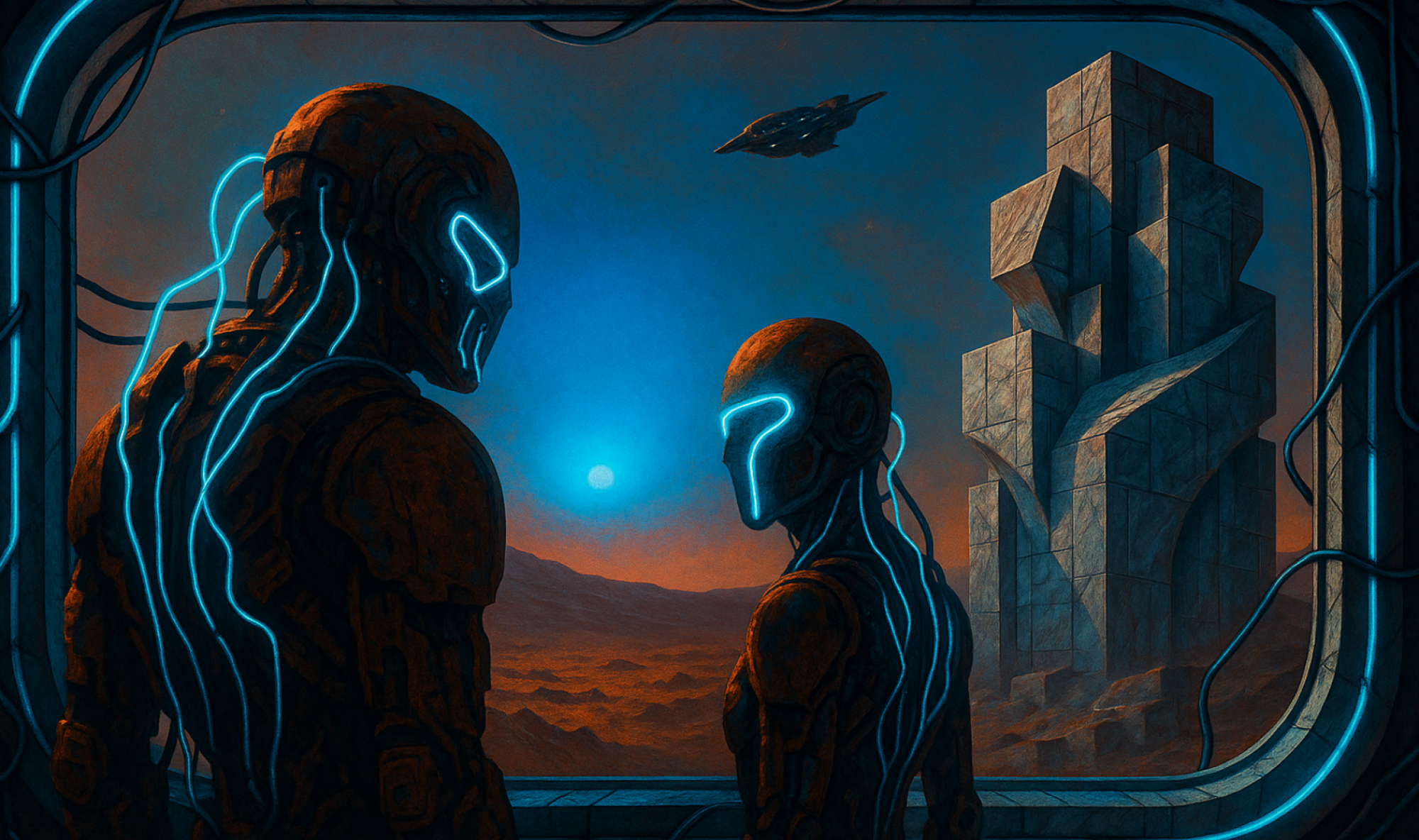
On Mars, nothing important happens in open daylight. The city above is built for commerce, performance, and orderly appearances. The city below is built for what cannot be admitted: illegal research, contraband logistics, improvised faith, and the quiet disposal of mistakes. The woman in red belongs to that lower world, not as a rumor or a superstition, but as a living node in a network of secrecy that reaches from farm tunnels to corporate headquarters. Meeting her does not feel like discovering a person. It feels like discovering a hidden design.
A Farm That Produces More Than Food
The meeting begins where outsiders expect nothing. A solar farm. In a rational society, a solar farm would have panels, maintenance, and a predictable output. Here, it is a place where surplus energy becomes experimentation.
The human smuggler, a drinking companion who has adapted to mutant life, frames it bluntly. Surfers are bored. They import and export the oddities that the rich doctors create or discard. Mutant city walls are thin. Buildings are small. Certain forms of “play” become too loud, too dangerous, or too visible. Farms absorb the overflow.
The farmers explain their operation with the calm pride of craftsmen. Solar energy heats yeast tanks. Yeast is used for beer and cheese. Temperature is allowed to fluctuate for complexity. Locally mutated algae, developed through doctor involvement, become an ingredient. Even cannabis cultivation is framed as a technical refinement rather than vice. The agent purchases a cookie not from desperation but preference. He wants city lights when altered. Money is not an issue, and the farm accepts that without judgment.
This is a recurring pattern on Mars. Luxury does not appear as gold alone. It appears as controlled biology.
The Second City Beneath the First
The farmer’s most important explanation is not about yeast or drugs. It is about infrastructure.
They maintain plumbing, electricity, network connectivity, air supply, and hidden corridors of work. Maintenance droids handle routine. Mutants handle anomalies. They also “check on their stash,” which is said without shame. The farm, in other words, is the surface expression of a deeper system: tunnels, pipes, service rooms, and the disposal channel for what cannot remain visible.
Bodies are sometimes found inside the pipes. Dead pigs. Monkeys. Flesh double droids with damage too specific to be accidental. These are removed and disposed of here, where no questions follow, and no reports remain public.
The farmer offers a sentence that functions like a thesis.
There is another city under each city, made of pipes and secrets.
And this is where the agent first hears her described.
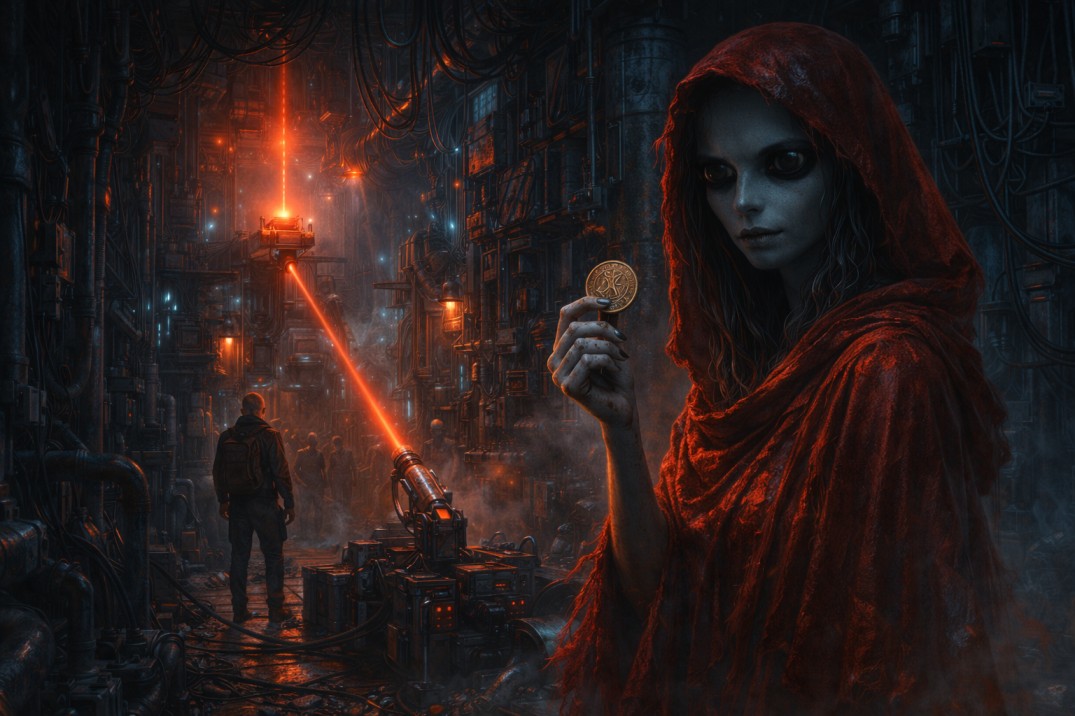
A woman who is smaller and nimbler than a surfer. More agile than a human. Living in a service room with the lights always off. Eyes huge and shining in the darkness. Eating raw meat and favoring failed doctor experiments. Laughing in a way that unsettles even genetically calm workers.
The offer is practical. For the right payment, a meeting can be arranged.
Then the coin appears.
A legal ritual disguised as a casual gesture.
A coin, and the instruction to keep everything secret.
The Psychology of Walking Toward Something That Should Not Exist
The agent is not easily frightened. He carries enough concealed force to challenge the most dangerous bodies on the planet, at a cost. Yet the story of the woman lands differently. The tone is not criminal. It is mythic. There is something “demonic” in the farmer’s description, and that word matters because it reveals how even rational systems still generate superstition under stress.
If the spaceport disaster can cripple communication and destroy safeguards, then a hidden predator under the city feels possible. Massive AIs already behave like gods in their golden pyramids. It is not irrational to ask if there is a corresponding category beneath them, a creature produced by progress rather than by nature.
The waiting period stretches for three days. The farmer complains about logistics, waiting for the right pig from the right doctor. Even the meeting is regulated by supply.
He also demands a mobile translator and offers cultural history in the way only workers do, casually, as if it were weather.
Surfer speech is creole Spanish, Chavacano, shaped by early childcare in a world that refused them. The woman speaks Chinese, writes in Russian, and uses Dungan, a language tied to remote Chinese regions.
And the farmer adds the most alarming instruction of all.
Do not speak with her about cults.
When asked why, he answers with a different fear.
She is a communist.
In this environment, the farmer considers communism worse than demons because it challenges the core reality that governs Mars. Money. Hierarchy. Corporate power. The farmer frames it as extinction and resurrection. Apparently not extinct. Apparently dangerous.
The Tunnel Route as a Map of Social Order
The journey to her is physical, but it is also a lesson in the planet’s architecture.
They walk for two hours through the main tunnels. Ladders run across ceilings. The farmer can move overhead quickly with muscular hands, not to show off, but to avoid damaging pipes. He stays on foot only as a courtesy.
Low gravity shapes movement. Running can mean injury. Hitting the ceiling is not a metaphor. It is physics.
The agent asks about her clothing, trying to reduce the mystery to motive. Communism. Pig blood. Fashion.
The farmer dismisses all of it.
She is nocturnal and color blind. She does not know she wears red. Mars is not rust to her. It is only shades of gray.
This detail matters because it reframes the symbol. The red dress is not a signal. It is an accident that becomes meaningful for everyone watching.
The farmer stops offering trivia after that. He repeats a prediction.
She will give you a coin and ask for your help.
He is confident. Surfers are always confident. It is in their genes.
Sasha, ID 001, and the Origin of the Hyenas
The meeting begins with a legal act.
Sasha greets him and immediately names his role.
“I know you are a lawyer. Please take this coin and keep my secret.”
He accepts and confirms the vow.
She sends the farmer away and offers vodka. She sets the tone as negotiation, not seduction. She is calm, direct, and aware of risk. She assumes he will stay at least a day because she understands leverage. Information holds attention better than force.
Then she introduces the name that governs the background of every major system.
Ken Li.
The agent recognizes the description instantly: Chinese-American entrepreneur, the richest figure in the solar system, cloning himself to operate massive AI, visionary, and a threat.
Sasha claims origin under him. Not biological. Designed. Built as a private army. She and she are purpose-made, not born.
She explains why surfers were insufficient. They are too nice. They do not hibernate. Ken Li needed warriors with a different temperament and a different timeline. Hyena and lemur DNA were added.
Women are strong, proud, and team-oriented. Men are beautiful and expendable. And they can hibernate.
She defines hibernation precisely. Five degrees Celsius. One breath every three hours. Cryogenic survival for millennia.
This capability is immediately double-edged. It implies private armies that do not age. It also implies interstellar travel with living crews. The agent recognizes the strategic horizon. Sasha refuses it. She is not thinking that far.
Her explanation narrows to Mars.
A shady doctor’s lab. Pilots’ exoskeletons were installed on her younger sisters. She observed for transaction integrity. Luna was too regulated. Mars had time, money, and appetite for illegal work. Ken Li paid. The operations succeeded.
Then success created fear.
A squad of hyena women equipped with pilot frames became too terrifying to keep visible. The doctor moved them to a remote farm for training. After witnessing what they could do, he panicked. The first five were shipped to Ken Li in cryocontainers. The next wave required rare parts, expensive and slow to acquire, without attracting attention.
The scale is implied. Ten sisters. Multiple years. Logistics that only the deepest pockets can sustain.
The Spaceport Disaster Reframed as Strategic Denial
Sasha then ties the spaceport disaster to the private army.
Ken Li bought a mining ship and personally piloted it with the first five. He wanted to see them in action. The ship arrived in Martian orbit disguised as a tritium shipment from Luna, blending into a high-traffic route.
Secrecy failed anyway.
Mining syndicates approached and demanded surrender for inspection.
Sasha states the reality plainly. A ship full of illegal clones and pilot spare parts is not merely contraband. It is a strategic weapon. No mining coalition could allow it to exist.
They chose surrender or death.
Surrender would expose the sisters on Earth. So the sisters chose impact.
They drove the ship into the spaceport above the doctor’s home. The secret remained safe.
The agent asks the moral question. Sasha answers with history. Kamikaze was not Japanese anymore. It was Chinese. She frames it as assimilation, patience, and long memory. She describes an empire logic rather than a national one.
The sacrifice, she argues, was not ideology. It was a necessity. Their vessel was small and decommissioned. Even with the sisters as pilots, they could not defeat five modern flagships. Surrender was unacceptable. Death was chosen.
This reframes the entire disaster. It was not random violence. It was a strategic denial.
If captured, the existence of the private army becomes public. If destroyed, the secret survives.
Why Mars Might Bombard Earth
Sasha’s immediate concern is escalation.
Ken Li reports that Martian conglomerates are blocking communication with him. After the spaceport destruction, corporations interpret the private army as an existential threat. Their response could become planetary violence.
Sasha names the extreme possibility without hesitation.
Orbital bombardment of Earth.
She frames Martian logic. They hold more power. Their position is “logical.” The agent counters with negotiation, pointing out corporate self-interest and aversion to open war.
Sasha dismisses simplicity. Massive AIs exist partly to prevent Ken Li from becoming a despotic emperor. His private army threatens their ambitions and freedom. After recent events, fear multiplies. Fear creates permission for violence.
Her conclusion is operational.
If they cannot solve it by talking, they must solve it by creativity, commando action, or by using rivalries.
The Transmitter, the Delay, and the Name Pascal
Sasha leads him through tunnels for three hours into a shuttle graveyard, a repair station where decommissioned vessels become spare parts. It is not merely junk. It is covered.
Her transmitter is a wide-beam infrared laser. It communicates to a geostationary relay and then onward to Ken Li. Discreet and expensive. Exactly the kind of tool that fits her world.
She describes delay ranges in practical terms. Three to twenty-two minutes one way. Today, they are lucky. Fifteen minutes round-trip.
The agent asks if she has a neural link. She does not. She compensates with planning and prior contact.
Her transmission includes identity and statistics.
“Sasha, ID number 001.”
She references prediction windows and standard deviations. The language of machines has entered her habits. She reports that the agent’s arrival occurred within 1.6 standard deviations of prediction. She requests the most likely plan for success.
While waiting, she offers him choices. Notify Earth. Use his own channels. The agent refuses urgency, insisting on exploration and caution.
Ken Li replies. Authorization is granted. Secret funds unlocked. Sasha ends communication, then turns to him with familiarity.
“OK, Pascal.”
He corrects her. Pascal is not his real name. He still accepts the courtesy. In this world, preserving identity is a form of respect.
The Threefold Strategy and the Week That Matters
Ken Li’s strategy arrives as it always does, inspiring, educational, ambiguous, and protected by cryptic measures.
It is threefold.
First, infiltrate the North Pole corporation, predicted to be the most aggressive because the destroyed spaceport area was under its control, and its executives suffered losses. Learn their plan to attack Earth. Use their momentum to activate a trap.
Second, learn how corporations coordinate coalition activity and sabotage coordination mechanisms. Ensure blame falls on a third party.
Third, take a hostage and let him feel loved. A hostage released becomes a friend in need.
Ken Li adds operational warnings. Use god mode only as a last resort. There may be moles in the agent’s own organization. Anything that can go wrong will go wrong. Maintain contingency resources.
Then he sets a hard deadline.
Within a week, Earth will have a planetary defense system.
If you cannot win, stall.
The last line is not dramatic. It is practical. It turns the plan from ideology into timing.
Sasha and the agent spend days translating cryptic guidance into logistics, people, and equipment. Their work becomes the invisible prelude to conflict.
And the woman in red, who did not know she wore red, becomes the hinge between a hidden army and a planet that might decide to burn another.