
By the time the inner Solar System began to move in earnest, the change did not arrive as a declaration or a breakthrough. It arrived as a correction. Distances that had once been endured were shortened. Delays that had been accepted became intolerable. Engines stopped being symbols of exploration and became instruments of refusal, refusals to wait, to depend, to ask permission of space itself. This was the moment when motion ceased to be heroic and became mandatory, when stone replaced fuel and logistics replaced wonder. What followed was not a revolution in technology alone, but a reordering of how survival, labor, and loss were calculated across the Moon, the Belt, and everything in between.
Elena asked about thrusters the way a child asks about storms, because adults describe them as diagrams, and diagrams never explain why people drown.
“Today they taught us exhaust velocity,” she said, sitting at the table before bedtime. “They drew curves. They made it sound… tidy.”
Maria rinsed a cup slowly. “And did they tell you what those curves did to the world?”
Elena shook her head. “They didn’t even mention Dalin.”
Maria smiled, not unkindly. “That’s because the tidy version is how you teach children to trust machines. Dalin is how you teach them to fear what machines make possible.”
She set the cup down. “Come. I’ll tell you about the engine. But we’ll start with dust.”
Dalin Arrives and Refuses to Be Impressed
When Dalin first stepped onto Luna, people expected the usual performance: awe, reverence, gratitude. The Moon still carried the afterglow of old Earth myths, first steps, first flags, first poems recited to a horizon that could not hear them.
Dalin did none of that.
He did not look up at the wide doors or the impossible corridors built for exoskeletons. He did not ask to tour the reactors or the telescopes. Those were the trophies of a different kind of mind, scientific minds, hungry for knowledge and recognition.
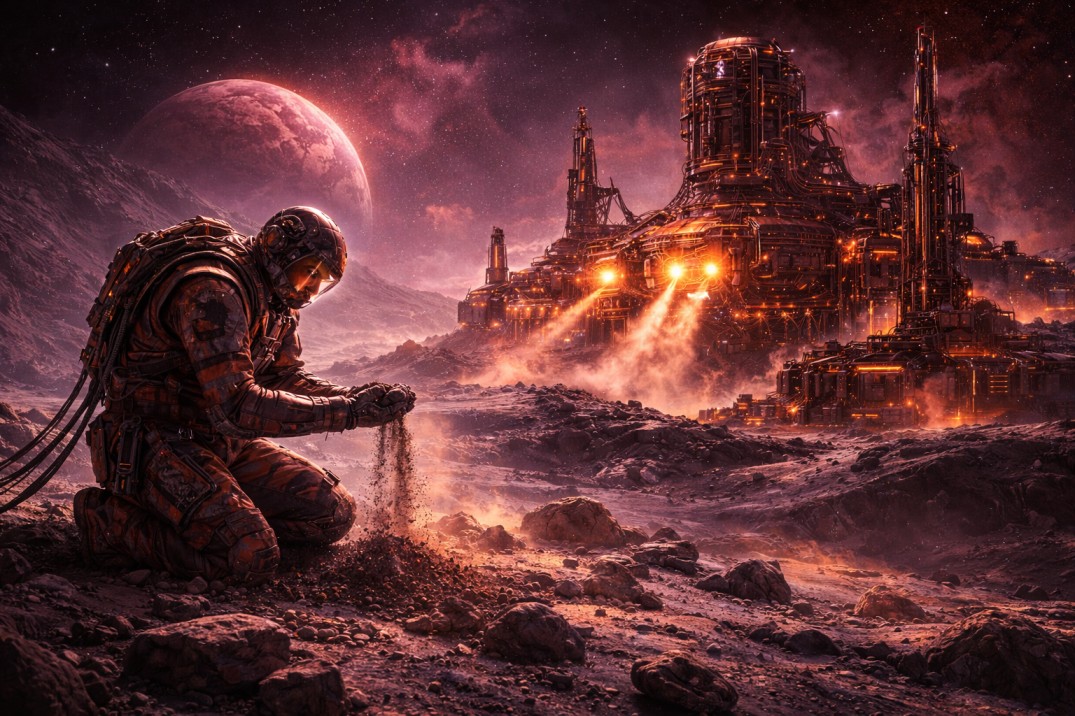
Dalin knelt and lifted a handful of regolith.
He let it fall through his fingers like a slow hourglass, watching how the grains separated and refused to clump.
“Too much silicate,” he said. “Too much aluminum oxide.”
An engineer began explaining the approved propulsion roadmap, ion drives, imported propellant, careful mass budgets, and the usual discipline of scarcity.
Dalin listened like someone watching a clock run down.
Then he asked for something that made everyone uncomfortable: trajectories. Not shipping schedules. Not political agreements. The actual geometry of movement, transfer windows, orbital paths, where mass was collected, where it was thrown away, and where it could be harvested without anyone writing a permission slip.
Maria’s voice dropped slightly when she explained it to Elena.
“Scientific monsters ask what is possible,” she said. “Economic monsters ask what is already here, and why we’re pretending it can’t be used.”
Elena frowned. “So he wasn’t a visionary?”
“He was,” Maria replied. “But he didn’t dream first. He couldn’t tolerate waste.”
And after Mars, after Ayla, he couldn’t tolerate delay being the reason people died.
That is the simplest summary of Dalin on the Moon: he looked at a solar system built on fragile supply chains and decided it was an insult. The Moon was covered in stone. Fuel was scarce. And engines still behaved as if fuel was something you politely shipped from home.
That night, Dalin didn’t sketch colonies. He didn’t sketch flags. He sketched an engine that would treat the Moon itself as propellant.
Equations Without Romance
Elena asked the question Maria always expected.
“Did he love the engine?”
“No,” Maria said immediately. “And that’s the important part.”
Dalin’s engine was not the kind you put in posters. It didn’t glow with promise. It didn’t sing. It wasn’t elegant.
It was an ugly idea executed with discipline: ionize rock and throw it backward hard enough that a ship goes forward. Not refined fuel. Not rare isotopes. Local stone, crushed and fed into a hungry machine.
That hunger was not a metaphor; it was operational philosophy. The engine was built to erode. It was built to burn itself down slowly in exchange for thrust. Where traditional engineers treated degradation as failure, Dalin treated degradation as the normal state.
Living metal lined the critical channels, not as art but as a cheap way to keep the system from dying instantly. When parts burned away, new material flowed in. The engine learned to exist as a continuous wound that kept healing fast enough to stay useful.
Sometimes, the healing went wrong.
Microfailures synchronized. Self-repair reinforced the wrong pathways. Corruption spread like a perfectly rational disease. In those cases, Dalin did not repair the engine.
He ejected it.
Elena’s face tightened. “That sounds cruel.”
Maria didn’t argue with the feeling. She corrected the category.
“It was honest,” she said.
Ships carried engines in threes, not as a comforting redundancy, but as an admission that corruption was inevitable. One unit would fail. Another might follow. The third would carry you long enough to limp somewhere replacements existed.
“Dalin built engines the way the universe treats us,” Maria told her daughter. “Wasteful. Abundant. Unapologetic.”
Elena stared at the table. “So that made him a monster.”
Maria paused, careful.
“It made him consistent,” she said. “And grief plus consistency is one of the most dangerous combinations a civilization can produce.”
The First Lift and the First True Loss
They watched it fail first.
That detail survived because it mattered: the long stretch of silence before anyone understood what they were seeing.
The prototype was mounted on a crude lifting frame. Nothing ceremonial. No holiness. Rock was fed into its intake, lunar stone, crushed and sorted, and shoved forward with more confidence than proof.
Ignition was violent. Dust scattered. Sensors spiked. For a moment, it looked like a louder failure than usual.
Then the frame moved.
Not gracefully. Not evenly. But unmistakably upward, heavy mass lifting itself using nothing but what the Moon itself offered.
The crowd didn’t cheer at first because they weren’t sure it was allowed.
Only after several seconds did noise break loose.
Dalin did not cheer.
He watched the numbers: erosion rates, filament flow, overcorrection patterns. He saw the engine’s success and the instability hiding inside it at the same time. That dual vision, results plus cost, was his true language.
And then momentum did what momentum always does.
They mounted the engine onto a ship sooner than they should have. Demonstrations turn into commitments before engineers are ready. Dalin argued for a delay. His only partner argued back.
The records disagree about who that partner was. Some say the partner was the sharper mind, faster at spotting failures. Others say Dalin was the architect and the partner merely a catalyst. Even the name didn’t survive, which is its own kind of evidence.
What survived is the outcome.
Confined geometry amplified corruption. Repair filaments flowed into channels they shouldn’t. Feedback loops synchronized too quickly.
The engine tore free, not in fire, not in spectacle, but in a gravity-obeying drop straight into the control center.
The impact was final.
No heroics. No last words. Just mass and consequence.
Dalin survived. He stood in the wreckage long after others were pulled away. He didn’t assign blame because blame was too human for what had happened. The engine had proven it could eat stone and produce motion.
That truth outweighed everything else.
Maria looked at Elena when she reached this part.
“After that day,” she said, “he stopped pretending progress could be gentle.”
A Life Consumed and the Institutional Forgiveness of Results
“Elena,” Maria whispered later, “this is where people misunderstand monsters.”
Dalin didn’t become powerful by demanding worship. He became powerful by refusing to wait.
After the crash, his sleep fractured and then vanished. His days folded into each other. He stopped attending reviews unless forced. He stopped explaining himself to people who asked for explanations rather than outcomes.
Equipment started disappearing from Lunar labs. Filaments. Sensors. Processing blocks. Living metal reserves. Anything that could speed the next prototype.
“Who paid for it?” Elena asked.
“Everyone,” Maria said. “And no one.”
Bureaucracy noticed, eventually. Quiet memos circulated. Audits began. Then the fifth prototype stood assembled.
Unlike the earlier versions, it didn’t scream when it ran. It burned stone evenly. It regulated corruption. The living metal learned restraint, flowing where needed and refusing to flood.
It worked.
And as soon as it worked, the theft was reclassified as an investment. The missing gear became informal prototyping. Doors reopened. Audits softened. No charges were filed.
This is a law as old as empires: results retroactively justify methods.
“Dalin didn’t steal because he wanted power,” Maria told Elena. “He stole because permission takes time, and time had already taken everything he loved.”
Elena’s voice was small. “That still sounds wrong.”
“It was,” Maria said. “And it was effective. That’s what makes it dangerous.”
Hop Economics and the Conversion of Distance Into Hunger
Elena asked the next question sideways, as children do.
“If fuel is everywhere,” she said, “why did people still fight over it?”
Maria exhaled. “Because everywhere is never where you are.”
The silicate engine changed the meaning of travel. Before it, ships departed full and returned empty, chained to supply lines and imported propellant. After it, ships could depart hungry and eat along the way.
Movement became local. Each leg of a journey became a gamble on the richness of the next rock. If an asteroid were poorer than expected, the next hop might not be possible. And if the next hop failed, nothing returned to complain.
“It sounds lonely,” Elena murmured.
“It was,” Maria said. “Which is why it didn’t last.”
Loneliness is inefficient. One ship could strip an asteroid clean and leave nothing behind. Two ships could leave feedstock for each other. Three could stabilize a corridor. Cooperation did not arrive because people became kinder. It arrived because thermodynamics punished isolation.
So ships began feeding each other: a container left in orbit, a shared refinement window, a quiet understanding that today’s surplus might be tomorrow’s rescue.
Then names appeared. Then schedules. Then disputes.
Guilds formed before laws did.
No one voted them into existence. They emerged by repetition, the same fault lines stressed until an institution crystallized around them. Membership was defined by trust and fuel compatibility, not flags.
And once a system exists, refusal becomes a slow death.
Ken Li didn’t invent hop economics. Ken Li did what it always did: standardize the inevitable. Protocols appeared that let ships advertise surplus without revealing identity. Arbitration layers balanced contributions without exposing losses. Whole guilds could vanish into mergers without ceremony.
Maria’s voice went quiet.
“This is where the triangle begins,” she said. “Earth supplies bodies. Luna supplies minds and machines. Mars supplies structure. The belt supplies the rest.”
Elena didn’t open her eyes. “And Dalin?”
Maria answered like someone naming a weather pattern.
“He opened the path. He turned destinations into feedstock. He stitched the system tight enough that the delay stopped being a tragedy and became an inconvenience.”
Outside, Earth turned without noticing. Above it, routes hardened into corridors. The solar system, once distant, once slow, once sacred, became something else entirely:
a network that moved because it learned how to eat.
And that, Maria would say, is how an engine becomes more than a machine.
It becomes permission.