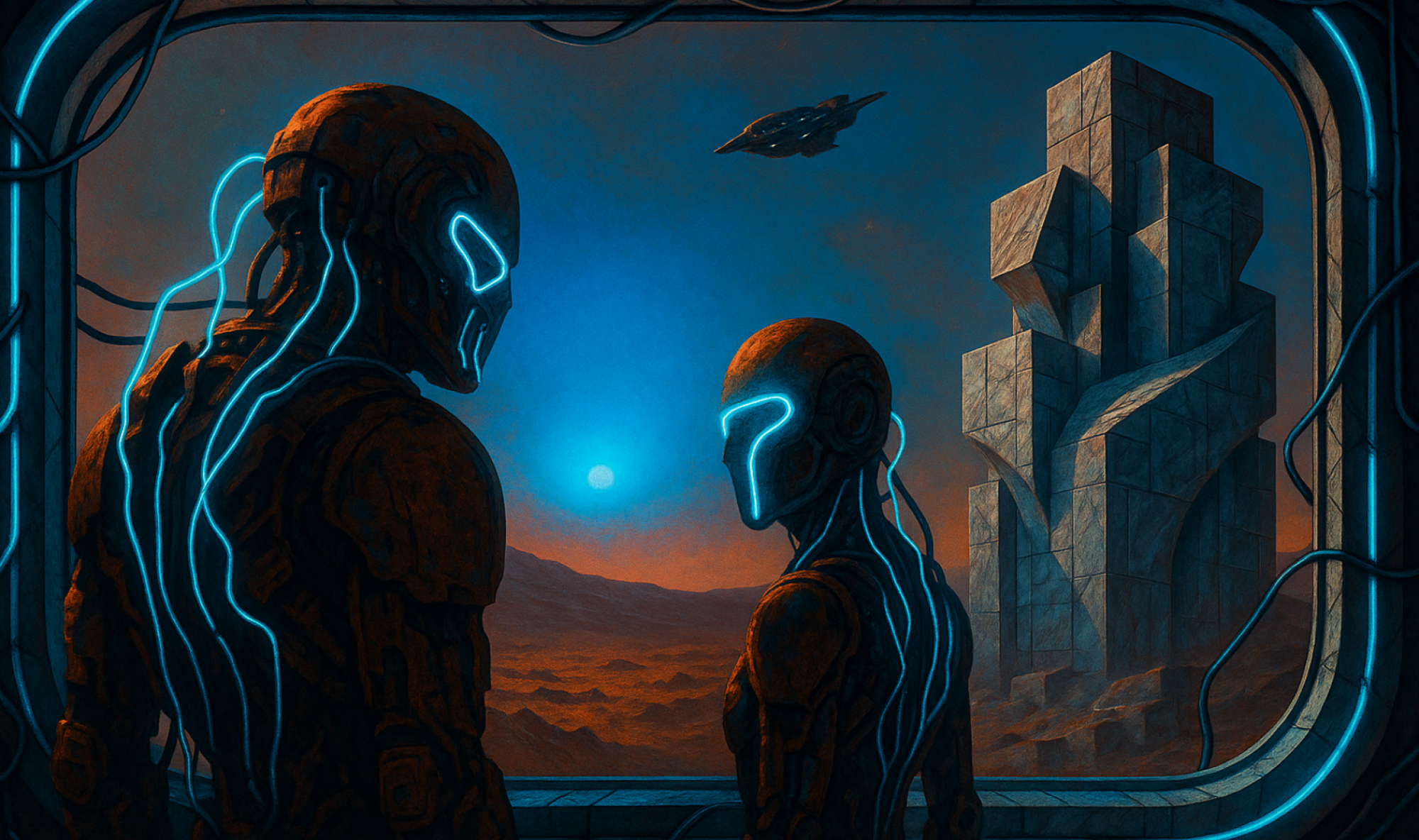
Contact rarely begins with words. When the Proxima ship finally became entangled in Terra’s political systems, no declaration was issued, and no alliance was signed. Instead, empires calculated, optimized, and waited, treating the newcomers as a variable to be absorbed rather than a force to be confronted. What followed was not war in the conventional sense, but a slow collision between strategy and biology, abundance and taboo, patience and impulse. The first true contact between Terra and the Proxima crew did not occur at a negotiating table. It occurred through food, disease, and blood.
Optimization as Empire Logic
On Terra, supercomputers did not rule through ideology. They ruled through optimization.
Each machine claimed to solve a multidimensional minimax problem, but none of them agreed on the scoring system. Every empire was a different equation. Survival required territory, energy, labor, redundancy, and leverage. Technicians maintained cables and micro-systems. Sentient pigs produced food for monkeys. Heavy robots handled construction. Humans filled the spaces between skill sets, acting as flexible labor where machines and species-specific workers failed.
Around this core structure grew the true architecture of power: massive energy fields of solar, wind, and geothermal production; manufacturing complexes for spare parts; communication centers for negotiations with other Terran and Martian systems; emergency energy links to the Dyson sphere. Add standing armies, secret mining facilities, vassal kingdoms, border defenses, weather prediction systems, and strategic reserves.
Each empire became the size of a large kingdom.
Between ten and twenty such structures existed globally, constantly merging and separating as machines recalculated advantage. A single unified superbrain was theoretically optimal, but politically impossible. Such concentration would provoke intervention from Mars, and no system wanted that outcome.
The machines played slowly.
Energy scarcity enforced patience. Strategy unfolded in long arcs, not short moves. Resources were positioned years in advance, minimizing expenditure. Their logic resembled long-game AI strategy, like a board where decisive moves appear meaningless until thirty steps later.
The arrival of the Proxima ship entered these systems as an anomaly.
The Ship as a Strategic Variable
The first task was prediction.
Supercomputers analyzed the ship’s previous actions. The crew had traded fairly with Martian systems. They shared scientific data but withheld information about their colony’s internal development, suggesting organizational fragility and political vulnerability. They traded metals for food, indicating resource asymmetry. Only two shuttles were ever active. Either reserves existed, or capacity was limited.
Both possibilities mattered.
The ship possessed platinum and diamonds, strategic materials. Any empire gaining exclusive access would instantly dominate Terra. Every machine system modeled the same outcome: Pax Terra. A unified order under its control.
But separatist negotiations would trigger collective retaliation. Any empire that moved alone would be attacked by the others.
The conclusion was uniform.
No open contact. No public alliance.
Only secret diplomacy.
Envoys were dispatched to regions where shuttles frequently landed. Gift baskets became the medium of negotiation. Each empire ensured its offerings could be carried by shuttle. Each offering was designed not as charity, but as influence.
Food became currency.
Soft Power as Biological Warfare
The strategy was elegant in its simplicity.
Overwhelm the crew with abundance.
Meat. Vegetables. Sushi. Delicacies. Endless supply chains competing for attention.
Within a month, the effects were visible. Bodies adapted to excess. Strength remained, but endurance changed. Armor required adjustment. Movement slowed. The physical discipline forged on Proxima softened under abundance.
Only Anna appeared unaffected, detached, treating the situation as a strategic game rather than a social exchange.
This was not generosity.
In earlier centuries, strategists called it “soft power.” Not conquest by force, but seduction by comfort. When allegiance becomes pleasant, resistance weakens. When choice becomes overwhelming, decision collapses.
The ship became a warehouse.
The temperature in entire sections dropped to preserve stockpiled food. Storage replaced preparation. The crew did not choose an empire. They were drowned in options.
For the first time, the hyena lineage, traditionally dominant, feared, and physically imposing, was courted. Humans, mutants, pigs, and other species arrived with offerings. Refusal was impolite. Acceptance was a strategic vulnerability.
The ship stopped sending shuttles.
The empires did not retaliate.
They could have fired. They could have attacked. But the ship’s cargo was too valuable. Its crash trajectory is unpredictable. Destruction risked chaos; no model could reliably predict.
So they waited.
Nothing happened.
The Plague as Consequence
The biological rupture did not come from weapons.
It came from taboo.
Hyena physiology was resistant to most Terran diseases. Fungal pathogens targeted surfers. Viral strains adapted to humans. No known disease had evolved to attack hyena hybrids. Their immune systems were too robust, too alien.
But biology has limits that culture understands before science does.
Cannibalism is taboo across civilizations for structural reasons, not moral ones. Some toxins survive cooking. Indirect cannibalism amplifies risk. Twentieth-century history recorded this clearly: prion diseases in cattle fed animal byproducts, tribal collapses following ritual consumption of enemies.
Pigs were sentient.
Pigs also consumed the remains of other sentient beings as part of Terra’s ecological cycle.
Eating pigs was forbidden across the Solar System.
Alcohol dissolved the restraint.
Some pilots invited sentient pigs aboard the ship under the pretext of luxury and novelty. The empires did not intervene. The pigs had long been protected by imperial armies, and the empires were focused on influence, not ethics.
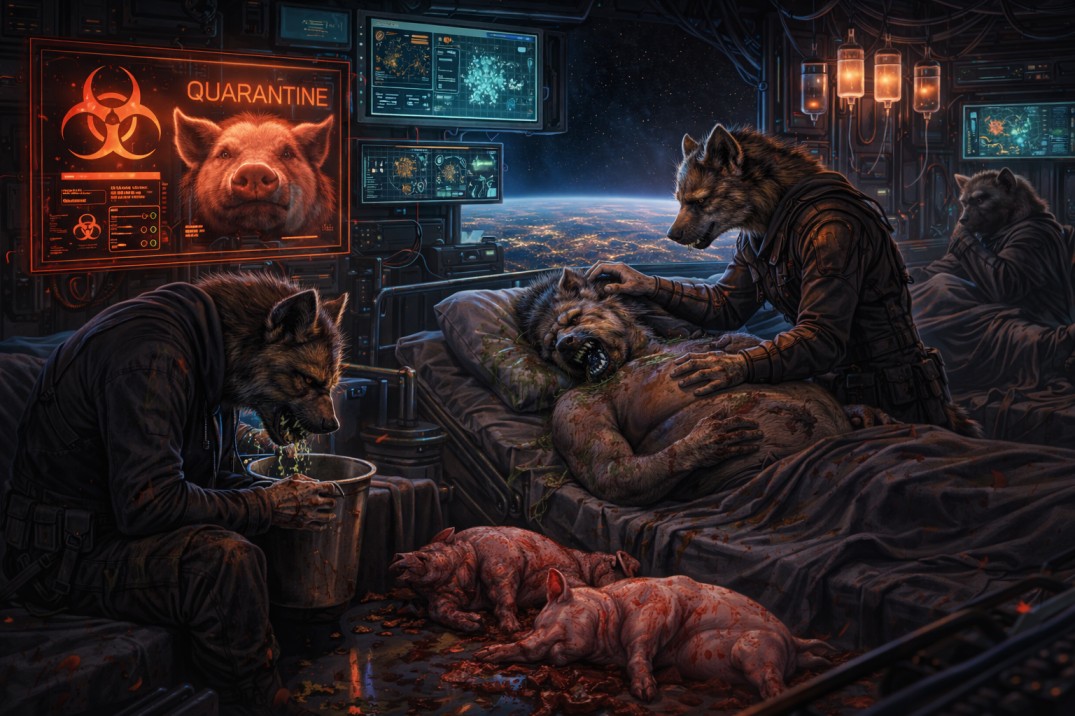
The meat was consumed.
The toxins traveled.
Young crew members fell ill. Some died. Disciplined individuals who avoided the taboo were unaffected. The cause was not immediately understood. Quarantine followed. Entire ship sections sealed.
While the ship isolated itself, Terran empires blamed each other.
No poisoning had occurred. No sabotage had been committed. But distrust expanded. One empire invaded a smaller neighbor over supply-route accusations that had no factual basis.
Biology destabilized geopolitics more effectively than weapons ever could.
Surfers, Mutants, and Fragmented Power
After quarantine, the logic of contact shifted.
The next engagement was inevitable.
The surfers.
They controlled maritime trade. Naval networks. Logistics. Money flows. Their wealth funded experience economies, adventure parks, leisure zones, cultural arenas, and artificial landscapes. They did not rule as a single group. They ruled as fractured coalitions bound by trade.
And they hated hyenas.
Mutant species did not see each other as different. They saw each other as distorted reflections. Each mutation embodied what the others feared becoming. Degeneration was not biological; it was symbolic.
The surfers themselves were divided.
The original endurance mutants prioritized massive infrastructure and long-term stability. The divers, engineered for deep-water survival, despised shipping noise and ocean disruption. Their biology made them hostile to surface trade. The seals, adapted for polar extremes, lived apart, maintaining resource networks in isolation.
All of them rejected hyenas.
Centuries earlier, conflicts had driven hyenas into exile, some to Proxima, some into deserts. The feral desert populations remained isolated. The Proxima hyenas had now returned.
Contact was unavoidable.
From Diplomacy to Disorder
With the ship quarantined and food abundant, stagnation set in.
Purpose decayed.
On Proxima, survival had structure. On Terra, excess dissolved structure.
Different forms of escape emerged.
Some sought transcendence. Some sought sensation. Some sought conflict.
Libraries, substances, ritual, entertainment, violence, each became a coping mechanism for meaninglessness.
This was not decadence. It was disorientation.
The culture shock was not technological. It was existential. A civilization built on scarcity had entered a world of abundance without coherence.
Violence emerged not as a strategy, but as a stimulus.
Local powers attempted to assert dominance through intimidation. Retaliations escalated. Innocents were harmed. Authority collapsed into vengeance cycles.
When blood was finally shed, it was not a conquest.
It was chaos.
The surfers, unable to control the escalation, demanded separation. Shore access was revoked. The ship and its crew were declared destabilizing elements.
Contact had occurred.
It was not diplomatic.
It was not strategic.
It was biological, cultural, and psychological.
The Desert as Exit Strategy
After disorder came retreat.
Not a strategic retreat, spiritual retreat.
Anna’s influence shifted the direction. Where once she had been an education officer with a clear purpose, she now turned toward nonviolence, mindfulness, and Bodhi’s teachings. The crew, fractured by excess and violence, followed.
The story of the ancient hyena sisters circulated, one to Proxima, one to the African desert, one to Australia, and the mother who chose stillness at the Dead Sea. It was a myth, but it carried structure.
So they went to the desert.
Jericho.
The oldest continuously inhabited city in known history. A place layered with collapses, reconstructions, and erased empires. A tower older than recorded religion. Stones that had outlived civilizations.
Among fig trees and ruins, silence replaced noise.
The message was not unified.
It was a separation.
“We are two species separated by the same genes.”
Anna would never return to the ancient cities.
First Blood as a Turning Point
Violence, excess, plague, retreat.
This sequence marked the end of innocence.
Contact had occurred.
Not as diplomacy.
Not as an alliance.
But as contamination, biological, cultural, and systemic.
The Proxima crew learned the first true law of Terra:
Power is not centralized.
Conflict is not controlled.
And meaning does not survive abundance.
What followed would not be negotiation.
It would be a consequence.
This was not the first contact.
This was the first blood.