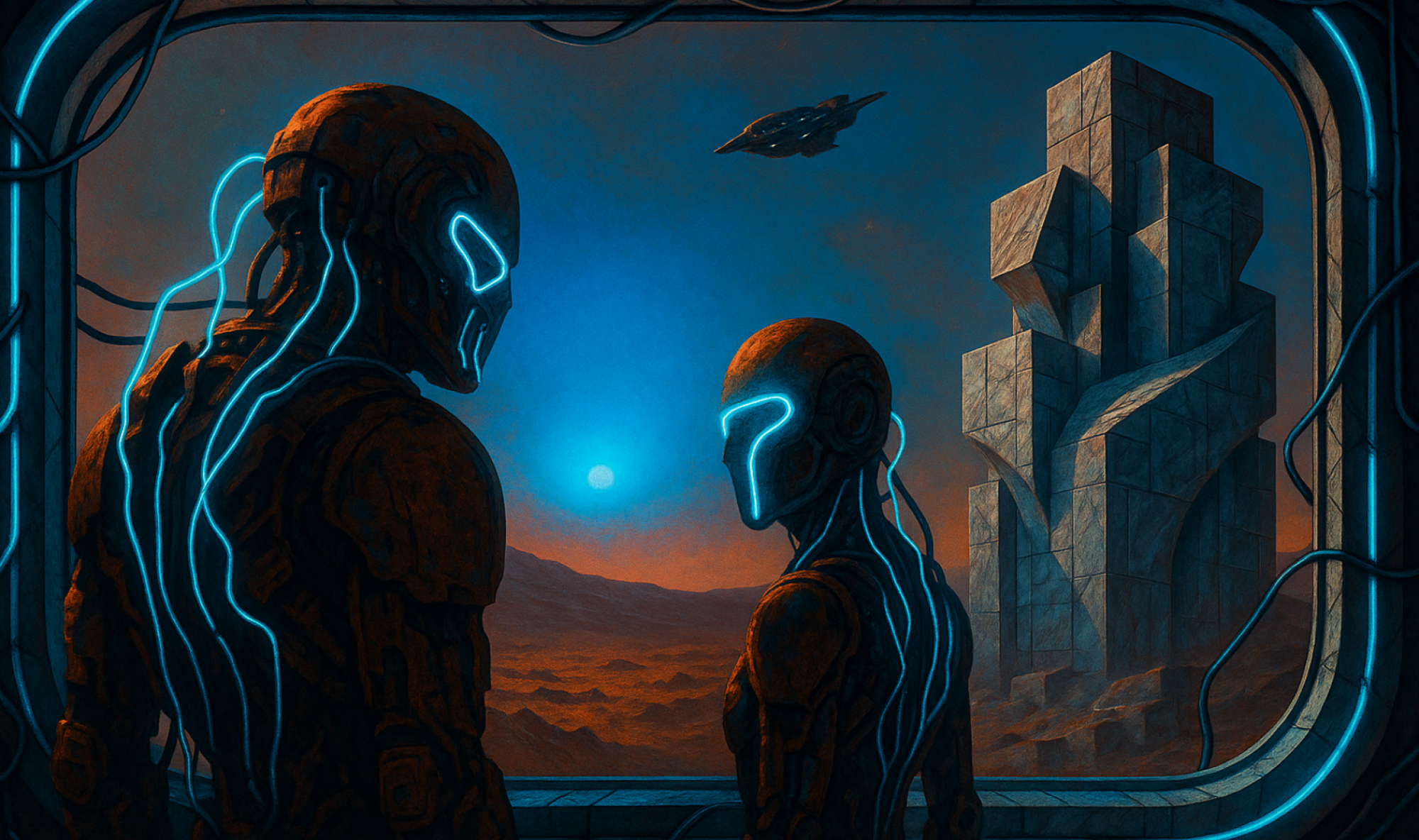
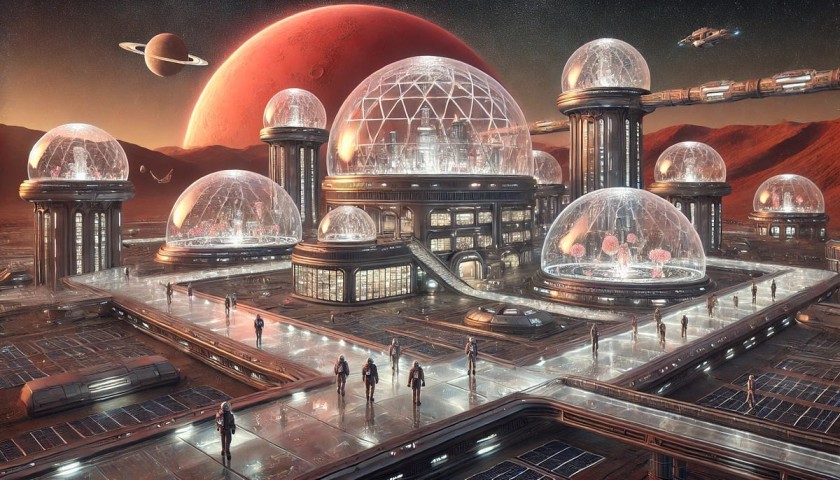
Mars did not fracture along national or ideological lines. It fractured along lines of function. As space expansion accelerated, entire populations were engineered, deployed, rewarded, and then quietly displaced when their labor became abundant. The cities that emerged from this process were not accidents or failures of governance. They were logical outcomes of optimization. Nowhere was this clearer than in the mutant cities that formed around energy, propulsion, and transport, places where humanity’s most powerful tools lived separate lives, governed by rules that no longer aligned with those of their creators.
Engineered Migration and the Birth of a Separate People
The beings later called Surfers were not born from ideology or rebellion, but from optimization. They were designed deliberately, assembled from traits borrowed across species and disciplines, intended to endure radiation, vacuum proximity, psychological strain, and mechanical intimacy. Long limbs, slow metabolism, controlled respiration, calm under stress, every characteristic served a function.
Their earliest generations were not raised in cities but on beaches. Australia and Oceania became proving grounds where engineered bodies practiced endurance not for leisure, but for survival beyond Earth. Reproduction was initially mechanical. Cloning chambers compensated for the absence of genetic diversity, while extreme inbreeding was addressed not through ethics but through removal. Those deemed too genetically compromised were chemically sterilized and reassigned to tritium facilities.
There, they were told they were elite.
And for a time, they were.
Migration followed profit. Luna and Mars required tritium engineers, propulsion specialists, and reactor custodians. Compensation increased dramatically. Families received money. Status improved. Sterilization became acceptable, even desirable. The pool widened. Natural reproduction replaced cloning. The Surfers stabilized as a population.
And then they became common.
When supply exceeded necessity, wages collapsed. Housing degraded. Prestige evaporated. The engineered elite became an engineered workforce.
Cities followed.
The Logic of Mutant Cities
The mutant cities were not chaotic. They were specialized.
One surrounded the primary tritium reactor.
One grew around propulsion assembly and engine repair.
One became home to shipboard engineers, smugglers, and the most sophisticated gambling markets in the system.
Crime existed, but not violence. Surfers were biologically calm, structurally rational. Their conflicts were financial. Their resolutions are quiet. Weapons were absent not by law, but by disinterest. Collateral damage was inefficient.
Illicit trade flourished where radiation crippled surveillance. Security drones failed near reactors. Humans avoided exposure. Mutants controlled access. Anything could be obtained except force.
This was where the man went.
Pilots: The Gods of the Streets
In corporate cities, streets were wide. Six pilots could walk abreast.
In mutant cities, the standard was one.
A pilot’s presence altered geometry. Their exoskeletons, scorpion-like frameworks of graphene and titanium, were not vehicles but extensions of the human nervous system. Five meters wide. Eight long. Powered by fuel cells capable of sustaining villages.
Pilots did not need ships to function. They were ships.
They could walk in a vacuum. Brace hulls with claws. Lift containers with tails. Run faster than ground vehicles. Their embedded systems allowed autonomous control even if the human inside lost consciousness.
They were the decisive force of early space expansion.
And they were dangerous.
When three pilots erupted from a gambling den, the street emptied instantly. The man stepped aside without hesitation. He carried weapons capable of disabling a pilot, but using them would end his mission and likely his life. Restraint was not moral. It was operational.
Power was everywhere here.
So was patience.
Language Without Belief
Surfers did not understand religion.
They understood utility.
Anything non-functional was labeled a magic artifact. Holy texts. Ritual bread. Silver crowns. Human belief systems were commodities stripped of meaning and traded for profit.
Communication itself was compromised. Surfer physiology limited articulation. Their creole Spanish lacked diphthongs, nasal sounds, and tonal variation. Neural implants could translate meaning, but not shape mouths.
The man’s request, a silver-crowned Torah and non-radioactive mazza, became linguistic theater.
Magic artifact. Crown god book book. Flat spring bread.
Confusion followed. Then interest.
Because the final phrase was universal.
Much money.
Search parties formed. Misunderstandings multiplied. Entire black-market networks mobilized to decode the request. Through trial, humor, and accident, the artifacts surfaced.
Payment arrived not from visible institutions, but from illegal AI systems, autonomous financial engines backing research too experimental for public approval.
The doctor received the items.
So did his project.
Machines That Reason Sideways
The artifacts funded something stranger than contraband.
The doctor’s research focused on alternative logic systems, artificial intelligence designed not for optimization, but for non-linear wisdom. Decision engines that produced outputs resembling aphorisms, parables, and contradictions. Answers that sounded profound and meaningless simultaneously.
They guided without clarity. Advised without precision.
Like ancient oracles.
Like fortune cookies.
Like faith.
The system worked well enough to justify its continuation.
Speed as Ritual
Propulsion City invited competition.
Engines were everywhere. Spare parts. Half-built ships. Testing lanes. The temptation to race was unavoidable. Illegal circuits formed naturally among machinery designed to exceed safety margins.
A question governed every race.
Could a team of mutants defeat a pilot?
Only under impossible conditions.
Luck. Coordination. Preparation.
And chemical interference.
Pilots’ systems could fly autonomously even if the human passed out. But the body still mattered. The race unfolded like a myth. Mutants pushed engines beyond tolerance. The pilot dominated until drugs and exhaustion converged.
Victory was brief.
Collapse followed.
Power, Debt, and Gratitude
The pilot fell with his battery depleted. His exoskeleton powered down.
Without a recharge, he would die.
The nearest compatible system lay in the electrician’s city, near the tritium reactor. Time mattered. Radiation mattered. Coordination mattered.
The man helped.
No heroics. No spectacle. Only logistics, risk, and urgency.
The battery was charged.
The pilot survived.
Gratitude followed, not emotional, but structural. A debt was established. Pilots remembered such things.
They would be needed later.
The Absence That Watched
Throughout the cities, stories persisted.
A woman in red.
Pale skin.
Dark lenses.
Non-human teeth.
She did not belong to the mutant cities.
She did not belong to corporate zones.
She was not seen clearly.
Only remembered.
Her absence became presence.
Her presence became inevitable.
The Shape of the Divide
The mutant cities were not failures of integration.
They were successes of design.
Humanity had created beings capable of surviving where humans could not, then isolated them once their utility stabilized. The cities that followed were not rebellions, but ecosystems, economically efficient, morally indifferent, structurally sealed.
Faith became currency.
Speed became ritual.
Power became localized.
And between these systems moved individuals who belonged nowhere fully, carrying requests that revealed how fractured civilization had become.
The cities did not threaten humanity.
They reflected it, engineered, segmented, optimized, and quietly irreconcilable.
And somewhere beyond them, something watched and waited, wearing red.