Nobody heard Evan Reyes die.
That was the first shock. In every simulator, in every briefing, catastrophe arrived with alarms and flashing overlays. But in a real vacuum, the universe does not announce itself. It simply changes the math.
Evan was the youngest cadet, seventeen, the kind instructors liked because he took procedure seriously and didn’t make drama out of competence. He flew like someone who believed rules could protect you. His ship drifted along the Luna–Earth transfer arc in clean formation timing, with the other cadets staggered far behind, eighty kilometers of safety that should have been enough.
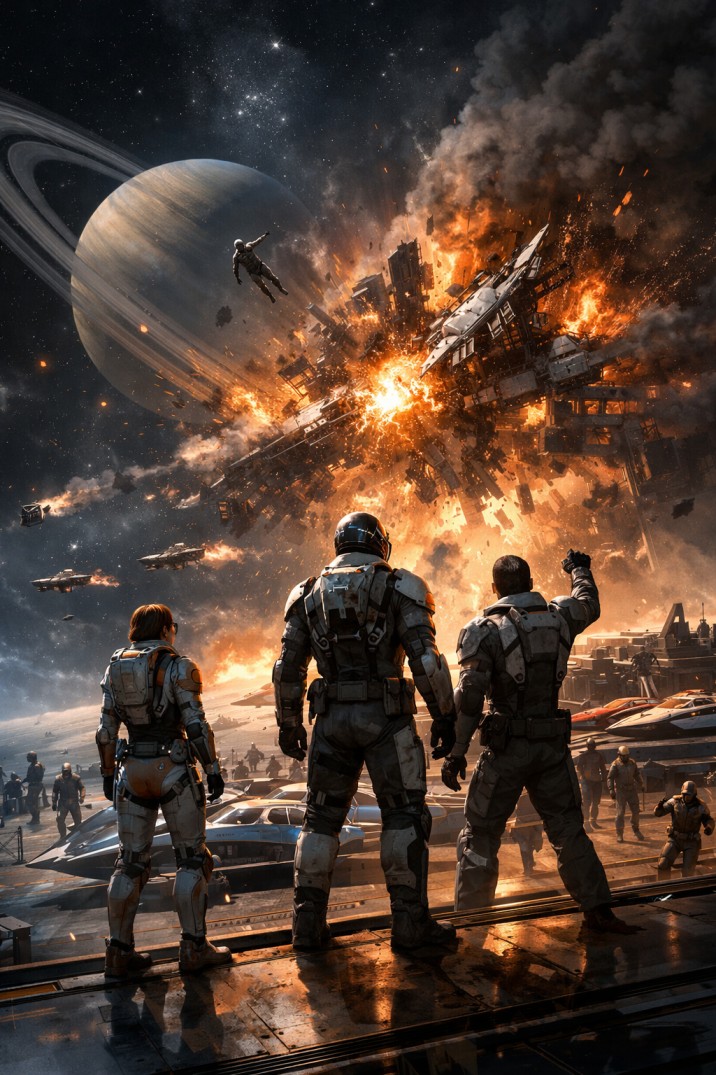
Then a cargo stack ruptured near the lane, not with fire, but with release: bracing rings and latticework and metal flakes turned into a fast, expanding cloud. It looked almost beautiful for a fraction of a second. Evan’s neural interface tried to parse it, flooded itself with warnings, and stuttered.
He could have dodged and bought himself a few seconds. Instead, he forced his damaged craft into the densest part of the debris to shove the whole cluster off-axis, meters, not kilometers, but meters were the difference between a “clear corridor” and a slaughter corridor.
Later, analysts would reconstruct his vector change with clinical precision. The cadets didn’t get that report. They only got the silence afterward, one icon missing from the roster, one space in the comm band, and the sick awareness that the safest lane in the system had just tried to kill them.
And the worst part was how quickly the system moved on.
The Reception Hall’s Second Lie
On Luna, the welcome reception was built to look like unity. It smelled faintly of hydroponic citrus, the lighting was warm enough to flatter cheap fabric, and the banners were a careful collage of power: Earthside blue, Chinese red, lunar silver, Martian black, the sterile white of the labs, the glossy chrome of private guilds.
Sahar arrived late because her shuttle overshot its docking arc by five meters, and the ground crew insisted on recalibrating her harness frame. She didn’t argue. She watched faces instead. People noticed her size, her posture, the controlled breathing that hinted at hidden loadouts and internal discipline. She carried herself like an instrument that had already been used in places nobody put in brochures.
A cadet near the window greeted her with the wrong title. “You must be Nurse Sahar.”
“I’m not a nurse,” she said, without heat. “Not anymore.”
Samson introduced himself next, a salvage diver, long-breath physiology, the calm economy of someone raised by water and disaster. Joseph arrived like a walking critique: bone-thin, lunar scientist, irritated by crowds as if sound itself were inefficient. Andrea stepped in with quiet precision, hands that wanted to fix things. Jason followed, big and steady, the folded exoskeleton on his back making him look half miner, half weapon. Nicholas joined last, the accountant-priest with a Jesuit discipline, eyes always measuring cost, risk, and moral debt.
They weren’t friends. Not yet. But they recognized something in each other: the instinct to watch the edges.
Jason leaned toward Sahar and asked the question nobody should ask at a party. “Who do you think dies first?”
Sahar held his gaze. “Not us.”
Nobody laughed. Even the celebration felt temporary, like a bright sticker slapped over a cracked hull.
The Hangar and the Price of “Small” Errors
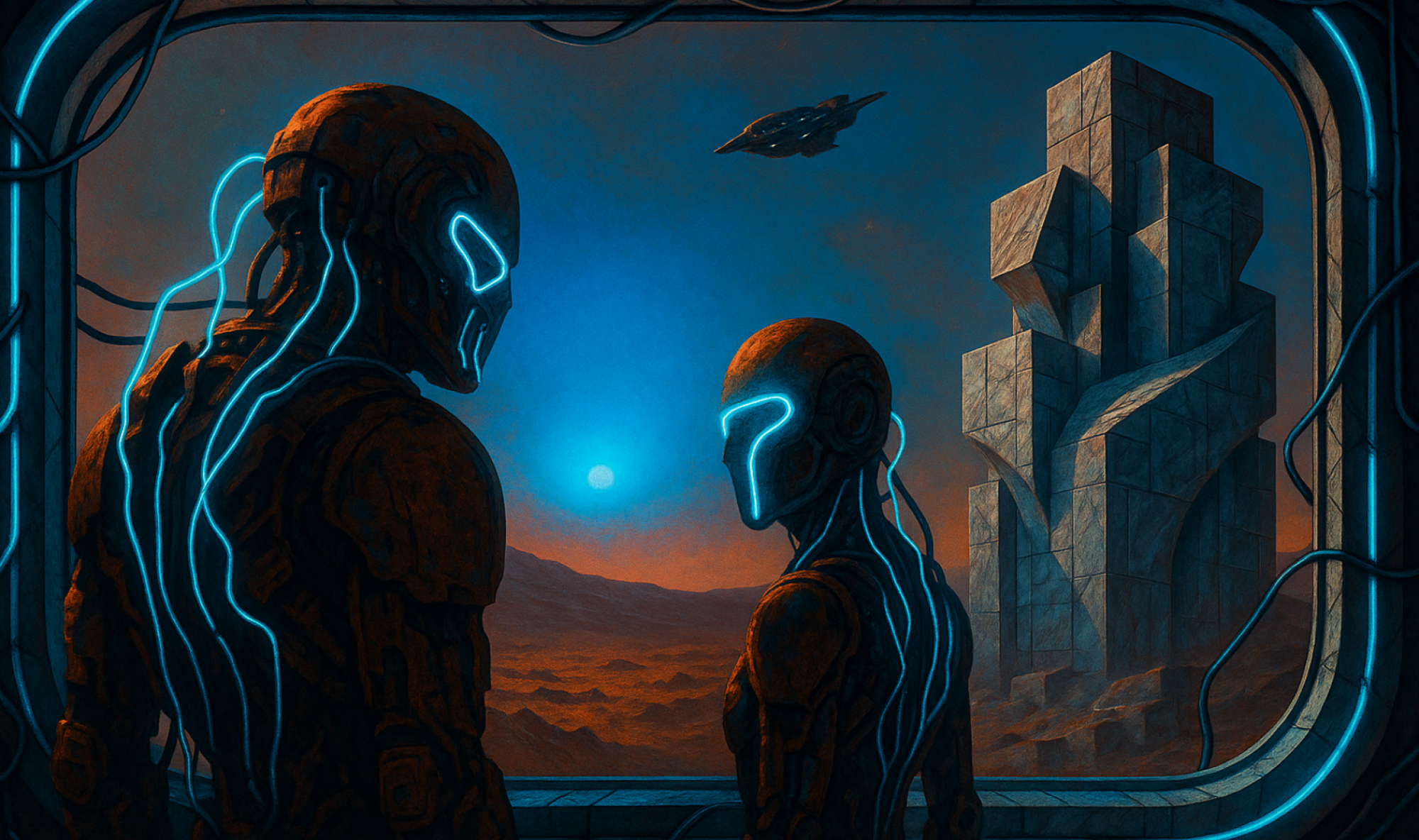
The next day, the speeches ended without announcement. The cadets were ushered through a narrow corridor toward the launch hangar, the air colder and cleaner, stripped of perfume and optimism. The hangar itself was a cavern carved into lunar bedrock, lit in industrial blue. The ships hung in magnetic cradles like lean fish suspended over a glass sea, living metal skin, curved solar panels, compact mass drivers designed to be fast and unforgiving.
The supervisors didn’t talk about courage. They talked about faults.
“If you cannot identify a defect,” one of them said, “you have already failed.”
This was where the Trials showed their real face. Not heroism, not destiny, inspection, calibration, and the relentless truth that physics does not care how hopeful you are.
Each cadet revealed themselves in the way they approached their ship. Nicholas catalogued everything as if balance sheets could keep him safe. Joseph leaned too close to the engine housing until a technician barked at him, and he only stepped back after memorizing coolant routing. Samson found a micro-tear in a solar panel and went quiet, jaw tight. Jason corrected two calibration faults with miner-level confidence, hands steady like he’d been repairing dangerous machinery since childhood. Andrea ran her fingers along a hull seam and felt her neural interface ping like an old bruise; she didn’t show it.
Sahar walked the hangar twice before placing both palms flat against her ship’s hull, feeling the reactor hum through living metal. Purpose, yes. But also a reminder: living metal behaves only if respected.
The Quiet Fire Under Their Feet
The first full-power ignition test wasn’t a spaceflight. It was a rehearsal under Luna gravity, mass drivers spinning up, coils heating, vibrations rising through the floor. On paper, a formality. In reality, a gauntlet that broke pilots before they ever saw open sky.
Andrea felt the vibration through her boots and disliked the pitch. Not dangerous yet. Just slightly off, like a machine clearing its throat before it screams.
Across the hangar, Sparrow trembled in its cradle. Joseph’s voice came fast through the comms. “Coolant choke. Overheat.”
The cadet inside hesitated, hands hovering over the abort switch. That pause, pure fear, lasted a heartbeat too long. The mass driver screamed, the coil chamber flashed white, and the canopy went dark. No cinematic explosion, no fireball, just a system failure that ended a career instantly.
“One cadet eliminated due to system failure,” the launch officer announced, mercilessly calm.
Andrea gripped her controls harder. Thirty percent. Hold. Don’t overcompensate.
Then Sahar’s ship stuttered. Not her fault, not fully, the ground crew had tried to modify the actuator balance for her mass distribution. The craft didn’t like being forced into shapes it hadn’t grown into.
“Two degrees starboard,” Andrea said through a direct link. “Let the actuator bleed off the misalignment.”
“I know,” Sahar snapped.
The correction came too hard. The ship lurched in its cradle. Metal clanged. Nicholas shouted, “Abort!”
Sahar killed the engine, steam vented, and cockpit lights flickered.
“You are grounded until further inspection,” the intercom said. “Not eliminated. Not cleared.”
A second cadet panicked during a fuel regulator surge and counterthrusted, exactly the wrong move. Sparks, blackout, elimination.
When the engines idled down, the hangar felt fragile with silence. Medics carried bodies. Technicians swarmed damaged hulls. Joseph scribbled notes like anger could be converted into prevention. Nicholas murmured a psalm. Samson closed his eyes and opened them again, like he was bracing for worse.
Jason met Andrea on the floor. “Three down,” he said. “And this wasn’t even space.”
“It never starts in space,” Andrea replied. “It starts right under our feet.”
Help, Harm, and the Problem of Trust
That night, none of them said Evan’s name aloud. Not because they forgot him, but because speaking it made the corridor feel too close.
Instead, the group formed a rough argument, the kind you only have with people you might need tomorrow.
Joseph insisted failures were measurable. “This is a system. Systems can be stabilized.”
Sahar answered like someone who had seen systems weaponized. “Systems can also be nudged. A few milliseconds. A few meters. That’s all it takes.”
Nicholas brought the moral ledger into it. “If this is selection, who is doing the selecting? And by what ethics?”
Jason’s voice stayed blunt. “By whatever keeps power comfortable.”
Samson was quieter, but his contribution landed hard. “If you can’t tell whether a mistake is natural or engineered, then it doesn’t matter what you call it. The result is the same. People die.”
Andrea listened, then said what she’d been holding since the first debris flash: “The real test is whether we can help each other without becoming the tool that gets someone else killed.”
That was the line none of them could define cleanly. Helping someone adjust a maneuver could save them. It could also put them in a corridor someone else wanted. Reporting a fault could prevent a disaster or paint a target on the person who noticed it.
Trust wasn’t a feeling. It was an operational risk.
The Blue World Turning Below
Earth orbit should have felt like an arrival. Instead, it felt like entering a room where the lights were on, but somebody was already hiding behind the door.
Sahar came in first, Crosswind steady, eyes locked on her jittering pointer lights. The timing mismatch was small, three milliseconds, then four, but small mismatches are how sabotage hides. Mission control ordered a three-degree starboard adjustment with a delay that made no sense if the system was healthy.
“Hold vectors,” Sahar said on the cadet band. “Earthside AIS is wrong.”
Joseph answered immediately, irritation sharpened into focus. “Lower AI layers are out of sync with resource directives. Bandwidth is being throttled.”
Jason translated, grim. “Earth is starving its own systems.”
Then Sahar saw the blue pulse: a meteor defense platform warming, not firing, but waking up like a predator lifting its head. It had no reason to paint a verified cadet craft, unless someone wanted fear, or an “accident,” or a forced reroute.
Nicholas’ voice cracked. “Sahar, you’re being painted.”
“I know,” she said, and didn’t explain why she suspected she was the obvious target.
Joseph, drifting in formation, noticed something else: maintenance prototypes on the pylons, not human workers. Ken Li’s uplifted monkeys, silver-eyed, moving with eerie precision. They weren’t checking docking clamps. They were checking reactor shielding.
“Should we worry?” Samson asked.
“Yes,” Joseph said. “Not about the animals. About what they’re maintaining.”
Samson’s sensors then caught an unregistered microburst: a data spike. Not a weapon. The kind used to overwrite manifests. He recognized the signature from old smuggling patterns that moved people like cargo.
“It’s coming from inside the station,” Samson said, voice tight. “Someone just edited an incoming record.”
Joseph ran fast diagnostics and made a call that sounded too calm for the stakes. “The primary magnetic bracket is unstable. If you dock with full mass-driver dampening, you risk collapsing the coupling.”
“Abort?” Nicholas asked.
“No,” Joseph said. “Zero-thrust drift. Let artificial gravity coupling pull you in. Slow.”
There was a pause, the moment where trust becomes action.
Sahar spoke first. “We trust you.”
They followed his maneuver, ships gliding in near silence. The field caught them gently, like a hand that could have crushed them but chose not to.
Only after the docking clamps engaged did the final truth settle across the group: somebody had expected them to fail. Somebody was watching to see which cadets could be eliminated without firing a single shot.
Earth turned below them, blue and beautiful and indifferent.
And the Trials, from their first quiet death onward, had made one thing clear:
The most dangerous attacks in this era don’t look like war.
They look like a procedure.
What began with a silent rupture in a transfer corridor and a boy who vanished without ceremony had already defined the logic of everything that followed. The early days of the Trials were not about bravery, spectacle, or destiny. They were about systems under strain, about machines that tolerated no error, and about institutions that hid failure behind procedure. Trust became a calculation.
Help became a risk. Survival became something negotiated minute by minute, not earned by merit but by attention, discipline, and the willingness to act when rules no longer protected anyone. By the time the cadets reached Earth orbit, it was already clear that the greatest danger was not space itself, but the invisible architectures of power, automation, and manipulation shaping every corridor they flew through. The Trials had not begun as a race. They had begun as a filter. And the ones who continued forward were not the strongest or the most gifted, only the ones who learned, early, that the future would not announce its disasters before it delivered them.