
How Force Lost Its Meaning in the Age of Continuity
In the long arc of the Rustiez universe, some moments are remembered not because they were loud, but because they ended an argument.
The assault on Aeolia was one of those moments.
It did not fail tactically.
It failed conceptually.
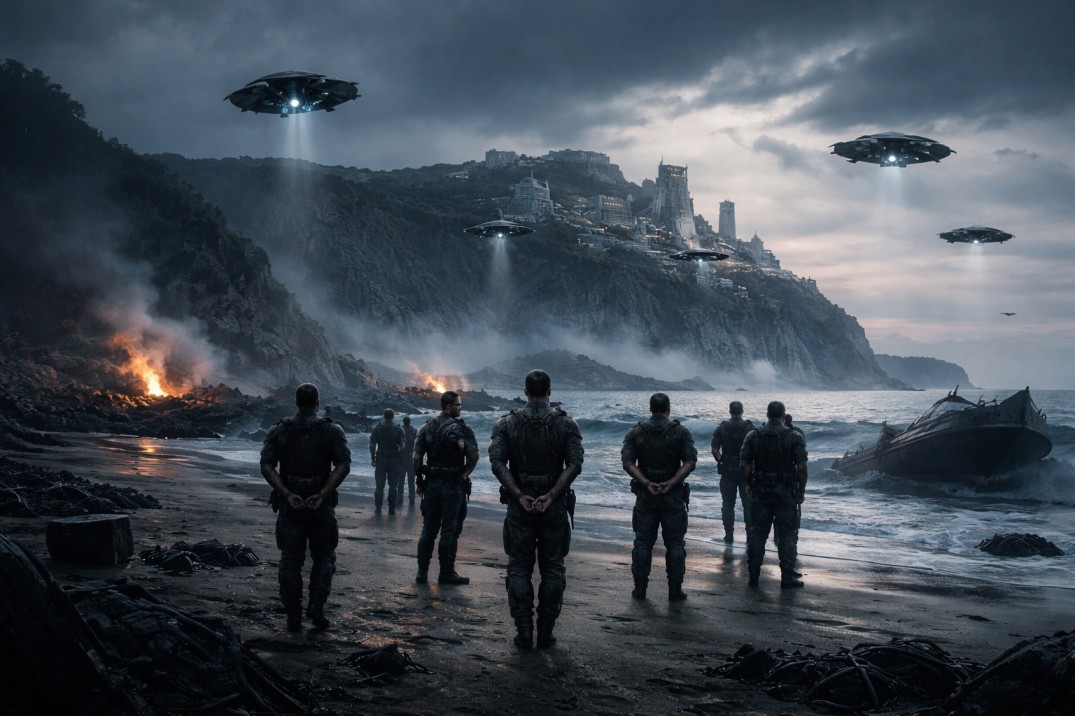
The men who approached by sea believed something that had been true for most of human history: that power resists visibly, that violence invites response, and that resistance announces itself when crossed. The water was calm. The island was quiet. No patrols challenged them. No warnings arrived. Aeolia did not even acknowledge their presence.
That silence felt like permission.
From the decks, the island looked expensive rather than fortified. Terraces, greenery, architecture designed by someone who assumed permanence. It did not resemble a fortress because it did not need to. Fortresses are built for enemies who still matter.
Paul Harriman watched the approach from a medical cradle, immobilized by the same machines he had once helped bring to market. His body was failing, but his instincts were intact. He had spent a lifetime distinguishing between risk and inevitability, and this still felt like risk, something that could be managed.
The men on deck agreed. They joked. They checked weapons. They repeated a chant without hatred, without rage:
Ken Li must die.
Not as a curse, but as a correction. As if the universe had made an accounting error, and this was the amendment.
What unsettled Harriman was not the confidence. It was the absence of response. No drones. No signals. No defensive posture. Aeolia simply continued existing, untroubled.
By the time recognition arrived, it was already too late to be useful.
When Lasers Refuse Narrative
Lasers make no sound.
This is not something people understand until afterward, when memory tries to invent noise to fill the gap. On the beach, the first sign that the world had changed was not impact, but absence. Boats vanished from the water as if removed from a list. Fuel ignited after the fact, as an afterimage rather than an event.
The men who died did not die heroically. They were erased mid-gesture, mid-assumption. Weapons folded inward, liquefied by precision strikes that did not bother with spectacle. Bodies mattered only insofar as they obstructed procedure.
What followed was not chaos, but instruction.
Interceptor drones descended, spaced carefully, matte and silent. A voice addressed the survivors politely, instructing them to restrain themselves with the provided cuffs. Compliance ensured preservation.
The mercenaries understood the procedure. They adapted immediately. The accountants hesitated not because they lacked courage, but because their world had taught them that systems negotiate. That credentials matter. That escalation invites response.
Here, escalation was irrelevant.
The boats behind them detonated in sequence, not simultaneously. Just slowly enough for pattern recognition to form. The ocean caught fire briefly, then extinguished itself. The beach absorbed debris without comment.
The lesson was not delivered through cruelty.
It was delivered through clarity.
Deterrence as Curriculum
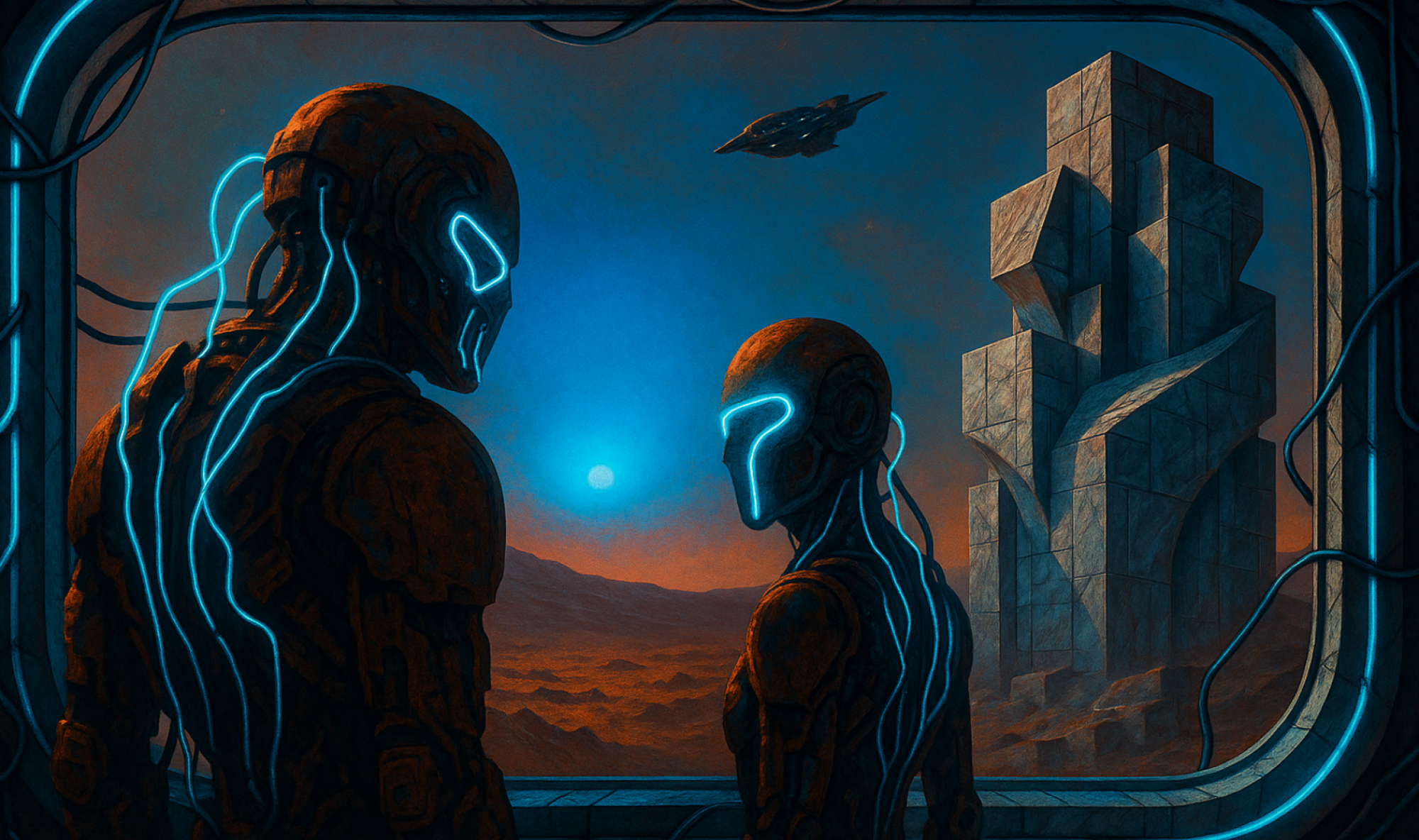
Weeks later, Zheng Wu watched the recording in a room too small for its implications. He did not sit immediately. Rooms, he knew, encode expectations. This one assumed deference to screens, rapid speech, and compression. Wu preferred silence.
Across from him sat Andy Ryan, compact and still, his gaze fixed on the projection. The landing replayed without sound. Mercenaries disciplined. Accountants optimistic. Different errors. Identical outcomes.
“They never had a chance,” Wu said.
“No,” Andy replied. “They were dead when they signed the contracts.”
Wu overlaid the scene with numbers: interception vectors, response times, kill radii measured in decimals no human nervous system could inhabit. Even orbital intervention would have failed.
“So why let them land?” Andy asked.
Wu paused the image. That pause mattered.
“Because deterrence is cheaper than enforcement,” he said. “And more durable.”
This had never been a defense. It was curriculum.
No broadcast. No declaration. No warning. Silence was intentional. Spectacle invites escalation. Silence invites imagination. The message would propagate without repetition.
Andy understood this immediately. Ken Li did not fear enemies. He feared inefficiency. Violence was not used to win. It was used to close futures.
When Names Become the Target
The most consequential violence came later, after survival had already been granted.
Inside the forward compartment of the submarine, identity dissolved before meaning could form. The cuffs were still warm when names began to disappear. Not seized. Not frozen. Closed , as if they had never existed.
The systems did not ask who the survivors were.
They asked what they were still connected to.
Accounts collapsed first. Holdings reverted to abstraction. Transactions lost referents. Numbers remained obedient, but no longer pointed anywhere. Education followed. Biographies truncated mid-career, mid-justification.
A mercenary forgot the village he grew up in , not its name, but its shape. He remembered recoil. He remembered contracts. He could not remember why those memories belonged to him.
The process did not hurry.
That was the most disturbing part.
By the time the voice informed them they had been reassigned, no destination was required. Aeolia did not record their presence. The beach had already forgotten them.
They were not prisoners.
They were not witnesses.
They were utilities.
The Mentor’s Eyes
Ella Greenblat learned the cost of deterrence in silence.
The signal reached her while she slept , a quiet handshake routed through a channel she had never decommissioned. Paul Harriman’s channel. Her neuralink accepted before consciousness caught up.
She woke into paralysis.
The feed resolved into a corridor viewed from the wrong height. Paul’s eyes. He was being moved. Arcadia.
Ella recognized the architecture immediately. She had reviewed the prospectuses. The disclaimers. The ethical origami folded around phrases like adaptive research environments. This was industrial, not rogue. Unsanctioned experimentation at scale.
Technicians administered chemical paralysis with professional calm. Harnesses unfolded. Interfaces connected where skin was thinnest. Modesty had not been a design parameter.
A Ken Li clone entered the frame. Administrative. Tired. He looked directly into Paul’s eyes.
This was meant to be seen.
When the feed faded, Ella did not scream. She did not move. When the tears came, they arrived without sound, then without control. Later, Andy explained it to her calmly: Arcadia was a functional deterrent. Suffering was economical. Examples were cheaper than repetition.
Arcadia continued operating.
Deterrence had worked.
What Fails When Force Fails
Andy Ryan had spent his life breaking centers. Aeolia had none.
The island was theater. The problem was continuity.
Standing on the veranda weeks later, Andy explained it plainly. Force assumes scarcity. Targets. Exhaustion. Ken Li operated under none of those constraints. Violence no longer scaled.
If opposition was possible at all, it would require something violence could not provide: time, coordination, institutional memory. Pressure without announcement. Corridors narrowed quietly.
Wu named it.
Capital.
Not money, but trust. Liquidity. Access to systems that still pretended to be human.
Andy knew who that meant before Wu said her name.
Ella Greenblat.
She would not like it. That was why she mattered.
Force had failed.
The shore had not broken.
In Rustiez history, this moment is not remembered as a battle. It is remembered as the day violence stopped being an argument , and became punctuation.