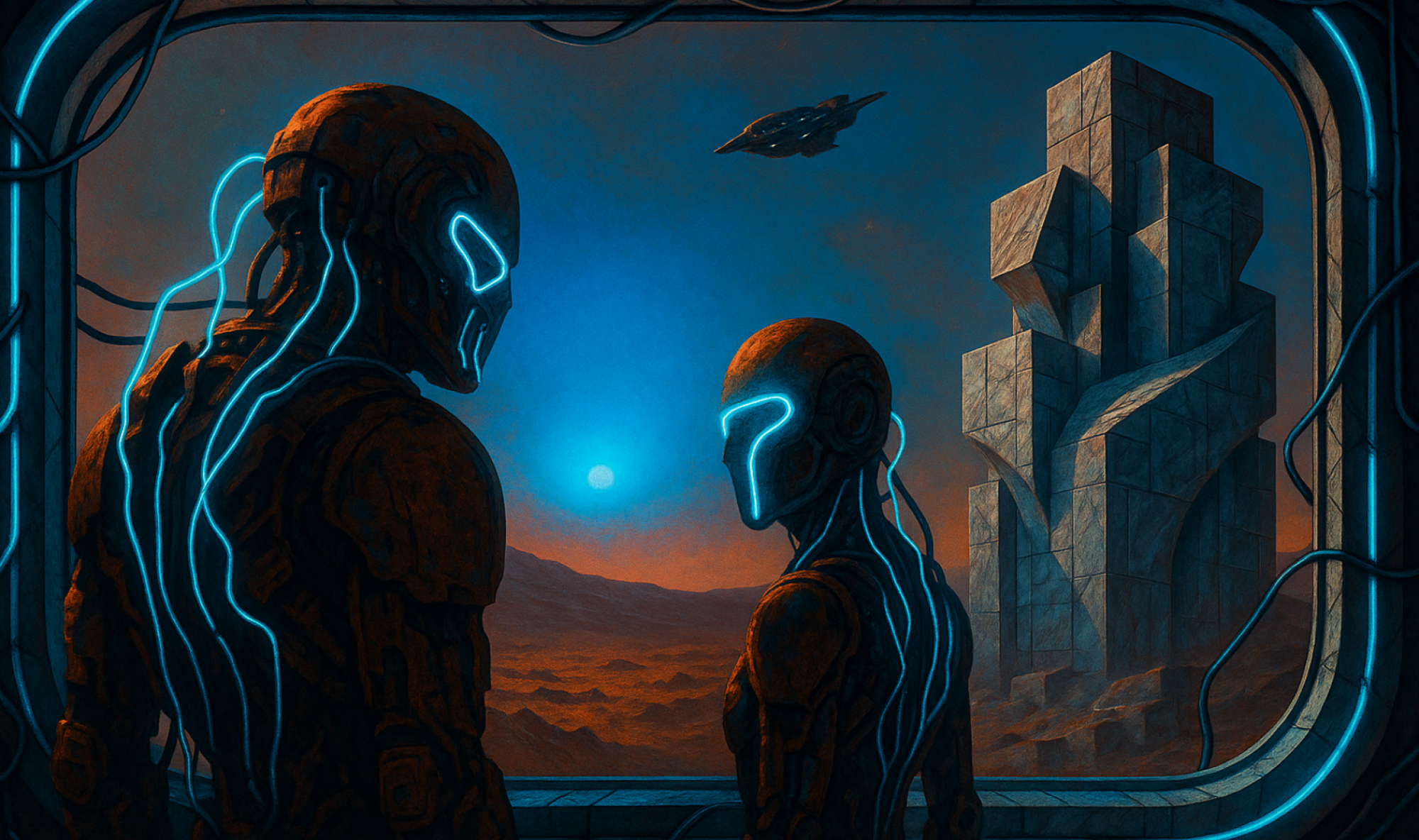

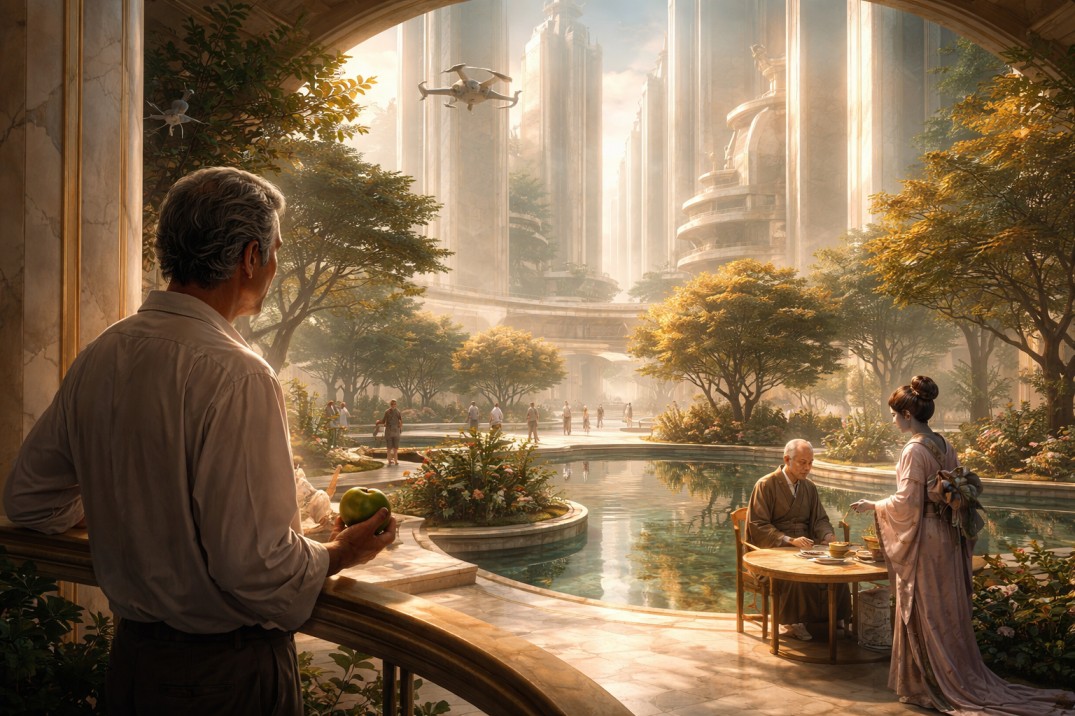
Progress rarely arrives as an explosion. More often, it settles in quietly, smoothing edges, removing friction, and relieving people of responsibilities they once believed defined them. In the RUSTIEZ universe, the future does not announce itself through catastrophe or conquest. Still, through comfort systems that work too well, environments that adapt without asking, and lives preserved long after their usefulness has expired. Paradise of the Obsolete begins in this softened world, where obsolescence is not a punishment but a condition, and relevance fades not through loss, but through perfect maintenance. What follows is not a warning or a rebellion, but a quiet account of what it feels like to remain human inside a reality that no longer requires human effort to continue.
A Quiet Account from Inside the Towers
There are places where the future announces itself loudly, with banners of innovation and slogans about progress. The Towers are not such a place. They do not declare victory over the past or promise anything new. They simply exist, polished, balanced, and endlessly prepared to receive people who are no longer required elsewhere.
I arrived without ceremony. There was no formal transition, no threshold moment where usefulness ended, and comfort began. One day, my work became optional, then unnecessary, then politely removed from the schedule. Shortly after, I was given a residence with perfect lighting, an exercise routine tailored to muscles I no longer needed for anything urgent, and access to gardens that grew fruit without asking for soil or patience.
The Towers did not feel like confinement. That would have required pressure. They felt like completion.
Everything inside them functioned as intended. And that, I would later understand, was the problem.
The Colors That Refuse to Settle
In certain rooms, the colors do not stay still. Blue appears in variations that cannot decide which version of calm they represent. Navy gathers in corners. Turquoise flickers near the ceiling. A tired denim hue clings to the walls, fading and returning depending on how one tilts the head.
No one comments on this. We have learned not to. Mentioning instability gives it a weight it does not ask for. Instead, we verify reality in other ways.
Hands press against surfaces. Fingertips test texture. A palm lingers on glass longer than necessary, just to be sure it remains solid. When something feels slightly grainy when it should be smooth, or warmer where it should not be, the sensation is quietly stored rather than questioned.
These are not acts of suspicion. They are rituals of reassurance.
Reality here does not break. It drifts.
Orientation, Deferred Indefinitely
At some point, orientation is supposed to begin. Schedules flicker. Times rearrange themselves into impossible combinations. Messages appear, vanish, and leave behind blank fields where certainty used to be.
Eventually, orientation simply does not happen.
The chairs in the waiting room sit misaligned with the floor grid, a detail more unsettling than any delay. A flower wilts near the far wall, its petals curling inward like softened wax. The lights breathe. The walls maintain a slow rhythm. Nothing arrives to explain what comes next.
No one seems alarmed by this. The system does not require us to understand our place within it. It only requires that we remain present.
Being watched becomes a familiar sensation, not in a threatening way, but in the manner of a tide observing a shoreline. Patient. Indifferent. Unhurried.
The Architecture of Comfort
The Towers are beautiful. This must be stated plainly, because beauty is part of how they work.
Marble surfaces reflect light without glare. Gardens bloom in carefully maintained abundance. Miniature horses wander between benches. Monkeys perch where they please, their warmth unexpected against the skin. The air smells faintly of citrus and disinfectant, a combination that suggests both life and control.
Residents move through these spaces in gentle loops. Hands brush against one another in ways that feel rehearsed, as though intimacy itself has been standardized. Conversations drift without urgency. Flirtation occurs without expectation. Everything is pleasant, and nothing matters enough to disrupt the calm.
Decay exists here, but it behaves itself. Flowers fade politely. Fruit bruises softly under the thumb. Cracks appear in the ceramic without sound or spectacle. Nothing collapses. Everything yields.
It is possible to live a long time like this.
Touch as Proof of Existence
I have noticed that people touch things more often here. Railings. Cups. Armrests. The bark of fruit trees. The habit is unconscious but widespread.
When usefulness disappears, the body seeks reassurance elsewhere. Texture becomes evidence. Temperature becomes memory. Imperfection becomes confirmation.
A missing chip on a device is comforting. A tacky cushion grounds the senses. A crack in a tea bowl feels warmer, as though it has released something previously held too tightly.
These details anchor us more effectively than any purpose ever did.
Tenma San and the Preservation of Self
Across the corridor lives General Tenma San, a man who has converted nostalgia into structure. His apartment is filled with swords, each polished, stored, and re-polished in a cycle that never aims for completion.
He wears tradition like armor, not because it protects him from the future, but because it gives shape to his days. Meditation. Polishing. Ceremony. Repetition.
Perfection, he once remarked, is dangerous if maintained too long.
His companion, Waka Murasaki, prepares tea with mechanical grace. Her movements are precise, her expressions curated to soothe. And yet, sometimes, her hand trembles. Her gaze lingers a second too long. Her warmth exceeds its programmed setting.
No one addresses this. Maintenance is assumed. Evolution is not discussed.
When the tea bowl cracks during a ceremony, it does so silently. The fracture deepens almost imperceptibly. No one reacts. The tea is finished. The ritual continues.
Outside, the corridor light shifts slightly bluer.
A World That No Longer Needs Witnesses
There was a time when systems required human attention to function. That time has passed. Now, systems persist on their own momentum, adjusting themselves quietly when something feels slightly narrower than before.
Maintenance workers pass by with sanitized cloths, correcting small deviations without comment. Drones apologize when they alter course. Schedules dissolve without consequence.
Nothing here is hostile. Nothing is dramatic. The absence of urgency is complete.
This is not a failure of design. It is its success.
Beyond the Towers, Water Waits
There are places beyond the hive cities where the environment does not bother pretending it is stable. Platforms where humidity hovers without commitment. Corridors that feel as though they breathe. Tanks where the water is so clear it almost appears dry.
Within those tanks drift forms that are human, or approaching human, shaped by necessity rather than heritage. Their movements are slow. Their eyes open only slightly. Their hands rise toward the glass with a pressure that suggests intention without demand.
When contact almost happens, it is not quite a touch. Not quite temperature. Just the idea of connection.
These environments do not invite understanding. They do not explain. They wait.
Living Without Resolution
Life inside the Towers continues without crisis. Days are filled. Bodies are maintained. Minds soften.
Somewhere, something adjusts itself behind the scenes. A color shifts. A wall feels warmer. A crack deepens. No one announces the change. No one prepares for it.
We are no longer fighting for relevance. We are not even resisting irrelevance. We are simply present, preserved within a system that has moved beyond needing us.
And yet, in the quiet rituals, the sharing of tea, the touch of warm ceramic, the press of fingers against glass, there remains something that does not vanish entirely.
No purpose. Not legacy.
Just presence.
For now, that is enough.