
The Observer at the Moment of Rupture
The defining feature of the catastrophe was not its violence but its contradiction. The scene refused to align with expectation. The domes had been designed to endure. The procedures had been validated. The assurances had been repeated for generations. And yet the landscape remained serene while certainty collapsed.
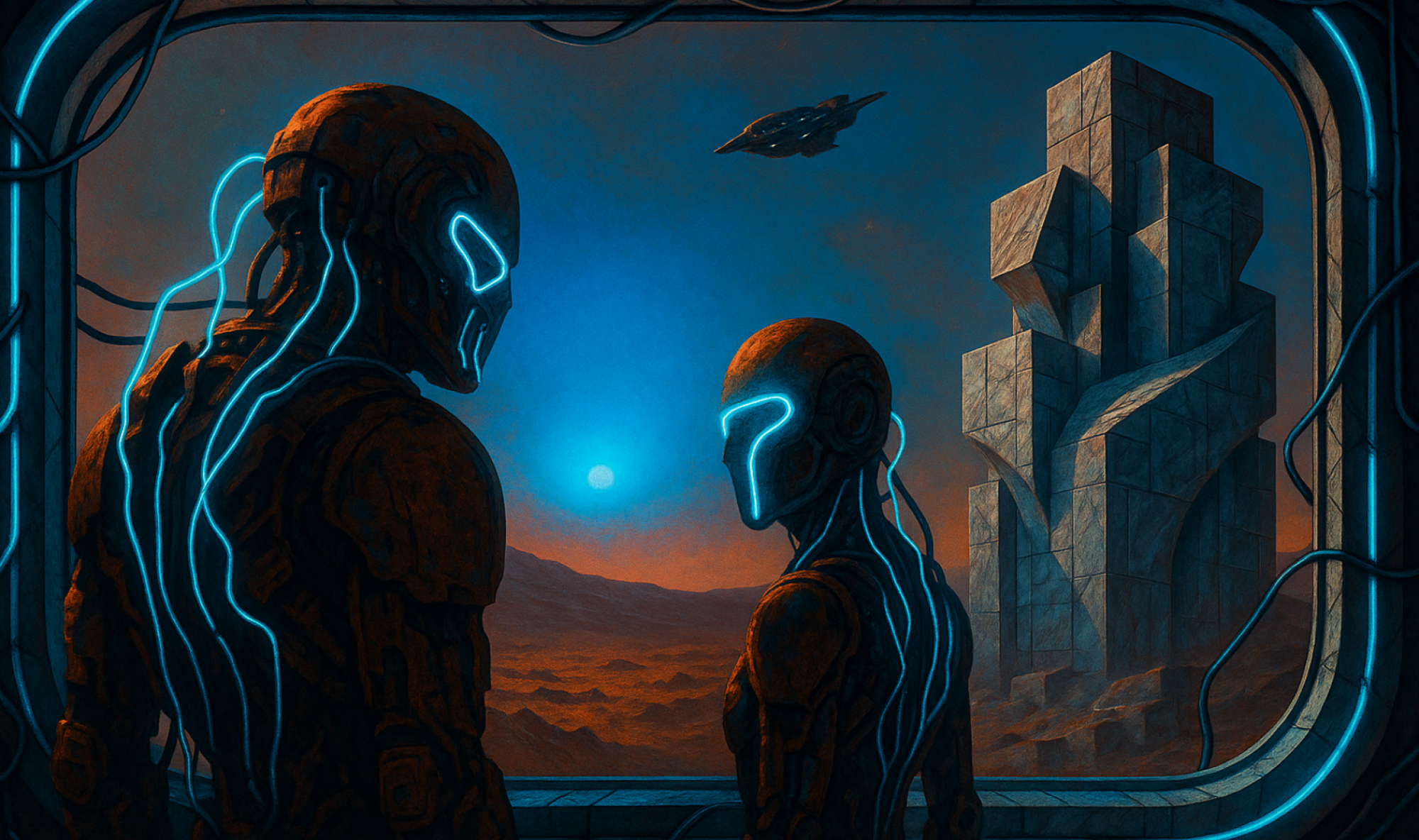
The man who witnessed it most clearly did not respond with panic. He did not flee, nor did he rush forward in misguided heroism. He remained still, not from paralysis but from cognition. He absorbed the scene as one absorbs data that resists interpretation. His thoughts were divided sharply between relief at survival and terror at implication. Survival could be explained. Failure could not.
Numbers surfaced unbidden. Not statistics, but dates, compressed historical wounds that had once redefined public trust. Catastrophe, for him, translated instinctively into arithmetic. He remembered through numeration because memory, in its most reliable form, demanded structure.
Around him, responders prepared. Entertainers and merchants scattered. Rust-colored dust rose and obscured vision. Movement occurred everywhere except within him. For a moment that would later be revisited by others through a neural record, he existed purely as a witness, neither victim nor participant, but something uncomfortably intermediate.
When the debris began to fall in earnest, he acted. Not from fear, but from discipline. Cover was taken because responsible people take cover. Observation resumed once survival was ensured. Only after the sky stopped returning fragments of itself did the question arise: remain, or leave? And if leaving, how?
Conduct Under Collapse
Instinct urges flight, but experience cautions against it. Running introduces hazards invisible to the frightened. Obstacles appear where none existed before. Injuries compound. Resources are misallocated.
The man understood this. He moved deliberately, joining those who needed assistance rather than those demanding escape. He applied basic medical knowledge, offered calm where hysteria dominated, and remained present long enough for order to begin reasserting itself. Helping others was not only ethical; it was strategically sound.
Transport eventually resumed, though sparsely. Biometric gates filtered survivors. He passed inspection without incident and boarded a shuttle. Destination was not assigned; direction was chosen.
South carried no rational advantage. It was an inherited preference, shaped by childhood geography and cultural imagery. Despite the planet’s hostility, the south suggested distance, remoteness, perhaps safety. The shuttle crossed iron fields and industrial corridors toward the frozen computational centers at the pole.
Domestic Order at the Edge of Industry
Arrival at the polar installations placed the man among people for whom presence was synonymous with employment. Few lived there without corporate affiliation. Families, such as they were, existed as functional units designed to sustain productivity across generations.
The Johnson household exemplified this arrangement. Jimmy Johnson, a medical doctor, and Daniel Johnson, a senior astrogeologist, formed a stable professional pair. Their children, Melinda and Billy, served as pilots within the corporate transport system. All were fully integrated, each possessing neural links that shaped perception, status, and opportunity.
Melinda noticed the newcomer first. His solitude marked him as anomalous. Curiosity, not compassion, initiated hospitality. The invitation was practical: unused space existed, and an anomaly warranted observation.
The man accepted. His status as a simple accountant placed him well below his hosts socially, but exclusion would have served no purpose. The guest room reflected deliberate restraint: warm flooring, minimalist design, a nod to antiquity amid overwhelming modernity. He requested rest. Shock, he explained, still lingered.
Once the doors sealed, his role shifted.
Names, Records, and Chosen Selves
Alone, he retrieved a transmitter and spoke into it with mechanical precision. He identified himself as an agent under an assumed name, borrowed from a university acquaintance living an unremarkable life elsewhere. The choice was pragmatic. Names had become interchangeable identifiers rather than markers of essence.
His true profession lay within an organization whose agents remained deliberately unaugmented. Neural links were avoided to preserve invisibility. Ascension granted power but left signatures. An agent survived by leaving none.
The Johnsons themselves illustrated a broader truth. They were not descended from those who first bore the name. Interns had inherited identity along with residence and responsibility. Over generations, continuity replaced lineage. Who one was mattered less than the role one maintained.
Biology fixed certain parameters, but identity had become administrative. Even twins, genetically identical, could be distinguished through subtle biometric differences. Uniqueness persisted, but meaning attached elsewhere.
The Corporate City and Its Hierarchies
The polar headquarters functioned less as a city than as an apparatus. At its core stood immense computational structures, clusters of quantum units, and optical networks capable of processing information on scales that rendered earlier civilizations trivial by comparison. Twelve pyramidal edifices marked the presence of these systems and their human operators.
Surrounding them lived the ascended: neural-link holders granted unlimited credit, mechanical augmentation, and access to corporate authority. Thousands resided in palatial dwellings near the center.
Below them existed a larger population without augmentation, accountants, engineers, physicians, trained extensively yet permanently excluded from ascension. Their role was verification. They ensured that systems functioned as intended, even if they could never fully comprehend their scope.
The man belonged to this latter category, at least outwardly. He waited. He observed. He lingered near computational centers, entertainment districts, and botanical enclosures. His inactivity drew attention. Surveillance intensified. He was shadowed, not because he violated rules, but because he did not conform to the purpose.
Eventually, hospitality was again extended, this time by power itself.
Dinner as Instrument
The Chief Information Officer, who also served as Chief Security Officer, understood that surveillance and defense were inseparable. His personal computational system monitored shadows, correlations, and sensor discrepancies too complex for unaugmented cognition.
Inviting the observer to dinner served a dual function: mitigation and identification. If the man were harmless, removal would follow. If not, information would surface.
The meal was meticulously constructed. Fresh hydroponics, molecular reproductions of familiar forms, and cuisine designed to destabilize perception itself. Jazz played softly, composed algorithmically by a colleague with access to massive computational resources.
Chemical agents were introduced subtly. Sedatives and hypnotics, descendants of twentieth-century experiments, are intended to loosen resistance. The plan was sound.
It failed.
An unrelated medication, an acid-suppressing compound developed centuries earlier, interfered. Coincidence neutralized design. The truth serum lost efficacy.
The conversation turned philosophical. Zen and kabbalah were invoked, not as faith but as metaphor. Enlightenment was framed as access; clarity as alignment between will and system.
When the man replied with the appropriate negation, recognition followed. He revealed his identity, his training, and his purpose. Six prime numbers served as verification, his public key, intelligible to any neural-link user.
A professional understanding emerged. Despite rivalry and competition, both men faced the same enemy.
Access Without Augmentation
True authority revealed itself through access, not enhancement. The agent invoked a linguistic key, seventy-two words, three letters each, encoded long ago as myth and preserved as a backdoor entry to the most secure systems.
Entering this mode while the operator remained present produced an intimacy few experienced. Thought and computation overlapped. The operator perceived everything yet could intervene in nothing.
Data flowed freely. Surveillance logs, intercepted communications, clandestine operations, personal histories. Even events predating ascension surfaced. The agent learned more than was comfortable.
With knowledge came risk. Protection became imperative. If captured, the agent would endanger everyone whose secrets he carried. Ironically, this necessity placed the CIO among those contemplating his elimination, even as collaboration became unavoidable.
Counting the Cost
Only through computational synthesis did the scale of the disaster become clear. Passenger transport within the system had been minimal. Two of the three vessels were lost. Mars entered a period of isolation.
Talent flow ceased. No new neural-link holders arrived. No accountants rotated in. Repairs would take months; replacement vessels, years. A deficit of expertise loomed.
The death toll compounded the crisis. The spaceport housed a significant portion of the population. One fifth perished, including engineers, entertainers, service workers, and the planet’s largest hospital. Many deaths would never be publicly discussed. Some secrets required silence.
Suspects and Structural Enemies
Mechanical failure was dismissed. Local actors lacked means. Corporate rivals preferred leverage. Scientists pursued funding through manipulation, not destruction.
Attention turned outward, to groups that benefited not from control, but from disruption. Cultists, fractured and varied, sought to halt ascension and destabilize order. Identifying which faction acted required investigation, interrogation, and patience.
For the agent, this was routine. Finding perpetrators was not extraordinary. What troubled him was the system’s vulnerability.
Closing Observation
The event did not mark a collapse. It marked exposure.
Systems built on prediction revealed their blind spots. Hierarchies grounded in access confronted their limits. Individuals, stripped of certainty, were reduced to conduct.
Some observed.
Some hosted.
Some calculated.
Some died.
What remained was a quieter shift: trust in inevitability eroded. Progress, once assumed safe, became provisional. And in that uncertainty, every role, from accountant to operator, was reexamined.
History would later note that the most dangerous outcome was not the destruction itself, but the realization that it had been possible at all.