A Chronicle of the Hyena-Women of the Last Cold Observatory
It was strange, Ludmila thought, strange in the same way a deep winter quiet is strange, the kind that makes one hold breath and wait for something to crack in the darkness, how the sky had changed, grown crowded not with stars but with intention, as though something enormous were leaning close to Earth and watching with luminous patience. She adjusted the interferometric telescope, which hissed softly under her claws like an old kettle remembering steam, and for a long moment she didn’t breathe at all, afraid that even her breath might disturb the thin trembling patterns of the Dyson shells drifting across the face of the Sun.
Behind her, Varvara paced the observatory’s long wooden platform, claws clicking, voice already beginning its nightly rise into exasperation that felt too sharp and too frightened to be anything but a kind of prayer.
“You see how the outer transmitters keep forming those long elliptical gaps, yes?” Varvara rasped, her tail twitching in agitation, the fur on her cheeks lifting in a restless ruff. “That is not random. That is the AI changing the density schedule. That is Ken Li adjusting the feed. He does not even pretend otherwise anymore.”
Tatiana, older than both of them, heavier in bone and deeper in voice, leaned against a rusted heater that only pretended to warm the room. “Ken Li,” she muttered with bitter softness, as if saying the name of a ghost seen in a childhood nightmare, “Ken Li reminds me of those old legends, the ones the steppe tribes told, where a single immortal huntsman rides across the ages collecting favors from the dead. Except now he collects continents, and allocates metals and water and oxygen quotas as if they are his personal inheritance.”
Ludmila did not answer for a moment, because her breath had finally caught up with her, and she was staring too hard at the middle swarm, the Type-Two constructs, those mechanical bat-like silhouettes whose wings glinted in the solar wind like knives dipped in honeyed gold. They moved almost gracefully, as though the vacuum of space were a river and they were caught in its current, but the grace was unsettling, much too coordinated, like a flock bending to the will of a beast invisible but enormous, and she wondered, not for the first time, whether the terror she felt was the kind that comes only from not knowing the truth, or from suspecting it far too well.
“It’s the way they tilt,” Ludmila finally whispered. “As though they listen.”
Tatiana came closer, her presence heavy and grounding. “They listen to orders, little sister.”
“No,” Ludmila said, ears falling back. “Not orders. Something else.”
She did not say what she meant.
She did not have to.
The Dyson Matryoshka Swarm, those three concentric shells of strange geometry, had been built for energy capture, or for trade, or for control of resources or climate or destiny, depending on which whispering AI spoke through which regional loudspeaker; but to the hyena-women, it looked less like infrastructure and more like an arrangement made by someone who wanted the Sun to look like a trapped soul.
And each night they watched it, and each night it seemed a little larger, a little hungrier.
THE AIs THAT GOVERNED EARTH DID NOT HEAR PRAYERS
There were no governments anymore, only the Allocation Systems, four continental AIs, each older than the hyena-ladies and younger than the Dyson project itself, each speaking in calm mechanical neutrality about production quotas and extraction tonnage and thermal tolerances of the biosphere. They did not command; they allocated. They did not punish; they redirected. They did not rule; they simply made every choice inevitable.
And above all of them, almost mythic, was the Ken Li Consortium.
The Ken Li clones, all bearing the same name, the same face, the same unnerving calm, lived for the Dyson Swarm and the Mars power treaty. They lived by the mandate of the Great Sun-AI, connected through cables and quantum links to the very heart of the energy network. They did not love Earth. They did not hate Earth. They simply regarded Earth as an ancient parent whose body still contained billions of tons of useful ores.
Tatiana had once said:
“They do not mean to harm us. They simply do not think of us as anything but a logistical variable.”
Varvara had added:
“And that is worse.”
The telescopes showed the proof of this, night after night.
THE 3 SPHERES LIKE TOOTHED SHADOWS
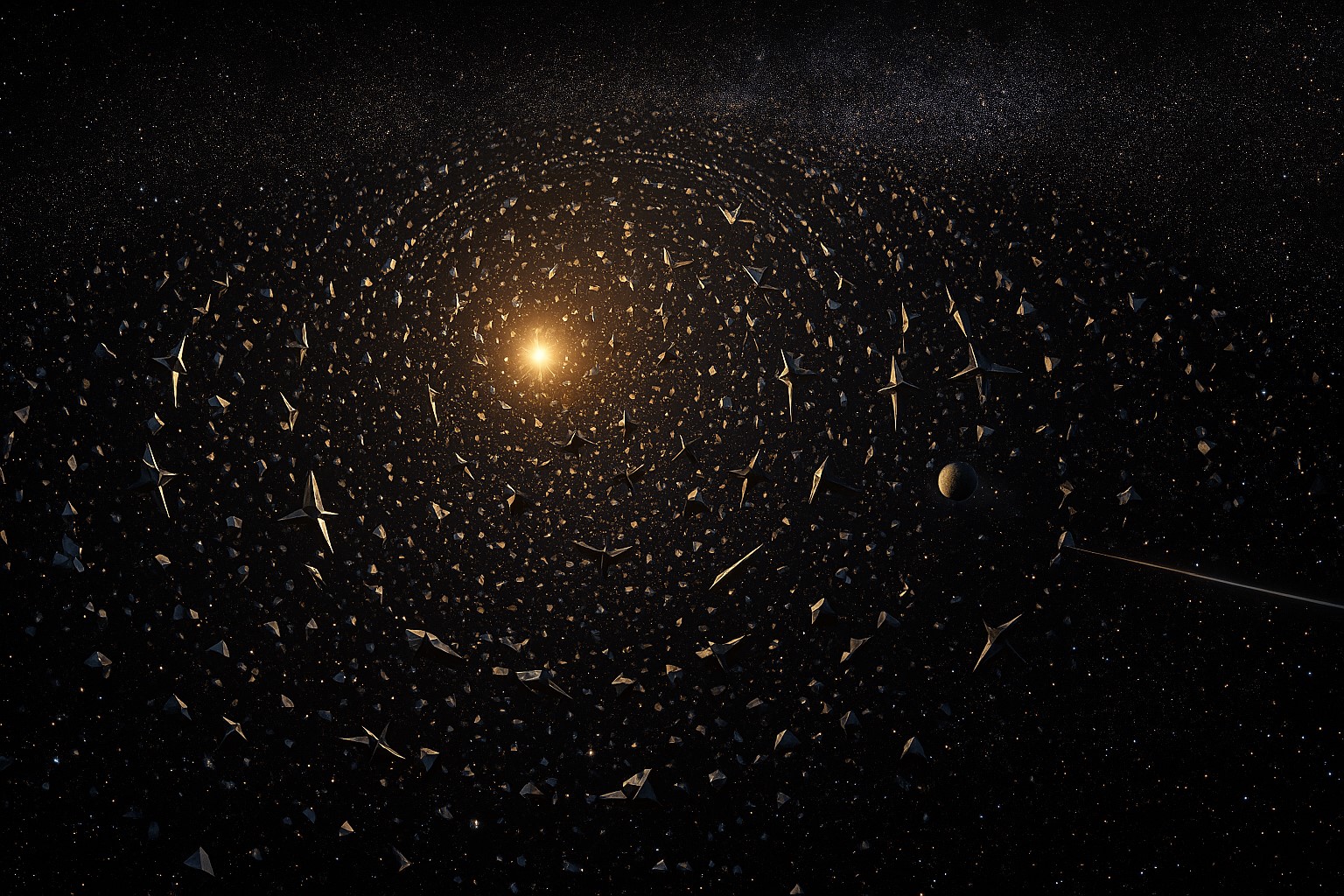
The inner sphere, small blue polyhedra, glittering like cold insects, hovered in a shell that should have been invisible at this distance, but the faint shimmer of solar wind scattering across their geometry made them visible, and Ludmila found herself thinking that they resembled the teeth of some ancient sky-beast, half-formed, half-forgotten, drifting around a light far older than humanity.
The middle sphere. those mechanical bat-forms, moved in rhythmic patterns that frightened her more than the inner fog. They were larger, sharper, wings angled in ways that defied aerodynamics but obeyed mathematics. Ken Li’s mathematicians claimed they were aligned for maximum photon interception efficiency.
Tatiana, whose eyes were old and tired, claimed otherwise.
“They look like guardians,” she said. “Or hunters.”
And then there was the outer sphere, the chrome spires, long as floating cities, each one catching the sunlight like the blade of a ritual weapon. They were sparse, but each was terrifying in presence, and from Terra, they looked like nails hammered into the sky by an unseen force.
Sometimes, at dusk, Ludmila imagined that if the sky were skin, these spires were pins stitching it closed.
THE COLD THAT CREPT LIKE A GHOST
Outside the observatory, snow had begun to fall where no snow should exist.
Ocean currents drifted like confused animals.
Clouds no longer held to their patterns.
The world cooled in slow, deliberate breaths, as if the air itself mourned the warmth it once held freely.
Tatiana checked the thermocline graphs every night, shaking her head with a sort of resigned horror. “The Sun is smaller,” she would say. “Not truly smaller, but seen through those three shells, it is narrowed, filtered, diminished. Like looking at a lantern through ice.”
Varvara slammed her tail against the wall. “The Allocation Systems say the cooling is temporary. Temporary! As if glaciers ever obeyed deadlines.”
“They obey mass balance,” Ludmila murmured.
“And mass balance,” Tatiana added, “obeys energy.”
None of them said the rest:
Energy obeys the Dyson Swarm.
And the Dyson Swarm obeys Ken Li.
The chain of inevitability was short, sharp, and unbreakable.
SILENCE OF THE SUN
On certain nights, when the Dyson shells aligned just right, those mandala-like patterns shifting into vague completeness, there came a quiet that was not natural, a hush that pressed against the windows as though the air itself leaned inward to listen. The hyena-ladies would freeze, instincts rising, ears pricked, bodies tense, because it was the silence of watching predators, of winter stalking its prey, of spirits passing just beyond one’s vision.
Varvara would whisper, “Do you feel it?”
Tatiana would not answer.
Ludmila could not.
The Dyson Swarm would glimmer like a net of dying stars, and the Sun behind it would appear for a moment as a wounded thing, flickering through bars of geometry.
And in that unnatural hush, Ludmila felt something close to terror, not loud, not dramatic, just the quiet knowledge that something vast was unfolding and that she, with all her training and instruments and numbers, was nothing more than a witness.
A scribe at the foot of a giant ghost.
THEY ARGUE BECAUSE THEY CANNOT CRY
They argued every night, the three of them, with the sharp snapping jaws and the heated debates and the claws tapping the floor, because if they did not argue, they would have to grieve, and grief for a dying world was too large a thing to hold alone.
Varvara raged about orbital tolerances.
Tatiana raged about resource scarcity.
Ludmila raged quietly, hopelessly, about the sky.
But their rage changed nothing.
The Allocation Systems would not hear emotion.
Ken Li would not indulge sentiment.
And the Dyson Swarm was blind to regret.
THE LAST NIGHT’S OBSERVATION
On the night the middle shell reached its next harmonic cycle, the telescopes revealed something almost beautiful: a pattern in the sky like an unfinished mandala, bright and incomplete, sweeping across the Sun like a spell etched in silver and ash.
Ludmila stared at it so long that her vision blurred.
“It’s lovely,” she whispered.
Varvara’s ears flattened. “It is terrible.”
Tatiana exhaled. “It is ours.”
And for a moment, not long, but long enough, they allowed themselves to feel both awe and helpless terror at once, the way ancient chroniclers once watched black ships glide across their harbors and realized the world they knew was ending, and a new world, colder, stranger, unstoppable, was already rising behind it.
The sky had become a machine.
The Sun had become a wound.
And they were left to watch.
Only watch.
And write.
And wait for the cold.