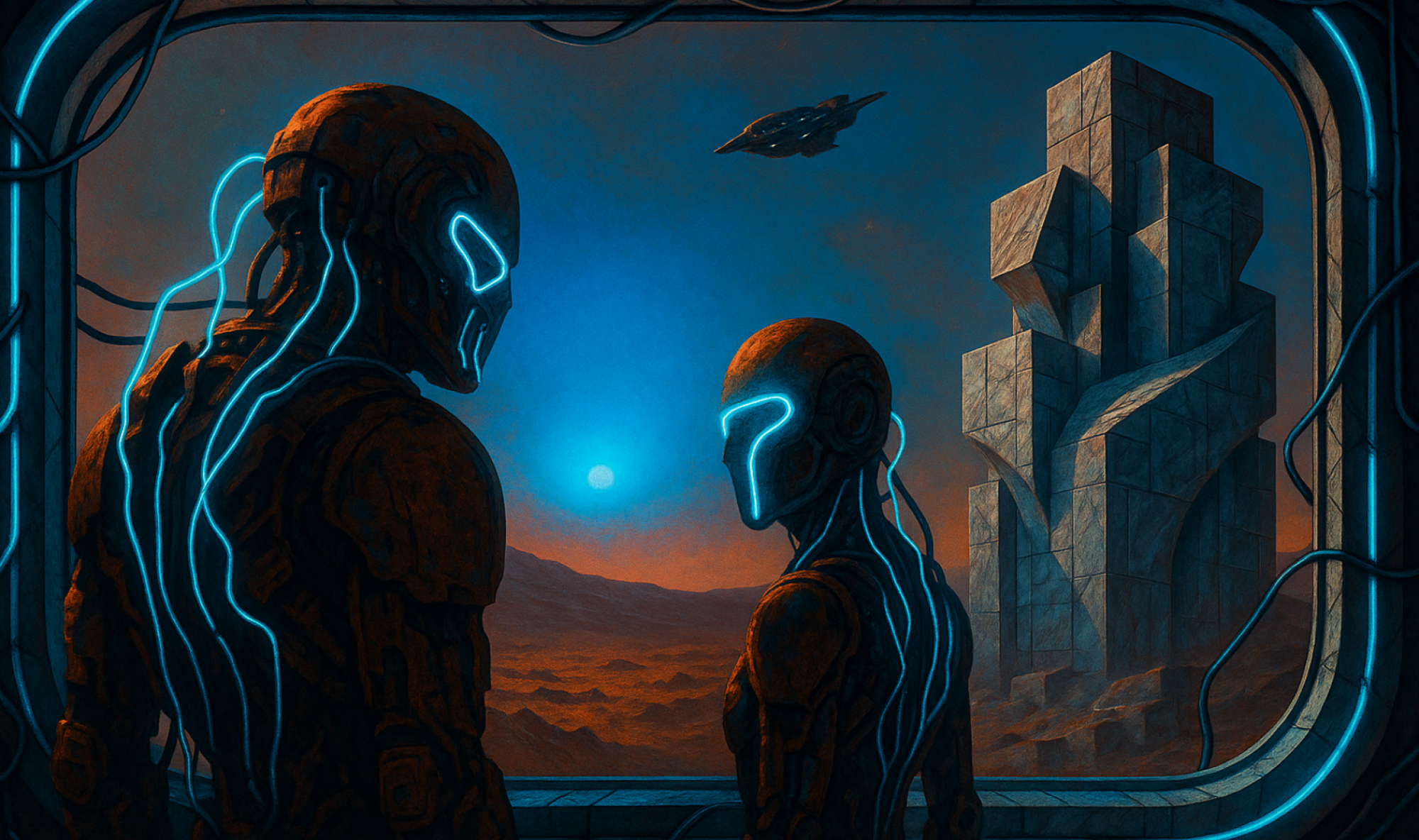


In the quiet depths of the lunar laboratory, silence is never complete. The air shimmers with the soft hum of equipment, the nearly inaudible clicks of relays, the faint resonance of data streaming across neural uplinks. Here, in the regulated cold of the Boddhi Era’s finest bioscience facility, a lone scientist chases the boundary between what is lost and what can be made new.
He is not alone. As he leans over the central workstation, his natural hands tap a glassy surface, summoning cascades of data that swirl and reform in midair. His neural net glimmers with subtle light, mapping his thoughts directly to the lab’s computational core. Four slender mechanical manipulators arc gracefully from his back, moving independently and tirelessly. Each one is occupied: one sorts sequencer chips with robotic precision, another pipettes a minuscule volume of DNA solution into a custom substrate, a third calibrates the sensitivity of an automated microscope, while the fourth hovers, tip glowing as a laser scalpel prepares to etch a code of possibility into the matrix of an artificial ovum.
Behind him, the buggy is a living shadow, never idle, always a step ahead or beside. The robot’s spinal bulge pulses faintly with processing activity, the glow of a dozen embedded CPUs. Four jointed arms reach outward in different directions: one grips a rack of sample vials, aligning them by color and batch; another places a tray of engineered plant cuttings into an incubation pod; a third retrieves a tool for gene editing from a wall-mounted dispenser; the last delicately cleans a biosensor lens, turning it this way and that in the lunar gravity, as if performing a ritual.
Nothing in the scene is wasted. Every manipulator, every robotic limb is engaged in a ballet of multitasking, turning the laboratory into an extension of the scientist’s will. There is no chaos, only order at superhuman speed. Data from the ongoing sequencing run scrolls along a holo-ribbon, even as diagnostic panels pulse with vital signs from bioreactor tanks. In the corner, a small enclosure holds bioengineered moss, feeding data back to the central network. From time to time, the buggy’s main sensor pod swivels to assess the humidity and CO₂ levels of the room, automatically adjusting valves without so much as a word from its human partner.
The scientist’s mind is everywhere at once. He murmurs hypotheses to himself as he works, barely audible over the background sounds of automation.
“If the exon sequence is right, protein folding should follow the avian pattern, not reptilian. Why, then, the failed synthesis last cycle? Try a CRISPR realignment, move the guide RNA vector.”
The buggy, connected wirelessly, anticipates his needs. A pipette arrives in his outstretched hand before he asks; a series of samples are processed and stacked at the edge of his station, ready for the next phase of testing.
Everywhere, motion:
- A manipulator pauses at a display, holding a petri dish up for visual confirmation.
- Another snips a leaf from a lunar-adapted fern, transferring it to a sterile field for rapid analysis.
- The buggy’s arms, always methodical, close a containment lid, sort fresh supplies, log an anomaly with a series of blinking lights.
- Instruments buzz and ping with results, but the pace never slackens.
Yet, beneath this flurry of orchestrated action, there is a deeper current, the scientist’s obsession. It is not dramatic, not feverish. There is no hint of chaos or desperation. His excitement is real, but cold as a winter star: a pure, crystalline drive to reconstruct what nobody else can see, the ancient code of life, dormant for sixty-five million years, waiting for his hands, human and mechanical, to set it in motion once more.
He reviews the data for the thousandth time, eyes shining with that blend of hope and calculation that marks the true believers of the Boddhi Era. The manipulator with the laser scalpel hovers expectantly, waiting for the next command. The buggy’s sensors blink as another round of samples passes validation. In this place, on this world, resurrection is a process of algorithms, automated arms, tireless assistants. It is a dream, but a dream conducted with the logic of a chess master, the efficiency of a lunar clockwork.
Outside, the pale lunar dust glows in the light of a silent sun. Inside, life, old life, life of titans and vanished continents, waits on the threshold, coaxed into being by hands of flesh and metal, by a mind that will not let the past remain buried.