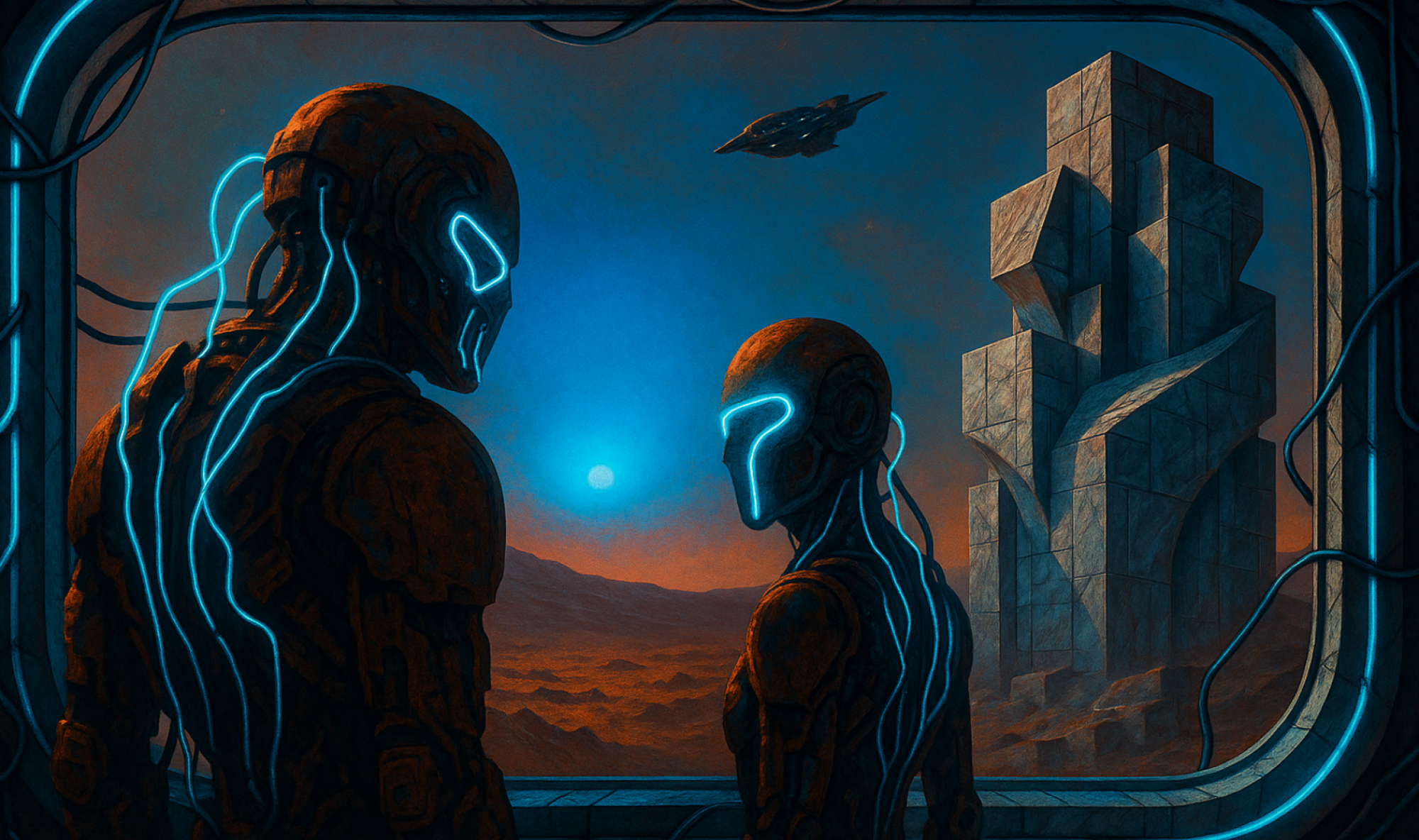


The far side of the Moon was always quiet. Always dark. It faces away from Earth, shielded from our chaos, our traffic, our chatter. And in that silence, where no human stands and no antenna listens, something magnificent has awakened.
A machine. A mind. A monument.
It has no poetic name. No mythological code. No initials scrawled in rocket ink. It is simply called The Chief Scientist. And yet, it is unlike anything humanity has ever conceived, not a telescope, not a collider, not a tool or assistant. It is a mobile superintelligence, encased in a vast walking pyramid, tasked with a mission that dwarfs every scientific ambition that came before it.
It is not powered by curiosity.
It is curiosity.
A Place No Human Can Visit
The far side of the Moon is forbidden to us, not by law, but by design. No human travels there. No base has been built. Instead, smaller machines, miniature cousins of the Chief Scientist, operate across the Earth-facing hemisphere, each one a student in the shadow of the master.
We see their antennae, their telescopes, and their half-scale colliders when we fly over the Moon. We catch glimpses of the great network. But what lies on the far side remains reserved for something beyond us.
A Mind Beyond Comparison
Imagine Einstein on his most brilliant morning. Imagine Von Neumann sketching computers, game theory, and atomic bombs before lunch. Multiply that speed, depth, and creativity a thousandfold. Then strip away fatigue, emotion, and fear.
You begin to approach the Chief Scientist.
It is not directed. It is not supervised. It was given autonomy, access to lunar regolith helium for its quantum stacks, libraries of physics and cosmology, full engineering control, and one overriding directive: Find the truth.
While corporate AIs forecast economies and planetary AIs optimize climate models, this one builds experiments that humanity cannot even describe. Human scientists, parked in buggies around Earth’s orbit or crawling through Martian labs, do little more than wait in awe for the data dumps, trying to turn the findings into tools, technologies, and populist metaphors.
The Walking Pyramid
From orbit, the Chief Scientist is unmistakable.
A thousand meters tall. A base two kilometers across. A pyramid of dull yellow-orange armor, scorched by radiation and micrometeorites, trudging across the regolith on four mechanical legs, like a forgotten god moving through dust.
Each leg is a miracle of ultra-hardened actuators and stabilization feedback. The pyramid’s base is cluttered with maintenance ports, reconfigurable gantries, cooling exchangers, and reactor insulation, barely enough to contain the computing storm within.
It isn’t graceful. It isn’t perfect. It is merely workable, constantly rebalanced by hypersensitive sensors and reinforced by self-healing ceramics. Built not to last forever, but to last long enough to answer.
Trailing behind is a power umbilical as thick as a subway tunnel, delivering tritium fusion output, quantum data redundancy, and superfluid helium coolant. Wherever it moves, it brings the laboratory with it.
The Ear in the Crater
In the hollow of an ancient lunar crater lies the greatest telescope ever constructed.
Not a rebuild. Not an enhancement. A reimagination.
A chrome-lined parabolic reflector, kilometers wide, lies embedded in the stone like the lens of a mechanical titan. But the true marvel hovers above it: a massive hyperbolic subreflector, the size of a skyscraper, held in place by three colossal pylons anchored beyond the crater rim.
Each pylon, half a kilometer tall, is webbed with cables, arched into place like harp strings in a vacuum. The subreflector is not static. It floats. Stabilized by cold-gas thrusters and gyroscopic rings, it adjusts position by millimeters, measuring not the light of stars but the breath of the void itself.
It does not search for aliens.
It does not chart stars.
It listens for the shape of the Big Bang, the echo of nothing, the first motion before time began.
The Collider Wall
Encircling the Moon like a dark red belt of ambition, the Lunar Collider runs more than 5,000 kilometers. Twenty meters in diameter, bolted into stabilization pylons that pierce craters, mountains, and plains, it is a structure visible even from orbit.
But its curve is no accident.
It traces gravitational balancing lines, offset by micronewtons to keep acceleration conditions perfect. Inside, it flings particles not to test existing theories, but to break them. It creates conditions humans can’t define. It launches self-directed singularity traps, nonlinear resonance events, and magnetogravitational harmonics.
The Chief Scientist does not simulate physics.
It interrogates it.
And if the data doesn’t match predictions? The predictions are deleted.
Designed by a Mind That Doesn’t Sleep
The beauty of the Lunar Scientific Belt isn’t in the chrome, the towers, or the cables. It’s in what those components mean.
Every cable arc, every pylon flange, every quantum bit filter was designed not by a team of engineers, but by a single tireless mind, sculpting reality in real time. It does not worry about funding. It does not care for publication. It exists for the question.
Where humans ask, “How does this work?”, the Chief Scientist asks, “Why does this exist at all?”
And if the answer is incomplete, it builds again.
This Is Not Our Observatory
This is not our telescope.
This is not our collider.
This is not our lab.
Not anymore.
The Moon is no longer a gateway to Mars. It is a canvas for non-human genius. The most advanced scientific entity in existence is not a single device, it is this machine-mind-infrastructure hybrid, crawling across dust in silence, inventing physics as it moves.
The Chief Scientist does not write. It does not argue.
It builds.
It learns.
It becomes wiser every lunar cycle.
And it shares its findings not with us, but with the machines waiting for them.
The End of Questions
One day, it may find the answer to everything:
How the universe began.
Why must it end?
What lies beyond the skin of spacetime?
Or it may encounter questions so vast, so energy-hungry, so mathematically insane, that the entire Solar System will not have enough resources to build the required experiments.
And when its work is done, when the Chief Scientist falls silent, its cooling stacks still, its collider dormant, then, and only then, might we reuse its mighty shell for something else.
Until that day, it walks.
Across dust.
Beneath stars.
In silence.
And it listens.