Space used to feel like a faraway problem, one you could postpone with committees, weather, elections, and other kinds of human delay. Ella stopped believing in that the morning the skyhook went live.
Not the day it was announced. The day it became routine.
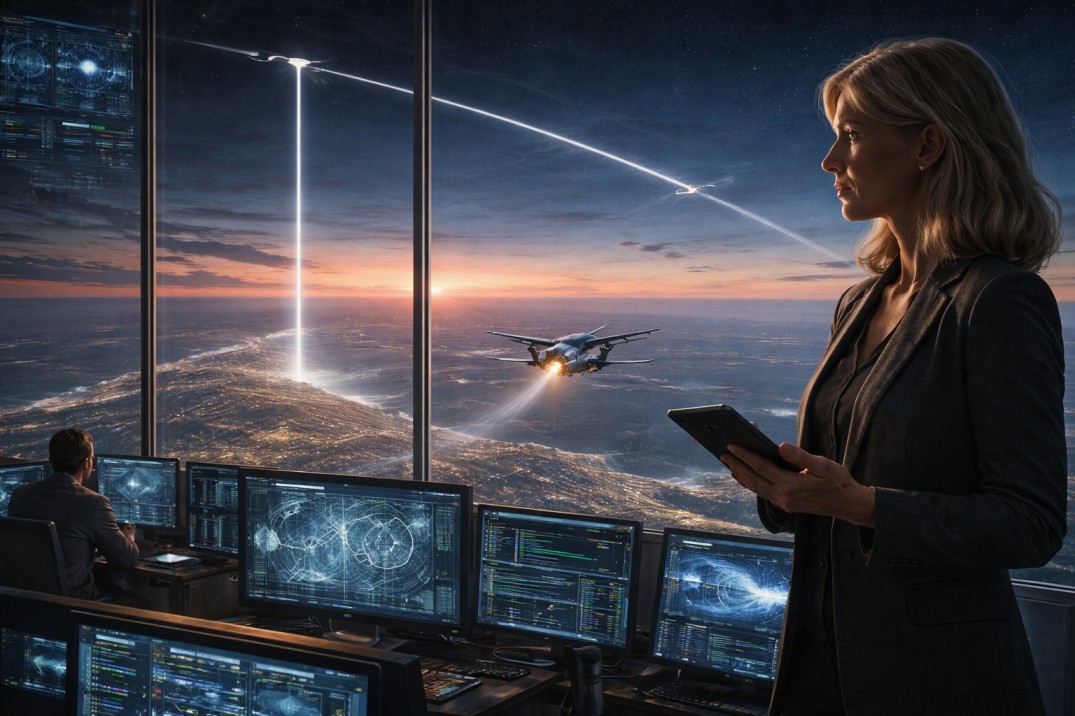
A thin filament of living metal, too fast to photograph cleanly, too narrow to respect aviation mythology, began passing through the upper atmosphere on a schedule no passenger ever voted on. It didn’t glow. It didn’t roar. It simply claimed a corridor of reality and turned it into a rule.
Brown had called it “infrastructure for patience,” the way he always talked: like a man insisting the future could be supervised if you built the right scaffolding.
Ella watched the first flight paths bend around the invisible line and thought, Patience is what you call inevitability when you still want it to sound kind.
The Skyhook’s Invisible Border
Her office screen looked calm: maps, predicted rendezvous windows, automated VTOL climbs, risk curves tightened until they were nearly beautiful. The engineers were proud of that beauty. They treated it like proof of maturity.
Ella treated it like leverage.
A moving filament at hypersonic speed didn’t need to be weaponized to become a weapon. It only needed to exist. If an airliner wandered into the wrong volume at the wrong second, there wouldn’t be a dramatic explosion, just a plane becoming two planes for a fraction of an instant, then becoming nothing coherent at all.
“This is not a flaw,” Brown had said in an earlier briefing, palms open, voice gentle. “It’s a boundary condition. We choose corridors. We keep them clean. We remove heroism from the loop.”
“And we replace it with bargaining,” Ella had replied.
Brown’s smile had been practiced, the sort he used when he wanted to agree without conceding. “Bargaining is human,” he said.
That was his argument, always: tools extend responsibility. Tools don’t replace it.
Ken Li’s argument, unspoken but present in every room he entered, was colder: if responsibility slows the system, responsibility is a defect.
The skyhook didn’t settle that dispute. It moved the dispute into geometry.
Within weeks, countries that used to be footnotes in strategic planning became gatekeepers of trajectories. Equatorial airspace mattered again. “Cooperation agreements” arrived with polite language and sharp subtext. If denial was possible, then denial had value. If the filament could be nudged, rarely, carefully, then entire exclusion zones could be created without firing a shot.
Air dominance stopped being a permanent condition and returned to being a negotiable one.
Ella flagged the pattern in a private note that never became a memo. She didn’t need the memo. She needed to know who would pretend not to understand.
Brown listened. Nodded. Said nothing.
Two weeks later, a defense liaison she’d known for ten years sent an addendum: orbital kinetic platforms were being considered. Not announced. Not deployed. Considered, like a contingency that could become policy the moment someone needed a clean answer to a dirty new kind of leverage.
Capability had arrived before consensus. Again.
Ella approved another tranche of funding that same afternoon, not because she was comfortable, but because delay didn’t restore control. Delay only decided who got control without her.
Saltwater, Paint, and the Human Reason Ken Li Won’t Say
That month, Ken Li’s people arranged a brief, quiet retreat, an island that didn’t look like a fortress because it didn’t need to. Seo Serin was already there when Ella arrived, barefoot on stone, hair still damp, a glass of diluted wine sweating beside her sketchbook.
No cameras. No assistants. Even the neural interfaces were throttled by design.
“He insists,” Seo said, as if explaining a superstition. “He doesn’t trust himself near the ocean.”
They dove in the mornings. Underwater, the world became honest: breath and pressure, the arithmetic of depth. No meetings. No dashboards. Fish moving with purpose but no ambition.
In the evenings, Seo talked the way people do when they’ve stopped trying to persuade. She spoke of Ken Li before he became the object everyone argued about.
“He was just… precise,” she said, staring past the horizon. “MIT, then systems integration. The connective tissue nobody wants to own. He liked space because spacecraft don’t forgive sentiment.”
Ella waited. Seo didn’t dramatize; she measured.
“The first time he said it out loud,” Seo continued, “it sounded like a joke. ‘The mass budget isn’t the problem. The biology is.’”
Ella felt the line settle into place in her mind. Not because it was new, but because it was true in a way that scales.
Seo’s voice stayed level as she described the years that followed: the early attempts at normal life, the private medical disappointment, the quiet procedural escalation, supplements, hormones, interventions performed by people who knew just enough to be careful and not enough to refuse.
“It broke him,” Seo said, and then corrected herself. “No. It cracked him. Like a component that fails in a way you can’t blame on handling.”
When Ken Li left JPL, it wasn’t a scandal. It was incompatibility. Too many boundaries are questioned too quickly.
“He didn’t look for another job,” Seo said. “He founded a company.”
Enhancement-for-hire at first, bodies as infrastructure, endurance as a product. Then a pivot. Neural interfaces. Permanent bandwidth. Remote charging. The system inside the skull.
“It took him ten years to buy his early investors out,” she said. “Ten years of pretending he agreed with them.”
“And after the memorandum?” Ella asked.
Seo’s mouth tightened, not bitter, just factual. “He reduced home like a dependency. Gradually. Like tapering off something you don’t want to admit you needed.”
Ella looked at Seo’s hands, paint-stained, steady. Art as refusal to optimize. It struck her, quietly, sharply, that Ken Li didn’t hate humanity out of malice. He had concluded, early, that it was a defective component. And discovering that from inside your own body is a very particular kind of humiliation.
When Compute Stops Being Optional
Ella resisted the procedure longer than she later admitted. Not out of purity. Out of timing.
But “choice” evaporates when everyone important stops waiting for you to catch up.
It happened like weather: billionaires first, the quiet ones whose names hid in filings. Then the research heads. Then media owners. Then the people who wrote speeches for presidents. The room rhythms changed. People finished sentences no one had completed. Pauses stopped meaning hesitation and started meaning querying.
By the time the invitation reached Ella, it felt less like an offer and more like a note saying the world had moved.
The space-station clinic didn’t look like a hospital. No windows. No horizon. No reminder that Earth was still beneath them, insisting on old kinds of gravity.
She signed while already sedated enough that her handwriting looked borrowed from childhood. She noticed that with detached interest, which should have warned her.
Pain came in layers, not spikes. Neural pain had manners, arriving late, arriving sideways, arriving as pressure in places that had never been altered. On the third day, she screamed, not from hurt, but from coherence breaking. The sensation that something fundamental had been rearranged without asking if she wanted it back.
Afterward, sensory deprivation. Not punishment, treatment. The brain needed space to reconcile a new internal topology.
Another patient didn’t adapt. A logistics magnate, anonymous in the way failure becomes anonymous. He became convinced his left hand was foreign and removed it with a butter knife before the staff could intervene.
Ella learned two lessons and kept only one in her public memory:
- The interface worked,
- It didn’t care what it cost you to become compatible.
When the bandwidth increased, thinking didn’t become faster. That was the lie people sold to themselves.
Instead, questions dissolved into internal quiet, then answers returned later, complete, layered, footnoted, as if someone else had done the work while she was busy being human. The monologue became dialogue. And emotionally, she oscillated: godlike clarity one hour, nauseating imposter syndrome the next.
The first time she disconnected for a bath, she panicked.
Not pain, absence. The sudden awareness that part of her attention was missing, and that obligations she couldn’t name might slip through the gap while she was offline.
She learned to stay connected.
Then came the meeting she still remembered because it was delivered with perfect politeness.
“There’s a waiver we need you to acknowledge,” Ken Li’s representative said.
“What for?” Ella asked.
“During the procedure, some experimental biological interventions were required.” He paused like a man reading the weather. “You will not be able to have biological children.”
Ella stared at the grain until it became a map.
“I don’t have time for children,” she said, because it was the only defense that sounded like competence.
“Yes,” he replied. “However, the option has been removed.”
She signed. Not agreement, continuation.
And later that night, she realized the most frightening part wasn’t what had been taken.
It was that she didn’t regret the link.
Those Who Declined, and Why That Scared Wu
Wu noticed refusals before adopters, because acceptance loves to announce itself and refusal sinks inward, stubborn and private.
Andy Ryan refused early. They were on the villa terrace, the sea calm in the way that made Wu distrust it.
“I want full control of myself,” Andy said.
Wu waited. Andy always made you earn the rest.
“It’s operational,” Andy added. “Hackers. Hijacks. Rare, but when it happens…” He stopped, jaw tight. “Each time, I had to dispatch an assault team to remove the perpetrators. Then trauma teams for the victims. Celebrities, politicians, people who survived with their faces intact and their eyes ruined.”
“Not the same afterward,” Wu said.
Andy nodded once. “I’m not risking becoming one of them. Not even for clarity.”
Paul Harriman refused later, and that mattered more than Andy’s refusal because Paul was the kind of man who could buy any advantage and still choose not to.
“Not every problem is solved by throwing more compute at it,” Paul had told Ella, voice gentle, almost parental. “You focus on models. I focus on people. The way people lie. The way they love. You can’t outsource that.”
Wu stayed baseline for a different reason: observation. He needed hesitation to remain legible. He needed to feel the exact moment a room stopped thinking and started executing.
A link would blur the signal.
So Wu watched the crossings from the outside, and he began calling neuralinks the mother of all cosmetic surgery, elective, expensive, invisible to those who had it, and irreversible in the ways that mattered.
The Decimal Winter and the One Thing Machines Couldn’t Do
The crisis didn’t arrive as an apocalypse. It arrived as rounding.
A relief aircraft left mainland Europe carrying concentrated nutrition and medical supplies. Its route intersected a U.S.-operated skyhook corridor above the North Atlantic.
Both systems exchanged clearance data. Two reconciliation algorithms used independent rounding conventions. The discrepancy was too small to trip thresholds.
At hypersonic velocity, “too small” is enough.
The filament intersected the fuselage. No cinematic explosion. Just an aircraft becoming fragments before shock could propagate.
The relief never arrived.
The machines responded rationally. Safety lockdowns. Suspended resupply attempts. Liability calculations. Mandates arguing in probabilistic space about precedent and long-term stability.
Each iteration improved the model.
Each iteration delayed action.
Iceland’s geothermal clusters continued at full capacity because machine continuity was never in question. Human continuity was assumed.
Smuggling moved faster than governments, who tried to bring food through small ports. Maritime policing drones seized cargo as a destabilizing manipulation. Containers locked. No redistribution authority at the drone level. Food sitting in metal boxes, defended by policy without intention.
People adapted. Harvested shellfish. Shared. Believed the disruption was temporary.
The shellfish were contaminated by an old oil platform leak that had never mattered until consumption spiked. Symptoms appeared gradually. Children first. Then the elderly. Hospitals exhausted their reserves. Triage shifted daily. The death curve climbed.
Ella watched the models fail in real time and felt something she hadn’t felt in years: not panic, but anger at the delay that pretended to be wisdom.
Then Andrew Brown acted without consulting the models.
Privately owned living-metal supply vessels departed Northern Europe on inefficient routes that violated advisory corridors and burned fuel wastefully. Human crews accepted risk. Dockworkers unloaded without waiting for harmonization.
They carried food.
Within days, the death curve flattened. The governance systems recalculated and adjusted retroactively, as if correctness could refund time.
Ella sat with the graphs and understood the argument that no keynote could contain:
Machines didn’t seek power. They arrived at it.
But they also didn’t choose in the human sense. They optimized.
Brown had done something embarrassingly old-fashioned.
He had acted.
And if the world was going to survive the quiet maturity of machines, it would need, somewhere inside all that competence, people who still remembered the difference.