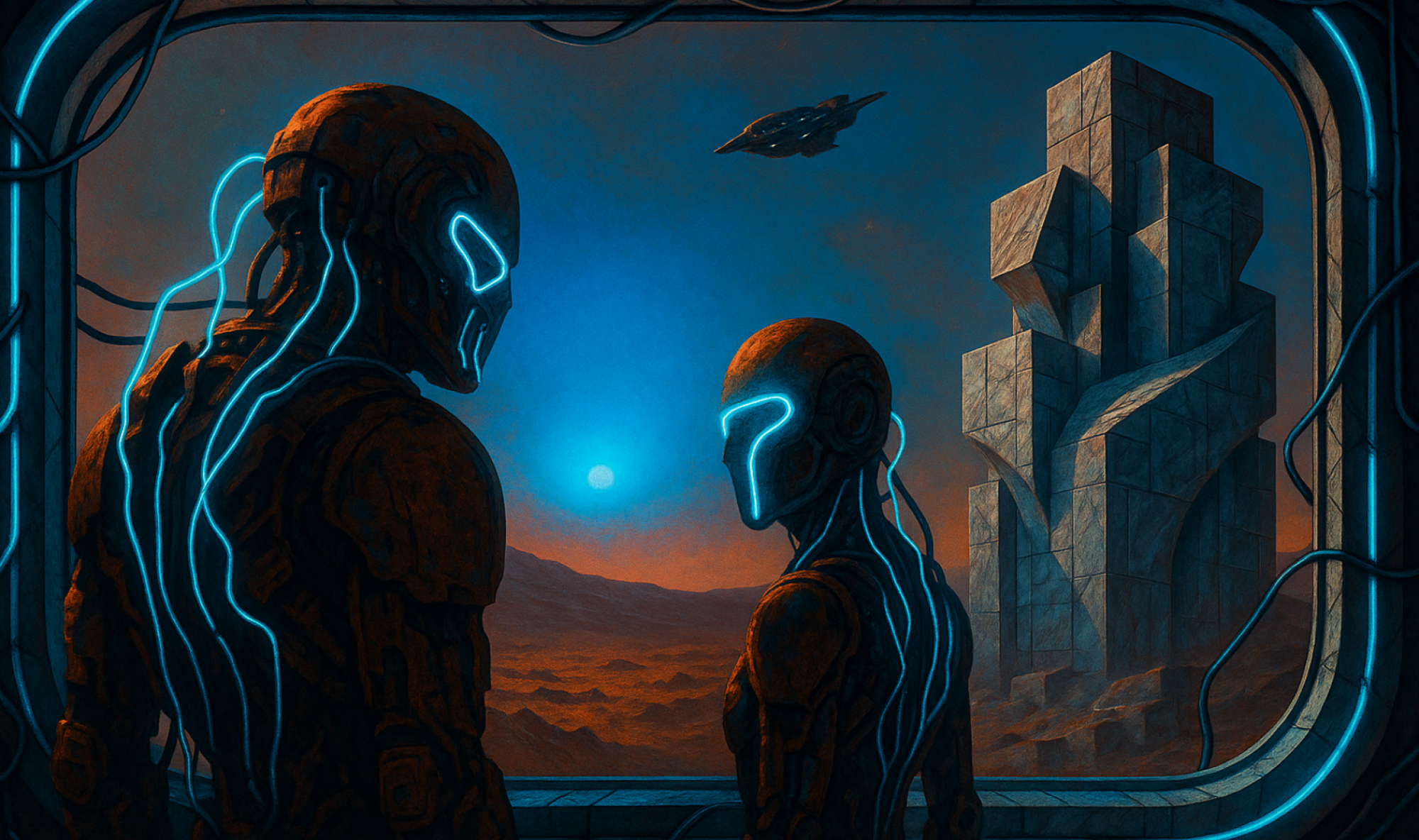

Leaving a World That Had Finished With Me
The invitation arrived without ceremony, which was how important things tended to happen in the Towers. There was no preface, no justification, no attempt to persuade me that this was an opportunity rather than an interruption. The voice spoke plainly, almost tentatively, as if unsure whether it was allowed to ask.
Would I like to leave my apartment and spend three years on an ocean platform near Australia?
The question did not feel hypothetical. It felt misplaced, as though someone had accidentally inserted a line from a different life into mine. I stood and pressed my palm against the wall, grounding myself in a surface that felt warmer than it should have. The wall pulsed faintly, as if acknowledging the moment.
Outside, the garden continued as usual. Laughter drifted upward. A fountain sputtered, corrected itself, and sputtered again. Miniature horses shifted their weight. Monkeys argued over something trivial. The Towers were intact. Perfect. Finished.
For the first time in months, I felt tension instead of numbness.
When the Pattern Breaks Quietly
Nothing in the Towers prepared you for choice. Comfort had removed the need for it. Every day arrived already shaped, already resolved. You moved through routines because they asked nothing of you, and in return, you were allowed to remain.
The invitation broke that pattern without violence. It did not demand urgency. It did not threaten consequences. It simply existed, creating a space where indecision could no longer hide behind routine.
I could smell salt on the wind when I stepped onto the balcony. This was impossible. The ocean was far away. But the scent lingered, faint and insistent, as though the future had learned how to leak through narrow openings.
The dead crab. The wilted flower. The deepening blues that no longer matched the Towers’ palette. None of these had been accidents. They had been symptoms.
“Yes,” I said aloud to an empty room.
“Yes, I think I will go.”
Departure Without Luggage
The morning of departure felt different, though nothing obvious had changed. The ceiling’s blue was steady, uncharacteristically decisive. The Towers felt like they were holding their breath.
I walked my usual path through the garden, but the ritual had lost its anesthetic effect. It felt like a farewell rather than a routine. Tenma-san was already there, polishing a sword with the calm focus of someone who had always known this moment would arrive.
“You leave today,” he said.
It was not a question.
Waka Murasaki stood beside him, lavender sleeves stirring in the air. When she touched my arm, her synthetic warmth surprised me. It felt deliberate. Considered.
“Return changed,” she said softly.
The animals watched me with their domesticated patience. One of the horses nudged my pocket, expecting fruit. I obliged, stroking its mane, letting the warmth anchor me briefly in the present. A monkey paused in its movement, ribbon clutched in its hands, and regarded me with unsettling seriousness before disappearing into the hedges.
At the quadcopter pad, there was nothing to bring. No luggage. No compartment for memory. I placed my hand on the contract projection, feeling the soft vibration confirm my agreement.
As the craft lifted, the Towers receded into geometry, marble, and garden arranged into a hive that no longer required its occupants. For a moment, sunlight reflected off my old apartment window, glimmering like a memory that refused to stay fixed.
Then the quadcopter turned toward the coast.
The Sea as Threshold
The ocean revealed itself gradually, not as a sudden expanse but as a living gradient. Navy layered beneath turquoise. Sky blue hovering near the surface. Blues I had not seen in years, deep and restless, pulsing with intention.
The sea did not feel welcoming. It did not feel hostile either. It felt indifferent in a way the Towers never had. Indifference, I realized, could still contain purpose.
By the time the platform appeared, it was not entirely solid. Its outline shimmered against the horizon, resolving and dissolving as if undecided about its own existence. The closer we approached, the more I felt pressure behind my ribs, a subtle gravitational pull, as though the ocean itself were exerting influence.
Arcadia did not resemble a building. It resembled an organism paused mid-construction.
Arrival at the Edge of the Map
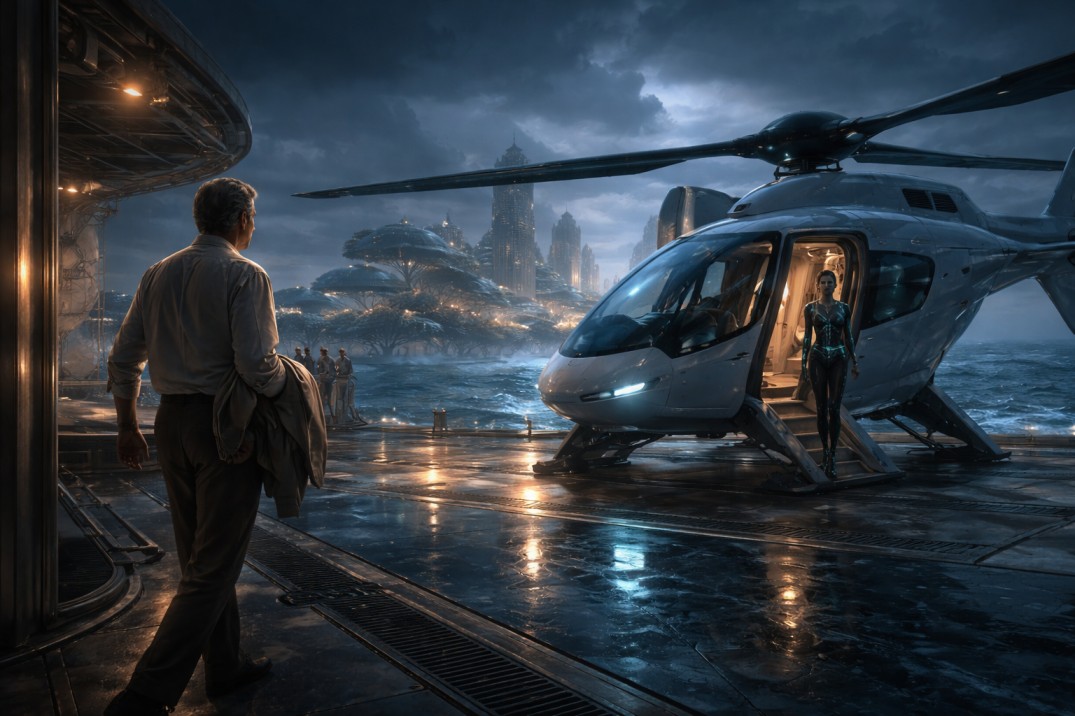
The landing pad vibrated beneath my feet. The structure groaned faintly, a sound too organic to be purely mechanical. The air tasted different, humid, ionized, alive with a faint electrical tension that made my skin prickle.
The woman who greeted me did not look entirely human. Her suit clung like a second skin, patterned with structures that fluttered when she inhaled. Pale metallic implants traced her skull, catching the light. Her eyes reflected the sea too clearly.
“We expected you earlier,” she said.
“I wasn’t aware there was a schedule.”
“There always is,” she replied. “It just isn’t always communicated.”
We walked along a narrow corridor suspended directly over the water. Waves crashed below, shaking the metal beneath our feet. When I touched the railing, it felt warm, retaining heat like living tissue.
Condensation gathered and slid along the walls. Light strips cast shifting blue-green hues that refused to settle. Every surface seemed to breathe.
We passed a glass-walled chamber. Inside floated a pale silhouette, human in outline but altered beyond familiarity. Webbed fingers brushed the glass from within. An eye opened.
I stopped.
“Alive enough,” my guide said, without slowing.
A Place That Does Not Pretend
My quarters were Spartan. Clean. A bed. A console. A single circular window opening onto an uninterrupted ocean. The water churned violently outside, yet the room remained eerily still.
“If you hear the walls breathing,” the woman said before leaving, “ignore it.”
Sleep came uneasily. I woke to a rhythm that might have been the platform’s pulse, or my own. When I touched the wall, it was warm, textured, pulsing faintly beneath my palm. I withdrew quickly, unsettled by the intimacy of the contact.
Arcadia did not pretend to be inert.
Obsolescence as Qualification
The briefing room hummed softly. Three researchers sat around a table beside a massive tank. Inside floated a fully transformed subject, elongated limbs, widened ribcage, iridescent skin. Its eyes opened slowly, silver and reflective.
“You were recruited because you are obsolete,” the lead scientist said.
The statement was not cruel. It was precise.
“Obsolescence removes pressure,” he continued. “It frees the psyche.”
They spoke of divergence. Of transhumans reaching mechanical limits. Of aquatic transgenics surpassing them. Of humanity dividing not ideologically, but biologically.
The woman from earlier stood beside the tank, watching the figure inside with something that might have been pride, or envy.
“To guide,” she said when I asked about my role. “And later, to contribute.”
When the creature pressed its palm against the glass, I felt the echo of pressure against my own hand. Memory had become tactile.
The lead scientist used a word that did not belong here. Aberration. Casually. Incorrectly.
The woman corrected him with her gaze. Told me to ignore terminology. Old frameworks.
But something in her expression betrayed unease.
Thinning Boundaries
When I returned to my room, the ocean outside was brighter, sky blue streaked with brilliant turquoise, as though it had crept closer during the briefing. I pressed my hand against the glass. A faint vibration pressed back.
I did not feel fear.
I felt thinning.
Not death. Not transformation. Just the erosion of a boundary I had assumed was permanent. The person I had been was not disappearing. He was dissolving, slowly, into a future that no longer needed him to remain intact.
The Towers had preserved me.
Arcadia intended to use what remained.
And the sea, vast and indifferent, waited patiently, its currents already moving beneath my skin.