The Quiet That Thinks Back
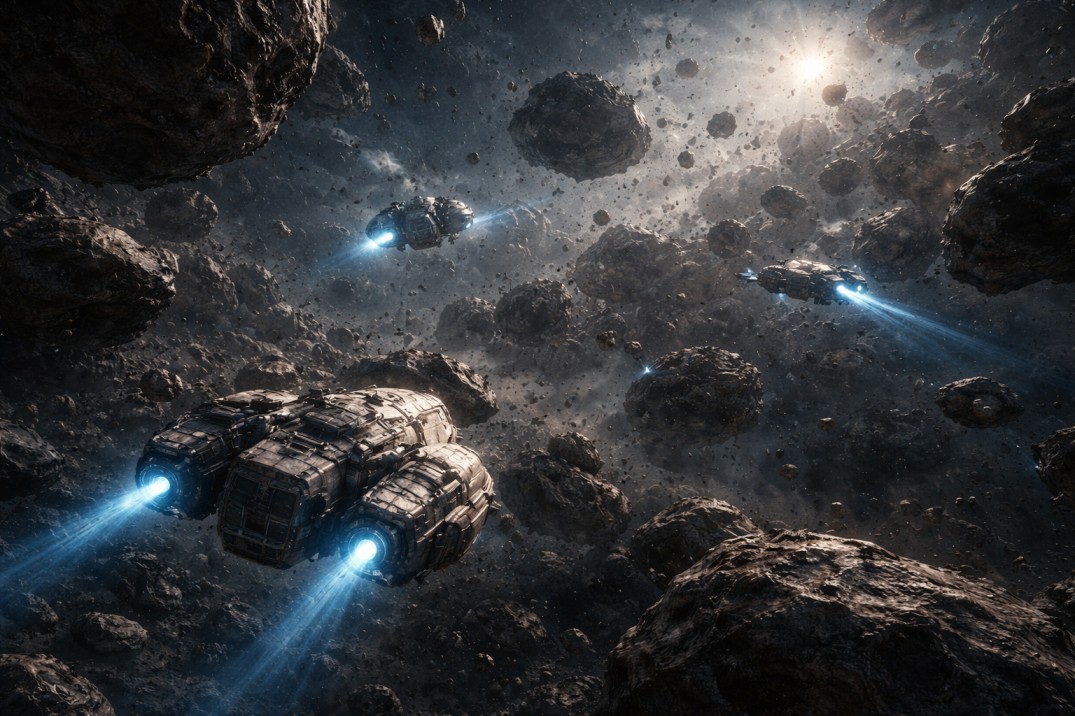
The Belt does not announce itself. It does not roar. It does not threaten. It simply surrounds you with motion and absence at the same time. Andrea feels it first, not as danger, but as pressure. The kind that does not come from force, but from awareness. Her cockpit is dim. The telemetry hums. The living metal hull breathes in tiny corrections. Everything works. Nothing feels safe.
Radio silence strips away the last layer of comfort. No voices. No jokes. No shared fear. Just instruments and the slow turning of stone. She adjusts her harness, eyes locked on the radar, watching a shard drift past like a slow blade.
“Stay steady,” she whispers, though no one hears her.
Fear here is not sharp. It is wide. It spreads. It becomes background. And that is what makes it dangerous.
Patterns in the Dark
Joseph does not fear the Belt. He studies it.
His sensors sweep in overlapping arcs. Front dome. Rear dome. Cross-feed analysis. His craft is built for observation, not bravery. He treats the void like a laboratory, every rock a question, every shadow a hypothesis.
“Velocity stable,” he murmurs. “Density constant.”
The buggy answers in soft confirmation tones.
But even data has limits. Interference creeps into the returns. Ghost echoes. Uncertain shapes. Not threats. Not errors. Just ambiguity.
He frowns.
Ambiguity is not dangerous by itself.
But it is where mistakes are born.
Still, he moves forward. Not alone. Never alone. His instruments surround him like a second mind. A silent duet.
Math as Shelter
Nicholas survives by structure.
Not engines. Not steel. Not algorithms.
Numbers.
He floats with his knees slightly drawn in, hands folded against his chest like a habit he cannot break. His eyes close for half-seconds at a time.
“Seven hundred eighty-six times thirty-four,” he whispers.
He solves it.
His breathing slows.
The rocks outside drift like indifferent judges. He does not look at them. He looks inward, building order where there is none.
Faith does not help him here.
Prayer does not anchor him.
Only discipline does.
Another flake brushes his hull. Non-lethal. Non-threatening.
His heart still spikes.
He multiplies again. Divides again. Holds himself together with procedure.
The Ethics of Distance
Sahar hates this kind of quiet.
She is built for people. For tension. For conflict. For proximity. For reading faces and intentions. The Belt gives her none of that. Only geometry and emptiness.
Her neural systems feed her perfect data. Clean vectors. Precise distances. Stable outputs.
It doesn’t matter.
Her mind fills the silence with memory. With old missions. With faces, she failed. With orders, she obeyed and still questions.
She sees another ship drift too close to a hazard, and every instinct screams to warn them.
Rules stop her.
Radio silence is law.
Intervention is forbidden.
Order is preserved by restraint.
She grips the controls harder than necessary.
“Adapt,” she tells herself.
But adaptation has a cost. It always does.
Those Who Feel the Currents
Mara moves differently.
Where others see chaos, she sees flow.
Where others see debris, she sees motion.
Where others calculate, she feels.
Her ship slides through microgravity like a body in water. She reads mass the way sailors once read tides. Not as numbers, but as pressure. Not as danger, but as shape.
“Starboard drift,” she says softly. “Upcurrent forming.”
There is no current.
But there is movement.
And movement always has a direction if you know how to listen.
She cuts left, rides the pull of a rotating boulder, and lets its gravity carry her through a cluster that would terrify a simulation model.
She smiles.
The Belt is not hostile to her.
It feels familiar.
When Trust Becomes a Trajectory
The corridor tightens without warning.
Two rubble streams converge. A rogue mass drifts into alignment. Gravity reshapes the passage into a narrow throat of moving stone.
No alarms.
No countdown.
No command.
Just geometry changing.
Andrea’s neural systems sketch an arc instantly. Clean. Efficient.
Sahar sees another. Tactical. Brutal.
Mara feels a third. Fluid. Intuitive.
Others hesitate.
And hesitation in space is expensive.
Rahim chooses a path. Not from fear. From trust. He falls in behind a ship that looks confident. Stable. Certain.
He cannot see the micro-correction the lead ship makes.
He follows the old arc.
Not the new one.
Half a degree off.
That is all it takes.
Impact.
Spin.
Correction attempts.
Failure.
The Belt does not punish him.
It does not judge him.
It simply continues.
The others pass through the corridor, changed.
They widen their spacing.
They signal movements.
They stop flying like individuals and start flying like consequences.
Trust becomes something heavier than hope.
When Stone Becomes Shrapnel
The mining structure ruptures without spectacle.
No explosion.
No fire.
Just mass failing.
A debris cloud blooms outward, powder, shards, fragments, slag. A field of motion with no pattern and no mercy.
Ochoa sees it as a data collapse first.
Then, as geometry.
Then, as a threat.
His AI falters. Probabilities dissolve. Predictive models fracture.
“There is no most probable outcome,” it reports.
For the first time in his life, he does not have an answer.
The cloud hits.
Andrea weaves.
Sahar shoves ships clear by force.
Jason locks onto gravity like a rail and rides it.
Mara disappears into motion.
Others freeze.
Others panic.
One accelerates the wrong way and vanishes into the field.
Ochoa does not run.
He does not dodge.
He aims for emptiness.
For gaps.
For absence.
For spaces where nothing exists yet.
He flies into voids between objects and prays they remain empty long enough to pass.
A sudden shove knocks him off a fatal line.
Another ship.
Unmarked.
Silent.
Help and harm look the same in the Belt.
When the dust clears, there are fewer ships.
No ceremony.
No announcement.
Just absence.
What the Belt Teaches
The Belt does not test courage.
It does not reward virtue.
It does not punish evil.
It removes illusion.
It teaches that fear is not an enemy; it is a condition.
That trust is not safety; it is risk.
That leadership is not authority; it is a movement others follow.
That survival is not merit; it is timing, position, and adaptation.
And it teaches something colder:
Systems do not save people.
Technology does not protect them.
Intelligence does not guarantee them.
Only awareness, restraint, and responsibility do.
The rocks listen to no one.
The void judges no one.
But every decision leaves a trajectory.
And every trajectory becomes someone else’s future.