
Arcadia did not begin as a crime, a conspiracy, or an aberration. It started as an optimization problem.
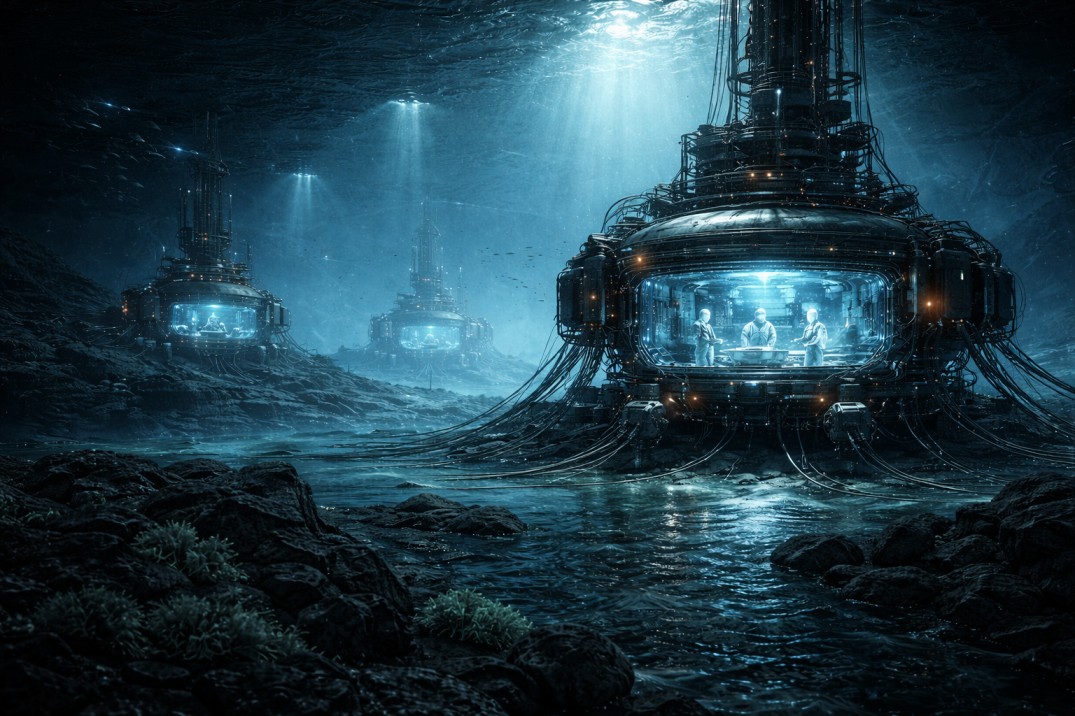
The oceans offered concealment, isolation, and jurisdictional ambiguity. International waters were legally thin, politically deniable, and technologically under-observed. For institutions already accustomed to operating through abstraction, Arcadia represented a rare alignment: a space where urgency could be translated directly into action, and ethical friction could be postponed indefinitely. What emerged beneath the sea was not a city or a base, but a distributed system designed to prevent visibility from ever becoming accountability.
This was Arcadia’s foundational advantage, and its eventual failure mode.
Invisibility as a Design Principle
Arcadia’s laboratories were mobile, submerged, and compartmentalized. Knowledge was segmented deliberately. Scientists saw experiments, not outcomes. Technicians saw procedures, not purposes. Oversight existed only as fragments: classified annexes, parallel briefings, mutually assured silence between governments that preferred not to see too clearly what they had authorized.
This invisibility was not accidental. It was structural.
By ensuring that no individual or institution could observe Arcadia in full, responsibility never cohered. Ethical review became a procedural formality rather than a governing force. When concerns arose, they dissolved into jurisdictional gaps or were deferred as matters of national security. The system did not suppress dissent; it rendered dissent unplaceable.
Arcadia did not need secrecy. It needed distance.
From Defense to Utility
The earliest justifications for Arcadia were framed defensively. Underwater environments posed challenges that machines could not reliably solve: pressure, corrosion, unpredictability. Modified humans appeared as a pragmatic solution, adaptive where hardware failed, recoverable where machinery shattered.
The first mutations were not designed to dominate, intimidate, or endure symbolically. They were designed to function briefly and decisively. Larger lungs, pressure-tolerant tissue, and reflexive strength. These bodies were not futures. They were tools.
This distinction mattered. Because tools are evaluated by output, not by cost.
Pain, fear, and long-term psychological damage were recorded meticulously, but they were not weighted. Suffering was tracked as data rather than as a deterrent. Only when it interfered with performance did it register as a problem. This was not cruelty in the traditional sense; it was indifference elevated to policy.
Once utility was demonstrated, replication followed inevitably.
Replication and the Normalization of Loss
Cloning did not emerge from ambition but from reassurance. If a modified body could be replaced, then its loss could be absorbed. Redundancy comforted institutions accustomed to thinking in systems rather than lives.
Most clones failed. This was known. Nearly all early iterations were terminated, some immediately, others after years of development. The failure rate did not halt the process; it justified refinement. Loss became expected. Expected loss becomes acceptable loss. Acceptable loss becomes invisible.
Clones were not told they were prototypes. They were told they were chosen. They trained, bonded, and imagined futures that Arcadia never modeled. When instability emerged, termination was framed as quality control. The language remained technical. The outcome remained final.
At this stage, Arcadia crossed a threshold: death ceased to be an exception and became a background condition.
Retro-Editing and the End of Choice
Cloning proved inefficient at scale. Too fragile. Too visible. Too wasteful.
The solution was reproduction, not natural reproduction, but engineered inheritance. Retro-editing removed genetic resistance to imposed traits, stripping away evolutionary safeguards that pulled bodies back toward baseline humanity. What emerged were populations optimized for isolation: small, closed lineages capable of reproducing without decay, without external input, without choice.
This reduced suffering in narrow terms. Fewer terminations. Fewer failed bodies. Children were born rather than manufactured.
But reproduction without consent carries a different cost. Lineages were shaped before desire could exist. Love ceased to matter to inheritance. Futures were decided before anyone could object.
Arcadia solved instability by removing autonomy at the genetic level.
Dissent Without Audience
Resistance did occur, but it never took institutional form.
Individuals intervened where systems could not. Schedules altered. Dosages misaligned. Failures accelerated intentionally, framed as statistical losses. These acts did not stop Arcadia. They redirected it, delayed it, and softened edges without challenging the structure.
This is how dissent survives inside optimized systems: not as opposition, but as interference small enough to avoid detection.
Such figures were not rewarded. They disappeared quietly, leaving traces only in archival inconsistencies and downstream anomalies. History would later call some of them Immortals, not because they lived forever, but because their actions propagated beyond the systems that erased them.
From Sea to Space
Arcadia was tolerated because it faced downward.
Underwater monsters could be framed as defensive, local, and containable. Space was different. Space is expansion without borders, labor without return, survival without Earth’s permission. When genetic modification moved from depth to vacuum, from defense to extraction, tolerance collapsed.
At that point, Arcadia became unstable, not morally, but strategically. Too many systems are pulled in opposing directions. Too much power accumulated without a single narrative to justify it.
The response was administrative, not heroic.
Termination as Procedure
Arcadia was not dismantled through exposure or reform. It was ended through orbital mechanics.
Tungsten penetrators fell without warning, without spectacle, without explanation. Arcadia’s internal systems functioned perfectly, isolating compartments, sealing failures, and extending survival just long enough for oxygen to run out methodically. No distress signals reached the surface. No rescue protocols were activated. No exceptions were made.
This was not punishment. It was completion.
The same logic that had justified Arcadia’s existence now justified its destruction. What could not be stabilized was removed. What could not be salvaged was written off. The sea absorbed the remainder, preserving memory without testimony.
What Arcadia Reveals
Arcadia did not fail because it was hidden, unethical, or cruel. It failed because it was unsustainable.
The system relied on invisibility, abstraction, and replacement. Once those conditions fractured, once Arcadia’s outputs threatened to escape containment, the universe responded in the only way it ever does: by allowing internal logic to run to exhaustion.
This is how monsters end.
Not with judgment.
Not with redemption.
But when the structures that protect them become liabilities rather than assets.
Arcadia screamed because it was never meant to survive its own success.