After the wave, survival stopped being a local problem and became a planetary one. There were no clean borders between disaster zones and safe zones, no clear line between those who needed help and those who would soon need it. Response was no longer a matter of speed or preparedness, but of endurance, coordination, and morale. Ships crossed oceans not because orders were clear, but because meaning was scarce. Hunger arrived quietly, reshaping behavior long before it ended lives. In this fractured landscape, logistics carried more weight than heroism, and even art was repurposed, not to inspire hope, but to keep people functional long enough for systems to recover.
This was not the age of victory. It was the age of keeping the world from coming apart, one decision at a time.
When Disaster Outgrows Its Responders
Every civilization trains for emergencies. It rehearses scale. It categorizes responses. Fire, flood, earthquake, riot. There are manuals for all of them, simulations refined over centuries of failure and iteration. First responders exist because most disasters fit inside expectations.
The great wave did not.
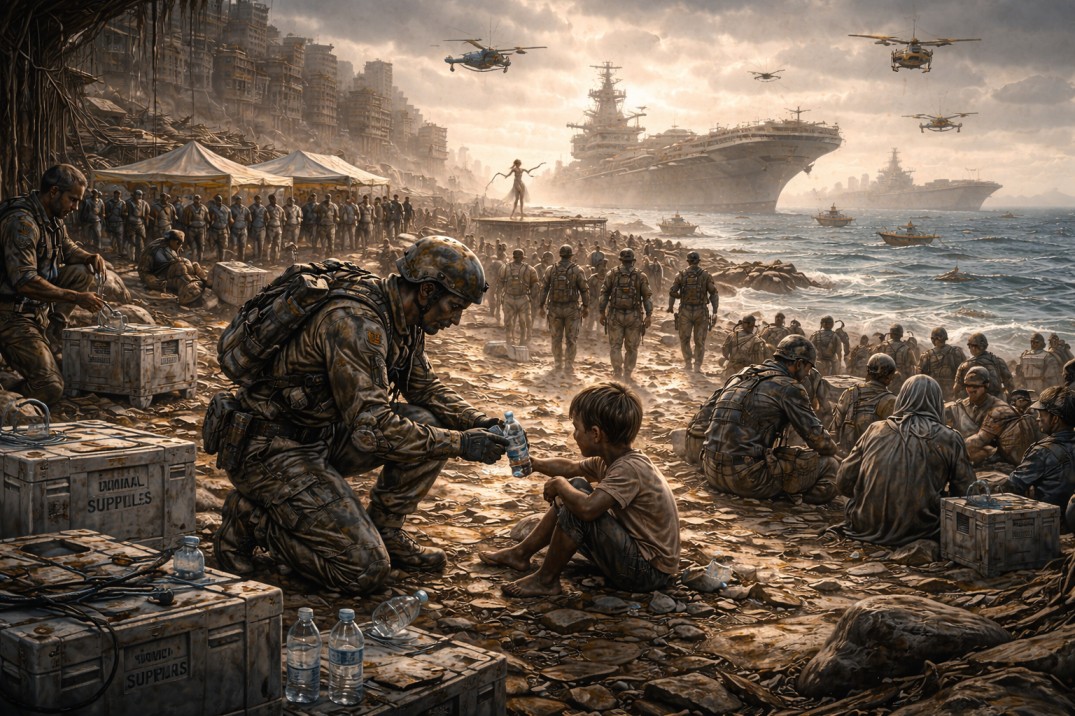
In smaller events, the response arrives with names and uniforms. Doctors with kits. Firefighters with machines. Police with authority. Smart animals. Autonomous units. The choreography is familiar, rehearsed, almost comforting. Larger disasters stretch that choreography but do not break it. Earthquakes, hurricanes, and even nuclear accidents still allow time for coordination. Mobile response units deploy. Ships sail. Aircraft carriers arrive like floating cities of order.
The wave was different because it erased the premise that help could be proportional.
No capital city. No coastline. No island nation. Half a world lay broken at once. The scale did not overwhelm courage or skill. It overwhelmed arithmetic.
The Fleet That Never Arrived Whole
Technology had shortened distances. What once took four days now took one. Modern carriers moved faster than historical weapons once designed to terrify navies. Supercavitation, ekranoplan logic, brute kinetic efficiency. On paper, response time had never been better.
Reality intervened.
Before the wave, Terra maintained eighteen carriers. Twelve active. Six under maintenance. Nearly half were destroyed outright. Ports vanished. Dry docks collapsed. Crews were lost with their ships, erased without ceremony.
Seven carriers remained.
Seven platforms loaded with medicine, policing units, engineers, and hope, tasked with stabilizing half a planet. No algorithm could soften that imbalance. No triage could make it fair. The disease would spread. Hunger would sharpen people. Violence would follow necessity.
The responders knew this before they disembarked.
The Ones Who Went In and Did Not Return
The first responders were not heroic in the cinematic sense. They were grim. Modified. Expensive.
Many carried neural implants tuned for crisis cognition. Exoskeletons compensated for exhaustion. Their training spanned medicine, mining, structural rescue, and crowd control. Each responder represented the labor of hundreds of unaugmented humans. Each could work without sleep longer than the human nervous system once allowed.
They deployed and disappeared into the devastation for months.
They did not come back to the ships at night. They lived where they worked. Among flooded ruins. On half-stable platforms. In makeshift zones that shifted daily. Survival was not guaranteed. Neither was extraction.
What they saved would never be enough. They knew it. They worked anyway.
Logistics, the Invisible Spine
Novices speak of tactics. Professionals speak of logistics.
While doctors cut, engineers lifted, and police contained, another group stayed behind on the carriers. Accountants. Load masters. System planners. People whose hands never touched a survivor, but whose decisions shaped who lived a week longer.
They tracked fuel. Calculated lift capacity. Repaired aircraft with scavenged parts. Loaded supplies continuously, day and night, pulling from any inventory still reachable. They balanced medicine against water, ammunition against generators, protein against morale.
They were not celebrated. They were not filmed. They did not inspire. They prevented collapse through arithmetic.
Without them, the responders would have burned bright and failed fast.
The Ocean That Barely Noticed
The wave devastated the shores. In the deep ocean, it passed almost politely.
Floating platforms survived. Fishing vessels felt little more than a long swell. Cargo ships rode over it without understanding what had just happened elsewhere. Luxury yachts finished dinners unaware that continents were being stripped.
Then the orders came.
Every vessel that could move was redirected. Mutants on platforms. Fishers. Cargo crews. Pleasure craft owners. Ships were told to head for the ruins, to pull bodies from brown water, to ferry survivors to whatever counted as safety.
Far from the impact zones, other owners loaded supplies voluntarily. Nets. Blankets. Weapons. Medical kits. Generators. Anything that could be spared. Not because it made economic sense. Because it made human sense.
A Planetary Dunkirk Without Admiralty
History had a precedent. Dunkirk. Hundreds of small private vessels crossing a narrow channel to save an army abandoned by scale.
This was not Dunkirk.
There was no admiralty. No clear front. No return trip guaranteed. Crossing an ocean took weeks. Navigation systems failed. The weather did not care about intention. Many ships never arrived. Many never returned.
Two hundred thousand vessels left.
Fishing boats that knew how to survive. Cargo ships with fuel and aircraft support. Yachts powered by wind, diesel, and conviction. Some reached the disaster zone within days. Others wandered for months. Some vanished quietly.
The world watched its icons move across shared maps. Red and blue points inching toward the carriers and ruined coasts. A slow, collective gesture of refusal to disengage.
This was not efficiency. It meant something.
Hunger as the Second Disaster
The wave brought fish inland. For three days, survivors ate.
Then the fish rotted.
Birds followed, sick from decay. People ate them next. Firewood ran out. Hunger arrived without drama, then stayed.
Starvation does not kill immediately. With vitamins, especially vitamin C, the body can be persuaded to endure. Production surged. Pills were dropped by drones. Distributed by hand. Stockpiled. Traded.
Hunger changes behavior before it ends life.
After weeks, apathy spreads. Paranoia follows. Violence sharpens. Sexual cycles stop. Identity narrows to calories and threat. Pills stop being gratitude and become currency.
People hunt strangers. Guard caches. Boil bark. Drink anything that resembles nutrition. Vomiting becomes routine. Bodies poison themselves slowly.
After two months without intervention, death accelerates. With minimal help, survival can stretch to a year. Restarting digestion afterward requires care that most zones cannot afford.
Food exists. Transporting it does not make sense to markets. Relief is expensive. Depressing. Dangerous. Some fund it to quiet guilt. Others profit. A few discover they enjoy managing suffering.
History confirms the pattern. The first year is hunger. The second is apathy. The third belongs to whoever reorganizes power.
Infrastructure returns faster than trust.
Why Performers Were Deployed Anyway
Morale collapses before systems do.
In ancient wars, drums and sermons moved armies. In the industrial age, musicians toured factories and fronts. By the third global war, digital entertainment followed soldiers everywhere, optimized and endless.
And yet, in catastrophe, humans still looked for other humans.
Digital performers filled feeds. They did not fill the silence.
Survivors and responders wanted imperfection. Breath. Mistakes. Someone visibly alive, standing in front of them, acknowledging the same danger. Even mediocre performers mattered if they were real.
The wave created new obstacles. Safe performance zones were rare. Platforms had to be transported, powered, and defended. Every show consumed resources that could have saved lives.
As morale dropped, performances were approved anyway.
Tanya Between the Fronts
Tanya was moved constantly.
She did not choose locations. She was assigned. Lifted by aircraft. Delivered to platforms assembled at the edge of stability. She danced for responders who had not slept in days. For survivors who no longer trusted language.
She saw the camps. The hunger. The quiet violence. She learned when not to perform.
Some nights she danced. Some nights she sat with medics, listening. She learned that inspiration was not always spectacle. Sometimes it was permission to feel human again without consequence.
She never pretended art could fix the damage.
Her role was smaller and stranger. To hold space where collapse had narrowed existence. To remind bodies that they still belonged to something other than survival arithmetic.
In a world rebuilding itself through logistics, she became a momentary refusal to become only a system.
And for now, that was enough to keep people moving.