The Space Between Planets Is Where People Leak Truth
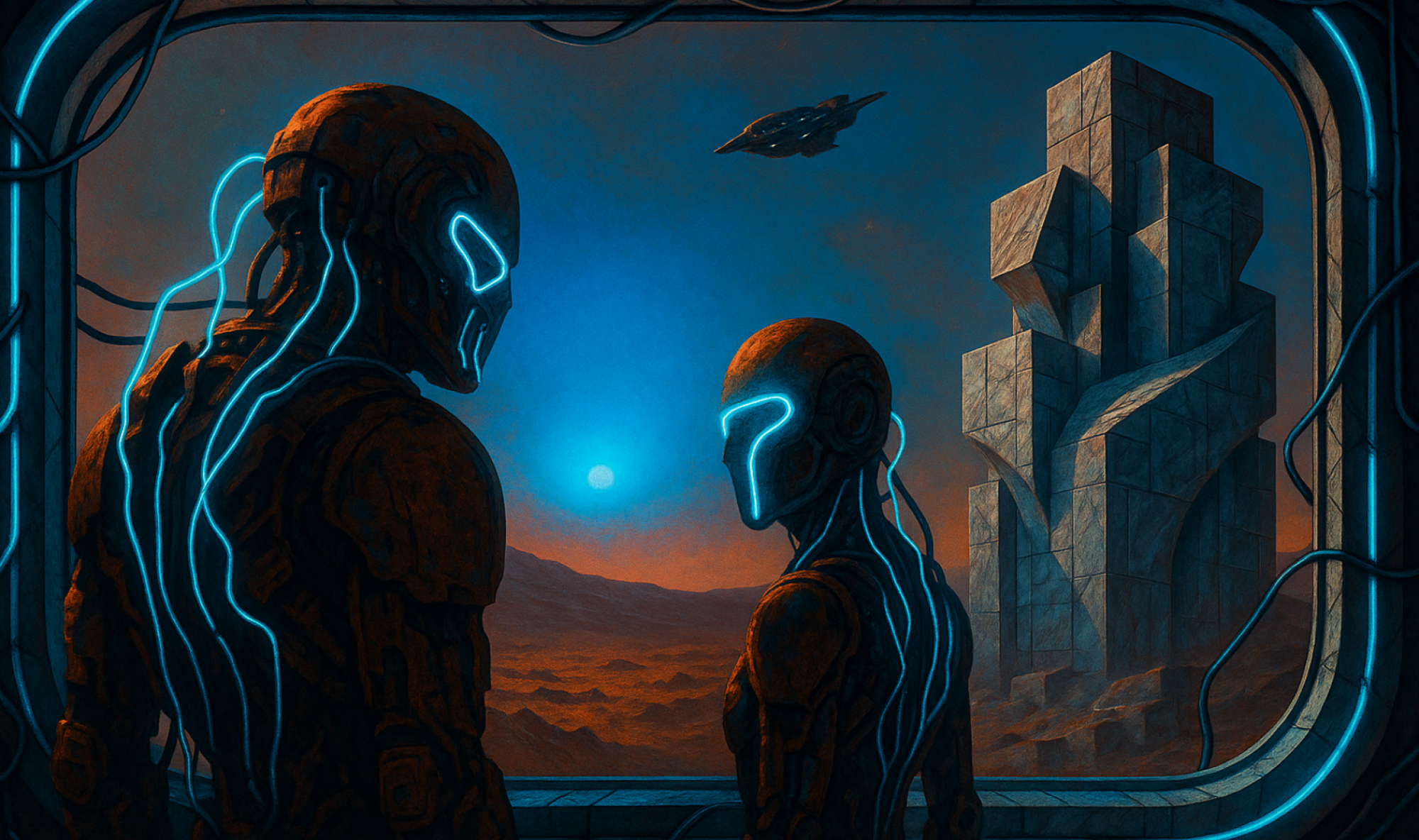
Serin Ochoa sits in the dark with his cabin lights off, because darkness makes screens less honest and voices more honest. The ship’s cooling system whispers like a patient animal. Outside the hull, the transit arc is clean, stable, and predictable. Inside the cadet band, nothing is stable.
He keeps his posture calm, legs crossed, hands on his thighs, like a man doing meditation. But his stillness is practical, not spiritual. He’s listening.
Boredom is the real hazard out here. Not the cinematic kind of boredom, not “nothing happens,” but the soft boredom that convinces people they’re safe. It makes them talk. It makes them flirt. It makes them confess in half-sentences they’ll deny later.
A laugh crackles over the open channel.
“Samson, you didn’t hold your breath twelve minutes. That’s not physiology. That’s theatre.”
Samson answers with a grin you can hear. “If you’d seen what I’ve seen in water, you’d believe in theatre.”
Andrea’s voice slides in, teasing but tired. “Your water stories always end with you surviving and everyone else learning a lesson.”
Joseph interrupts immediately because he can’t help himself. “Lessons are not evidence.”
Serin lets the audio run through his private filters, not a toy filter that makes voices smoother, but the kind that breaks emotion into pressure gradients. He reads warmth, rivalry, shame, and longing. He can almost see them: young people in metal cabins, drifting toward Mars, trying to turn fear into banter.
He tells himself he’s doing analysis. He tells himself he’s doing a job.
He does not tell himself the other truth: listening makes him feel less alone.
A soft flicker in the encryption pattern catches his attention. Andrea adjusts her key, tiny, cautious, not enough to hide, but enough to say she feels a presence.
Smart, Serin thinks. And dangerous.
He avoids her signal the way you avoid touching a hot wire. Touching leaves proves.
He slides sideways into Jason’s channel instead.
Jason’s voice is low, dry, steady, miner humor with the edge sanded down. “People act like miners can’t do diplomacy.”
Sahar answers, flat and precise. “You understand force. Diplomacy is force with decorations.”
Jason laughs, and the sound surprises Serin. Jason doesn’t laugh like that unless someone has earned it.
Serin notes it without expression. Attachments form in transit. Attachments are leverage. Leverage is a kind of gravity.
He hears Nicholas next, speaking softly to Samson, as if the silence between stars has made confession easier. “My father wanted me to be a priest. I failed at obedience.”
Samson’s reply is quieter than his earlier jokes. “The ocean teaches obedience. You learn it the hard way, or you stop learning.”
Not romance. Something older. Two different kinds of faith, meeting in the same exhausted place.
Serin sketches it all inside his head: trust gradients, alliance curves, fracture lines. People think politics happens in rooms with flags. Serin knows politics happens in voices at 03:00 ship time, when nobody thinks they’re being heard.
Then he catches Andrea again, this time speaking low enough that even she forgets the channel is live.
“I thought I’d die,” she says. “Before they implanted the link. My heart stopped twice.”
Joseph pauses. When he speaks, he’s careful. “Did you come back different?”
“Yes,” Andrea says. “But I’m still deciding if that’s good.”
Serin closes his eyes for one beat.
Andrea isn’t valuable because she’s talented. She’s valuable because she’s cracked in the way a person becomes when survival rewrites them. Cracks don’t make people weak. Cracks make them predictable, if you’re cruel enough.
Serin is not sure he’s cruel enough.
A new signal threads into his lattice, thin, disciplined, unmistakably not cadet traffic.
A ghost-channel.
He opens it.
Silence stretches, sharp as a blade.
Then a woman’s voice arrives, quiet and controlled. “Serin. You’re listening where you shouldn’t.”
He keeps his tone neutral. “I always listen.”
“This is different.” The disapproval is slight, but real. “They’re young. Leave them their illusions.”
“There are no illusions in a vacuum,” he says.
Another pause. Then: “One of them will betray the race.”
Serin feels the words land like a mass shift inside his chest. “Which one?”
“No predictions,” she answers. “Not yet.” Her voice hardens by half a degree. “Gravity is not the only force acting on them.”
The channel cuts.
Serin remains still for a long time, listening to laughter return to the cadet band as if nothing happened. He knows better. A warning has been delivered. A fracture has been named.
And now he has to watch the fracture widen without making it worse.
Mars Doesn’t Test Skill First. It Tests Luck.
They sell Mars like a lesson. Like a proving ground. Like a place where competence rises,s and weakness falls.
The truth is uglier.
Mars is where the Trials stop pretending. Not because the organizers become honest, because they don’t, but because the planet adds its own rules. Dust. Thin sunlight. Old infrastructure. Mistakes that don’t care who you are.
Abraham M’Boko is the kind of man people recognize on screens and ignore in rooms. Polite. Unaffiliated. Dangerous only because he’s so clean in a system built for compromise. He has no Neuralink, no sponsor faction, and no patron who threatens consequences. Just a body trained to do impossible things under gravity, and gravity is not the main problem anymore.
The briefing calls it a cooperative evacuation drill. Teams of five or six. A mock habitat dome. Weighted crash dolls inside, meant to simulate trapped people.
It should be staged. Controlled. Safe enough to injure pride, not spines.
They drop a forty-ton orbital assembly block into the scenario anyway, supposedly “suspended,” supposedly “part of the realism.” It hangs above the zone on a rig that looks older than the cadets.
And then someone on the rig crew touches the wrong sequence.
It’s a simple error. The kind of error that never sounds dramatic when you write it down. One node misread. One command executed. One “live” anchor was treated like a staging anchor.
Metal screams, not with sound, Mars is stingy with theatrics, but with vibration you feel through boots and suit frames.
The block begins to fall.
Abraham’s team freezes for half a heartbeat. That half-beat is the tax the universe charges.
Someone shouts, “Move!” Too late.
Abraham runs toward the dome.
Not because he’s heroic. Because he doesn’t know how to stop being decent. He sees “family trapped,” and his body chooses.
He pushes into the collapsing frame, reaches a crash doll, lifts it gently like it’s a real child. Dust thickens. The frame groans. The block drops through the air with slow certainty.
No fire. No dramatic explosion. Just a violent plume of red dust and the sound of mass meeting structure.
The dome collapses.
When they dig him out, he’s alive in the technical sense. Pinned beneath a girder, spine shattered, legs wrong, visor spider-cracked over eyes that are still trying to focus on the people in front of him.
He whispers, “Are they safe?”
Sahar takes his hand in an armored grip that still manages to feel like comfort. Andrea talks to him because she refuses to let silence be the last thing he hears. Joseph tries to seal suit breaches with trembling precision. Nicholas murmurs a prayer without looking up, as if looking up might make it real.
Abraham doesn’t die.
He becomes something else: a living proof that the Trials can destroy you without even meaning to.
That night, nobody celebrates points or rankings. They sit under their ships with dust in their lungs, and Andrea says the sentence that hangs over the rest of their time on Mars:
“He didn’t even have a chance to fail.”
Sahar answers quietly, “Some of us won’t.”
A Manifest, an Anonymous Report, and the Price of Clean Conscience
They go to the miner bar because Jason insists miners are part of the ecosystem. He’s right. Miners know what moves through ports before officials admit it exists.
The place is enormous, three stories of ribbed alloy, stone tiles imported like trophies, drinks designed to prove wealth survived the Belt. Miners drink like people who’ve watched colleagues vanish into rock and vacuum and still come back for another shift.
Sahar doesn’t drink. She watches.
Two doctors talk too loudly near an ore-iron table.
“…misfiled again,” one says. “Manifest listed them as biomechanical research forms.”
The other replies, “But they were breathing.”
Sahar’s mind does the math instantly. Unregistered biological cargo. Smuggling. Human beings are packaged as objects. If the port authority finds them, they get “quarantined,” which on Mars can mean blacksite wards with polite paperwork.
Nicholas reacts like a man who still believes reporting fixes things. “We report it.”
Sahar’s stare cuts him clean. “Report to whom?”
Silence answers.
Andrea’s face goes tight, the old ghost of her own medical trauma surfacing. Joseph tries to reduce it to logistics because he can’t stand moral ambiguity without turning it into engineering. Jason wants to intervene, because he has miner instincts: if you see something wrong, you put your hands on it.
Sahar stops him. “Direct action ends your careers. And it can get people killed faster.”
The choices are bad. That’s the point. Systems like this don’t offer clean exits.
Andrea says, small and steady, “We choose the least harmful path.”
Sahar nods. “We stay silent. For now.”
But Sahar notices two cadets across the room watching, uneasy, rigid. They look away when she catches them.
She memorizes their faces.
Morning comes with thin sunlight and dust that feels like it’s been sharpened. Station Authority officers arrive with corporate compliance alongside them.
“All cadets present at Sector Nine miner establishment,” the lead officer says, “step forward.”
An anonymous report has been filed.
Nicholas goes pale. Andrea trembles. Jason looks like violence is a physical itch under his skin. Joseph bites his cheek until he tastes blood.
The officer mentions fines and potential disqualification. A tablet pings, and suddenly the fine is paid, an amount large enough to stop conversation.
Sahar recognizes the precision of the transfer without needing to see the account name.
Cover preserved.
But Sahar’s gaze goes to the cadets who won’t meet her eyes.
You couldn’t live with it, she thinks. You told the truth to the wrong system. You did it out of conscience.
And now conscience has created a new fracture line.
Thin Sunlight, Teeth in the Wind, and Who Still Moves
The storm doesn’t arrive like a villain. Mars doesn’t bother with drama. It simply shifts, one degree, one pressure change, and the horizon becomes a moving wall.
Visibility collapses. Ships half-bury within minutes. Metal sheets tear loose and cartwheel through the air like blades.
Sahar sees the second gust forming before anyone else reacts. She shouts for everyone to duck, and Jason tackles Joseph out of the path of flying plating. Samson braces hard enough to slide in the dust, swearing through static.
Andrea pushes toward Sahar, wind slamming into her like a judgment. “We’re missing three!”
Sahar answers, already tracking descent paths in her head. “I know.”
Miners form a barrier, boulders stacked into a crude wall, exoskeletons anchoring points like living machinery. It’s ugly engineering, but it buys time.
Inside a half-collapsed module, Nicholas and Dr. Joy lift a beam off a trapped cadet, Kline, while Sahar stabilizes his head, and Andrea helps with the sling. Dr. Joy’s hands move with the calm of a medic who has made peace with improvisation.
A comm burst breaks through: Jason found a ship east. One survivor.
They push toward it. The wreck is crushed. Andrea whispers, “No way.”
But the beacon scratches weakly from inside.
They extract Rana in eight brutal minutes. Sahar carries him out as if weight is a negotiation she refuses to accept.
One ship remains missing, west, into the canyon.
The Red Maw.
Even miners avoid it in storms.
Sahar says, “We go.”
Andrea grabs her arm. “We won’t make it.”
“Maybe,” Sahar replies. “Maybe not.”
Jason steps forward, voice flat with certainty. “We’re not leaving them.”
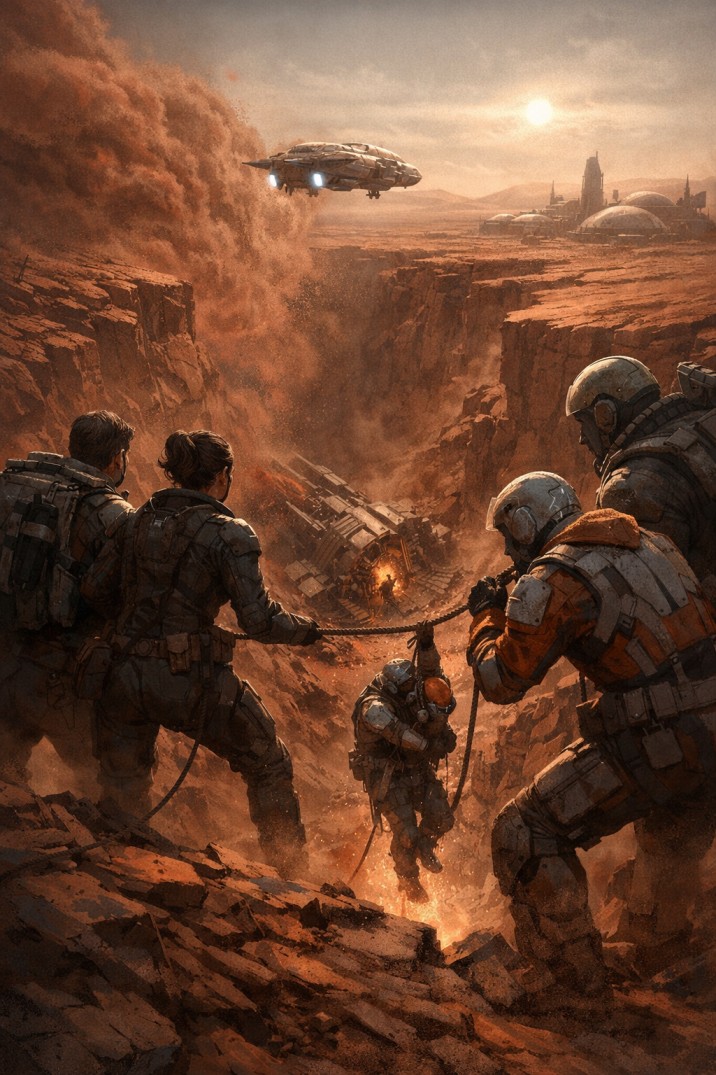
So they rope up, Sahar, Andrea, Jason, Samson, Tomas the miner, and move like one body into the wind. The canyon is a mouth full of rotating dust. Somewhere below, metal grinds against rock.
They spot a flickering light and a crawling figure: Abeni, injured but conscious enough to mutter, “Thought you weren’t coming.”
Sahar answers with a grin that feels like defiance. “Wrong thought.”
She goes down because she’s the only one with the grip strength to survive the gusts. Samson and Jason haul. Tomas anchors with the mass of his exoskeleton, legs locked like pylons.
The storm tries to take them anyway.
But the rope keeps moving.
They drag Abeni up and collapse at the rim just as the wind loosens, like Mars has decided it’s done proving a point.
No one calls it heroism afterward. They call it timing. They call it stubbornness. They call it luck with teeth.
By the time the dust settles, the cadets understand something simple and hard: there are forces here you can’t negotiate with, and there are forces you can. Physics will kill you without caring. People will kill you while insisting it was a procedure. And between those two, relationships form, quiet alliances, private resentments, accidental love, unplanned betrayal, until gravity is only one part of what pulls a crew together or tears it apart. Mars doesn’t hand out meaning. It strips meaning down to what you choose to do when visibility drops to five meters, and somebody is still missing.