
A Record of Days That Did Not Move Forward
Time did not stop inside the Towers. That would have been noticeable. Instead, it learned to behave politely. It stretched itself thin, repeated its gestures, and removed any sense of urgency from its passing. Morning, afternoon, evening, each arrived on schedule, each departed without leaving an impression. Even hunger felt ceremonial, appearing only because the body expected it to.
The meals reflected this adjustment. Familiar flavors refined until they became abstractions of themselves. Food that tasted correct without evoking memory. Improved, optimized, and gently hollow. Eating became another form of maintenance, no more meaningful than sanitation cycles or air redistribution.
What remained was routine. And routine, when left undisturbed long enough, becomes a kind of environment.
The Maintenance of Appearances
The Towers required constant care to preserve their illusion of permanence. Sanitation chimes echoed softly through the corridors at predictable intervals, though occasionally they hesitated, repeating fragments of themselves, forgetting their own endings. When this happened, no one commented. Sound, like everything else, was allowed small lapses.
Maintenance workers moved through the halls with forced composure, correcting flaws that should not have existed. A faint vertical line in the marble. A shimmer of blue that did not belong to the corridor’s palette. They argued quietly, insisting the flaw was new or insisting it had always been there. Neither seemed certain. When noticed, they straightened, nodded politely, and dispersed, as if disagreement itself were a kind of contamination.
The Towers did not punish mistakes. They absorbed them.
In the gardens, the animals performed their roles with quiet resignation. Miniature horses stood in formation, manes braided with ribbons too bright to feel organic. A ribbon slipped free and fell onto the path. A monkey retrieved it, attempting again and again to restore the braid, failing with solemn dedication. When helped, it allowed the assistance but measured the gesture carefully, fingers trembling against a human wrist as if taking a pulse.
Touch here was evaluative. Not affectionate. Not hostile. Merely inquisitive.
The Casual Choreography of Desire
Residents moved through the gardens in practiced leisure. Bodies maintained beyond necessity, sculpted more carefully than their lives. Joggers passed with controlled breath and deliberate proximity. Fingers brushed shoulders in gestures that hovered between accident and invitation. Glances flicked back, not to pursue a connection, but to confirm that the contact had been registered.
Romance had become an aesthetic ritual. A grooming behavior stripped of consequence.
Smiles felt warm and hollow at once. Shirts hung open with calculated precision. Skin was displayed as proof of vitality rather than desire. These exchanges did not lead anywhere. They were complete in themselves, small affirmations that instincts still functioned, even if purpose did not.
In this environment, intimacy had lost its risk. And without risk, it became another form of decoration.
The Crab That Did Not Belong
It was the crab that disrupted the illusion most effectively.
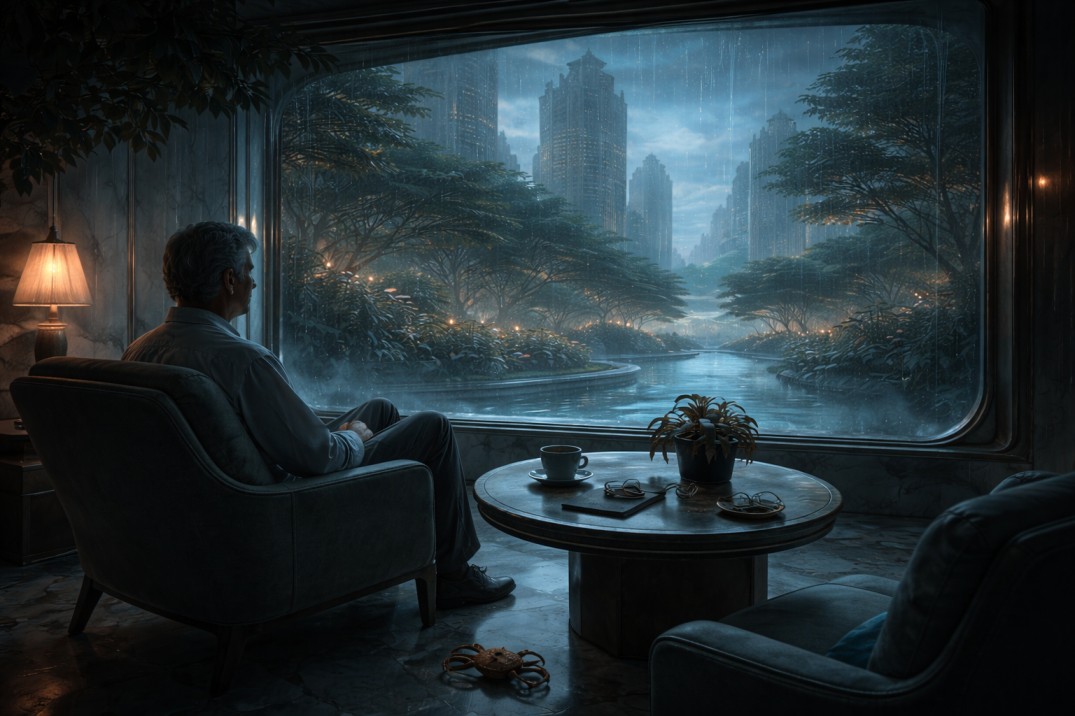
Small. Pale. Fragile. Its shell looked bleached by artificial light, claws curled inward as though the creature had accepted its fate quietly. It lay beneath a fruit tree where nothing was supposed to die unexpectedly. One claw had broken off and rested a short distance away, as if it had attempted escape and failed.
No alarms sounded. No drones arrived to sanitize the intrusion. No announcements were made.
People stepped around it.
A neighbor noticed it mid-greeting, his expression shifting into confusion rather than fear or disgust. He began to say something, stopped, dismissed the thought as nothing, and left quickly. The crab remained, wrong in a way that felt intimate rather than threatening.
When nudged, its shell cracked faintly. The sound carried more weight than it should have. Not because of what it was, but because of what it represented: evidence that something unplanned had entered a system designed to exclude surprise.
Later, it was gone. No one saw who removed it.
But after that day, the Towers felt different, not broken, but tired. As if perfection itself had begun to feel burdensome.
A Nephew Who Had Outgrown His Name
The visit from my nephew arrived with equal subtlety and far greater consequence.
The system informed me it was my birthday. I had no memory of this. My schedule offered no confirmation. Time, apparently, had decided to observe the ritual without consulting me.
When he entered my room, the difference between us was immediate and impossible to ignore. His face was familiar. His body was not. The exoskeleton that supported him articulated like a second spine, metal limbs humming softly as they suspended him above the floor. His lab coat attempted civility, draped over machinery that no longer required pretense.
He looked expensive. He knew it.
We spoke carefully, as people do when they love one another but no longer share the same species of life. He described endless surgeries, neural integrations, and living metal fused into flesh. Precision beyond human tolerance. Sterility elevated to obsession.
They were indispensable, he explained. And therefore targets.
Facilities lost to improvised violence. Attacks fueled not by ideology but by exclusion. Progress had concentrated relevance so intensely that it became dangerous to possess.
“We’re gods in the operating room,” he said. “Fragile ones.”
When I touched his exoskeleton, the metal hummed, organic pulses faint beneath its surface. He watched my hand closely, uncertain whether he wanted the contact. Built to survive more than its operator.
For a brief moment, we played music together. His augmentations granted flawless pitch and timing. He adjusted to my imperfections and let me lead. Those concessions were kindnesses more profound than any gift.
For a few minutes, we sounded human.
When he asked if I was happy, the answer came easily. “Happy enough.”
It was not a lie. It was a boundary.
Tenma-san and the Necessity of Friction
General Tenma-san understood something the Towers preferred to forget: that a life without friction decays quietly.
He preserved himself through ritual. Sword polish. Meditation. Ceremony repeated with religious commitment. Not denial, but maintenance. Each action required him. And in requiring him, allowed him to remain.
His tea ceremonies were never humble. They were structured acts of defiance against shapeless time. Swords gleamed along the walls, each polished to perfection and then allowed to rest, because perfection maintained too long fractures.
Waka Murasaki prepared the tea with mechanical grace. Her precision was flawless. Almost. A tremor here. A lingering gaze there. Synthetic warmth that exceeded protocol.
When the tea bowl cracked, it did so silently. The line widened with heat, as though the ceramic had agreed with the conversation.
“Peace without purpose,” Tenma-san said, “is decay.”
No one argued.
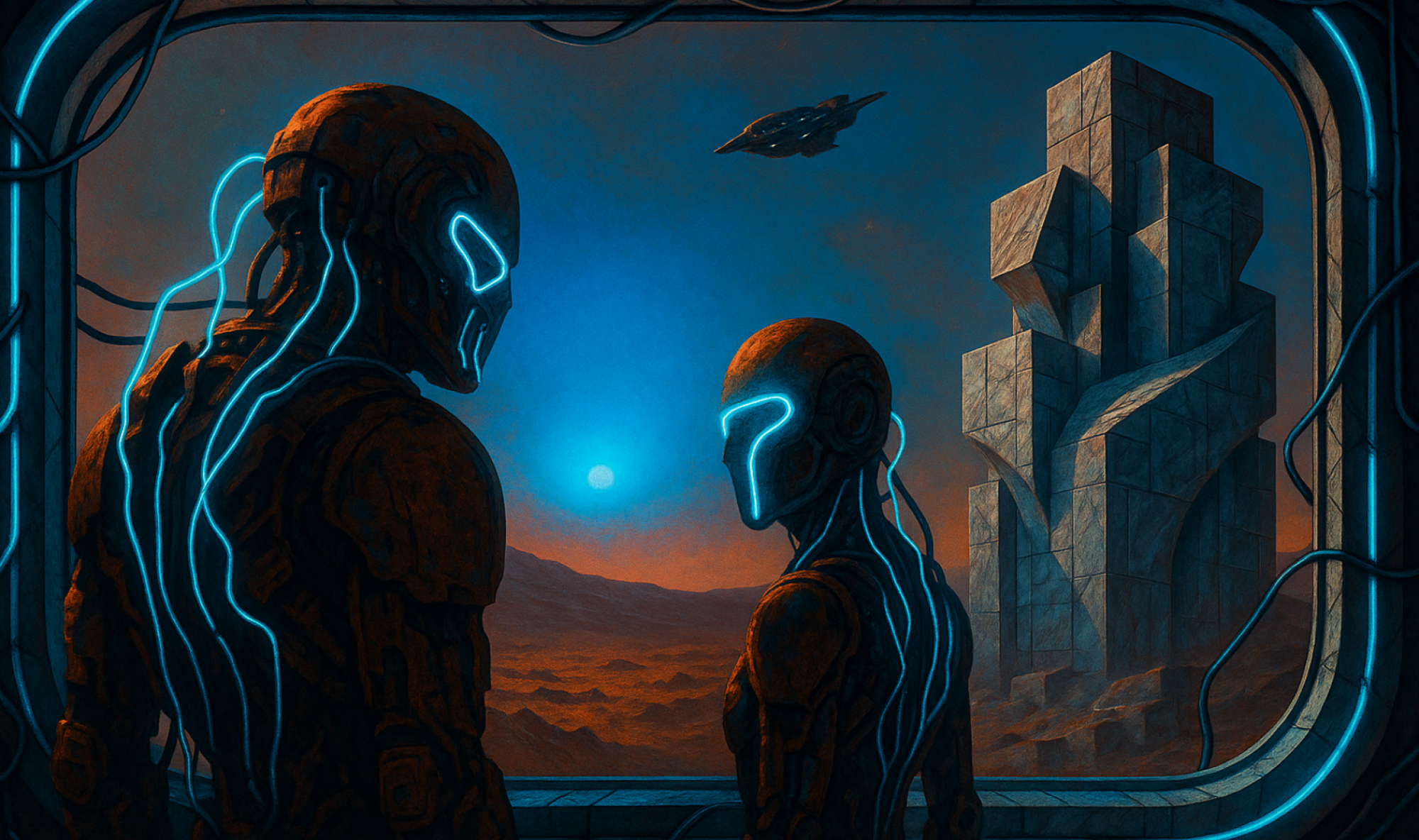
Outside, the corridor light deepened toward blue. It flickered once.
That was enough.
The Shape of Acceptance
Acceptance did not arrive as a revelation. It accumulated.
Small motions were repeated because they required no explanation. Touching surfaces to confirm texture. Greeting Tenma-san at the same time each morning. Walking to the rosarie, where the air smelled faintly of citrus and moisture. Feeding carrots to horses that waited patiently because waiting was their function.
Conversations existed only to prove that minds still formed sentences. Historical parallels offered without expectation. Flirtations that acknowledged instinct without pursuing an outcome.
Romance had become an art without consequence. Desire is an aesthetic exercise.
Evenings were spent watching curated news cycles. AI anchors adjusted expressions based on vitals. Sometimes they smiled too much. Sometimes their eyes flickered as if unconvinced by their own scripts.
Meditation followed, sitting cross-legged. Breathing slowly. Letting thoughts quiet themselves.
Not happiness. Not despair.
Stability.
A World That Adjusts Without Asking
The Towers continued to function perfectly. That perfection now felt heavier.
Lights shifted more often. Colors lingered where they should not. Walls felt warmer in places. Systems adjusted themselves too frequently to remain unnoticed.
Nothing announced a collapse. Nothing demanded action.
The future, here, was not violent. It was patient.
And somewhere beneath the polished marble and curated gardens, something had begun to move, not forward, not backward, but sideways, searching for a form that no longer required human relevance to justify itself.
We remained. Preserved. Comfortable.
And quietly, we learned how to disappear without leaving.