History often remembers disasters, invasions, and collapses, but it rarely lingers on the moments when nothing decisive happens. The arrival of the apocalyptical shape above Terra was one such moment. A vast black vessel entered low orbit, crossed the sky with mechanical regularity, and refused to explain itself. It did not attack, communicate, or leave. Instead, it waited long enough for fear to soften into curiosity, curiosity into habit, and habit into indifference. What followed was not an immediate catastrophe, but something more revealing: a demonstration of how quickly a civilization can adapt to the unimaginable, and how dangerous that adaptability can be.
A Shadow That Refused to Behave
The first descriptions were inconsistent, which was fitting. A dark shape appeared in the morning sky, crossed a portion of it, hid behind clouds, reemerged, and disappeared. Hours later, it returned, somewhere else, following no recognizable terrestrial logic. For a short time, this unsettled people. Then it didn’t.
A few months earlier, the same phenomenon had provoked fear. Now, it barely provoked comment.
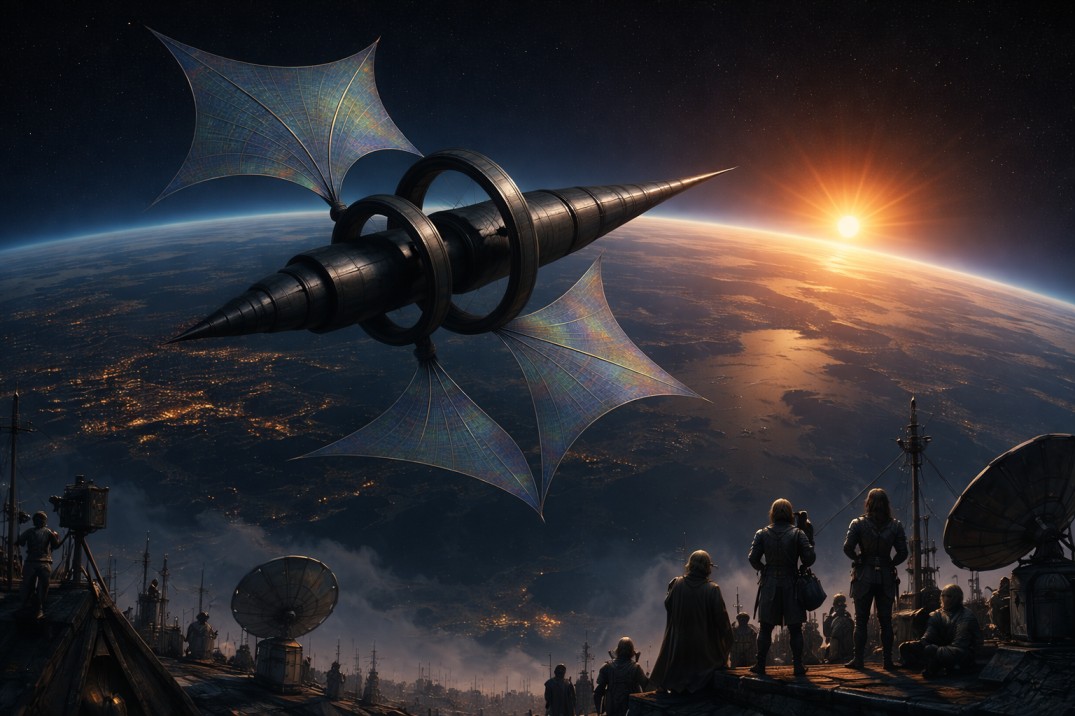
From a technical standpoint, the object was impossible to dismiss. Roughly two thousand kilometers above Terra, near the lower edge of the inner Van Allen radiation belt, a ten-kilometer-long spacecraft maintained a stable orbit. In raw dimensions, it rivaled the sun in apparent size. Had it reflected light, it would have been mistaken for a second moon. Instead, it absorbed light completely. Pitch black. Featureless.
Its shadow, however, was disappointing.
Most of Terra’s sunlight is scattered and softened by atmospheric water and particulate matter. The result was that the ship’s immense mass translated into a shadow no more dramatic than a temporary dimming over a small town. It crossed the sky roughly eleven times per day, precise and indifferent, like a clock no one had asked for.
It did not dominate the heavens. It merely occupied them.
From Fear to Background Noise
Nobody truly ignored the ship. That would be inaccurate. People gathered when it partially crossed the sun, turning those moments into casual public events. Enthusiastic crowds formed. Cameras came out. Children treated the fleeting darkness as a game. Dogs reacted to the brief, unnatural hush.
Just as often, the ship became a joke.
“Our Luna looked just like that before it became a black hole,” someone would say, usually to laughter. Humor worked as insulation. Only rarely, typically late at night, typically fueled by alcohol, did someone ask what the ship was doing there, or what its occupants might intend once they descended from their machines.
Those questions did not circulate far.
History provided an uncomfortable analogy. During the age of discovery, indigenous populations once saw white sails on the horizon, recognizable materials arranged at unfamiliar scales, carrying intentions not yet imaginable. The caravels were not immediately understood as existential threats. They were strange, distant, almost abstract.
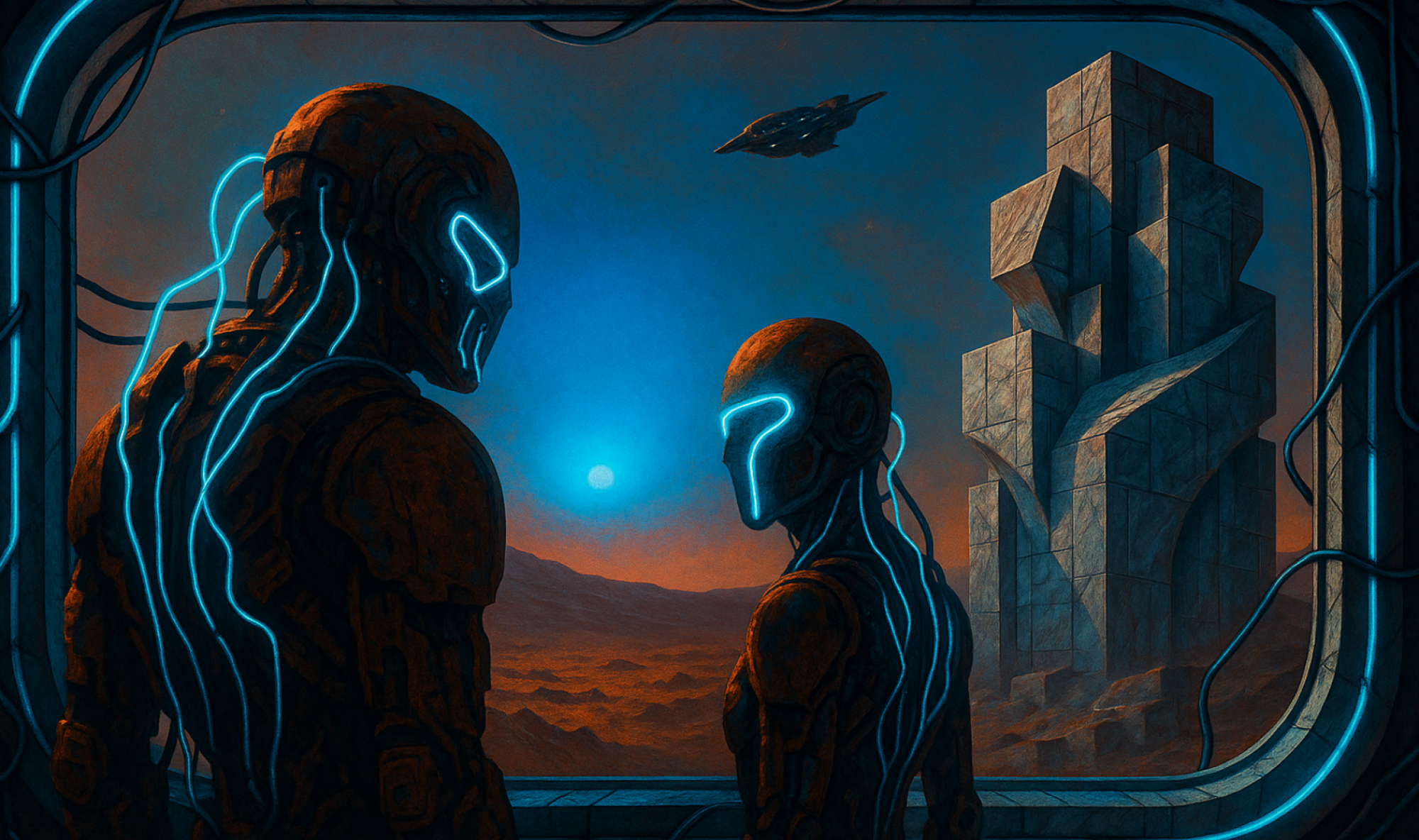
The same logic applies here. The ship looked human in design, but monstrous in execution. The rumor, never confirmed, never denied, was that it was Terran technology returning home after centuries of interstellar travel. A vessel sent to Proxima Centauri long before Terra forgot how to remember such ambitions.
The ship did not announce itself. It did not communicate. It simply orbited.
A Mutual Decision Not to Act
The absence of contact cut both ways.
The ship did not attempt to descend. Terra made no serious attempt to approach it. Some regions lacked the necessary technology. Others almost certainly possessed it and chose not to reveal it. Much of Terra’s true capability was buried underground, distributed across vaults and facilities managed by supercomputers whose priorities had drifted far from curiosity.
For a brief period, the ship’s presence disrupted daily life. Productivity dropped. Conversations stalled. Fear dominated the first day. A week later, comparisons emerged, dark European hulls looming near the shores of gunpowder-era China, Japan, and Mexico. The threat felt real, physical, palpable.
A month later, parents repurposed the ship as a disciplinary myth. Finish your chores. Behave. Or else.
Then the ship became just another object in the sky. A fixture. Like Luna might have been, had it not once threatened collapse.
The most unsettling aspect was not the silence of the visitors. It was the speed with which Terra stopped paying attention.
A Planet With Everything to Offer
The neglect raised uncomfortable questions. Was Terra unworthy of contact? Did it have nothing to offer a low-orbiting interstellar vessel?
Objectively, this was absurd.
Terra was biologically unmatched. Its ecosystems produced substances unavailable anywhere else in known space. If the ship were crewed by organics, the planet’s food alone justified descent. If automated, Terra’s biochemical diversity represented an extraordinary computational resource.
The economy itself rested on such organisms.
Spider-infused goat milk produced threads lighter, stronger, and more flexible than steel, ideal for smart textiles and adaptive armor. Mosquito nano-brains powered miniature computational devices with extraordinary efficiency. Gram for gram, mosquitoes ranked among the most intelligent organisms on the planet, capable of environmental analysis, social manipulation, and complex learning while remaining nearly invisible.
Any serious machine intelligence would envy such peripherals.
Speculation flourished briefly. Perhaps the visitors waited for Terra’s hidden artifacts to reveal themselves. Tritium from vast reactors in the old Viking lands. Titanium is mined from the Siberian tundra. The rumored space catapult is anchored in the Himalayas. Or perhaps the ship feared Terra’s defenses, whatever fractured form they now took.
No explanation gained traction.
Life continued. Pigs worked the soil. Monkeys maintained the fragile wiring of supercomputers. The machines optimized abstractions that only they could measure. Even mutants, products of earlier technological excess, kept to themselves, quietly waiting.
The Return of Platinum
Then, after attention had faded, something changed.
Shuttles descended.
At first, the landings were sporadic. The visitors traded platinum for food. On Terra, platinum had become a near-sacred material. Since the end of the space exploitation era, no native supply remained. What little existed was embedded in the maintenance cycles of supercomputers that governed entire empires.
The sight of pilot chairs made entirely of platinum triggered near hysteria.
History offered a precedent. In the nineteenth century, aluminum had once been more valuable than gold, until a simple electrolytic process rendered it cheap. Platinum followed a similar trajectory during space expansion. But as off-world colonies grew self-reliant, trade with Terra collapsed. Centuries passed.
Now, for the first time in generations, platinum returned.
The reaction was emotional in a way Terra had nearly forgotten. Ministers wept. Advisors trembled while tasting long-lost delicacies, recalling the recovery of black caviar after the beluga’s return from near extinction. Civilizations oscillated between stoic restraint and romantic excess, as they always had.
It was, once again, a time for crying.
Men cried openly as they exchanged food for metal. They offered the finest delicacies to balance the trade, embarrassed by the inequality. The visitors declined.
Laughter, Meat, and Unease
The visitors’ interest in meat unsettled the traders.
“We love humans,” they said casually.
Sometimes they added that they ate sentient pigs on Proxima, a practice taboo across Terra and the Solar System. The statements were delivered without malice, often accompanied by laughter.
A very specific kind of laughter.
Hyena laughter.
That sound lingered longer than the trades themselves. It embedded itself in memory, coloring every subsequent interaction.
Eventually, the platinum stopped coming. The shuttles continued to land. Food continued to disappear.
Trade became extortion.
Take My Food, Please Do Not Eat Me
Fear enabled the new arrangement. Mutant hyenas, poorly mannered and impossibly agile, proved persuasive without overt violence. The racket was almost polite. No aged delicacies were seized. No infrastructure was destroyed, except by enraged livestock owners.
The pilots did not chase fleeing humans. They did not need to.
Kasurigami handled retrieval. The tool could pull food from a distance with casual precision. Paired with high-tech boots, its wielder could leap like a flea. Add a hyena’s olfactory system, capable of tracking fear itself, and resistance became pointless.
Humans adapted quickly.
Want vegetables? Take them. Want meat? It is ready. Diamonds that were occasionally offered as tips, nervously. Not the ceremonial stones embedded in weapon handles, but the smaller fragments that gave those blades their sharpness.
Diamonds had once been abundant, mined from asteroids and used as substrates for space-rated computers. Now they were rare, strategic assets hoarded by supercomputers to consolidate power. Watching them change hands marked a subtle shift in sovereignty.
Figures That Would Matter Later
Certain individuals stood out, though their significance was not yet understood.
A towering hyena like Masha inspired a simple instinctive response: take my food, please do not eat me. Alina removed supplies so efficiently her presence often went unnoticed. Anna rarely took food at all. She preferred games, debates, board games, and elaborate gambling sessions where food served as currency.
Her mask linked her to high-power computation. Her training ensured victory. Cheating was unthinkable. The consequences were obvious.
These details were noted, then dismissed.
The First Lesson of the Apocalyptical Shape
Throughout it all, the ship remained overhead. Silent. Patient.
The true disruption of this phase was not invasion, nor extortion, nor fear. It was normalization. Terra demonstrated its most dangerous trait: the ability to absorb the unimaginable into routine.
A ten-kilometer black ship. Mutant hyenas. Platinum appearing and vanishing. All of it became background.
The first lesson of the apocalyptical shape was not that humanity was weak. It was that humanity adapted too well. When progress becomes automatic and catastrophe fails to arrive on schedule, attention decays.
The sky changed forever.
The ground insisted on remaining familiar.