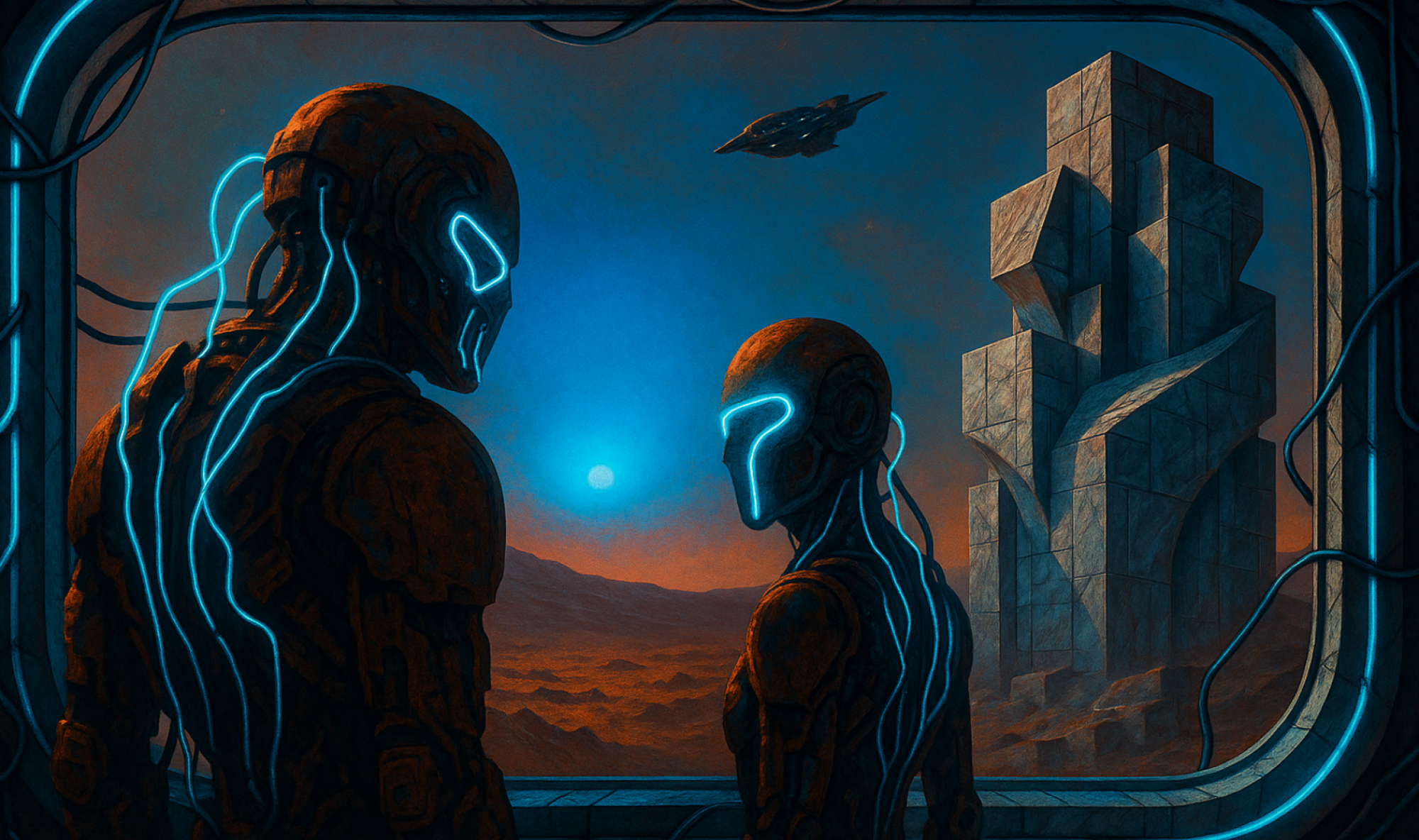

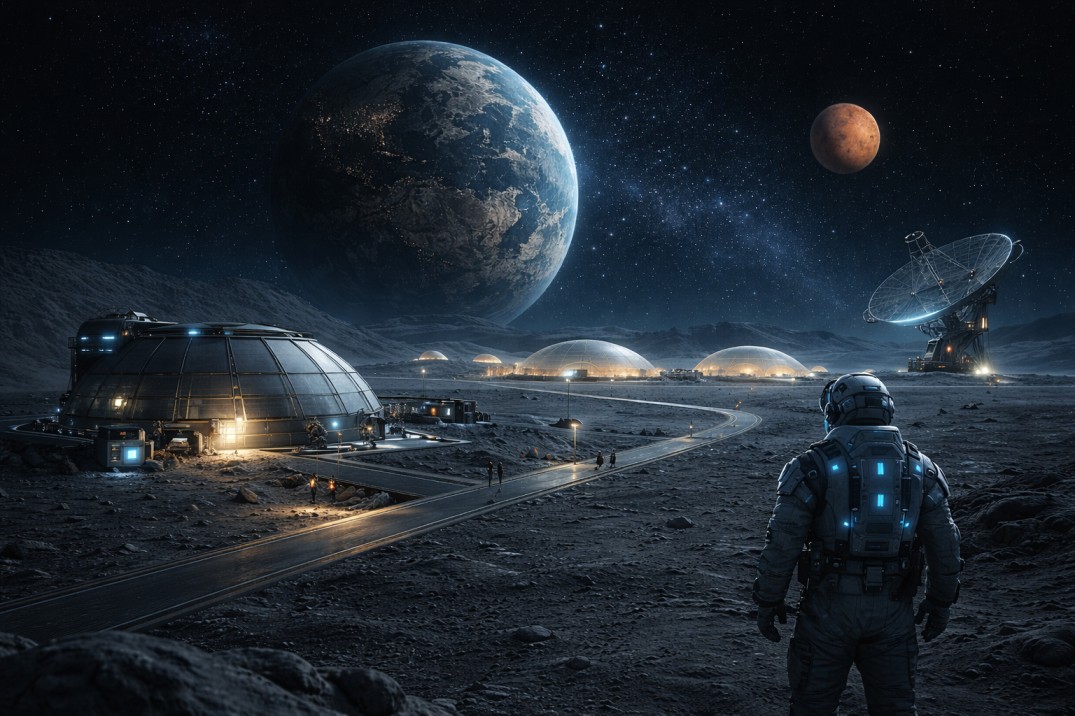
Two centuries later, the first permanent years on Luna are rarely remembered as an adventure. They are recalled instead as a transition, quiet, procedural, and difficult to locate emotionally. What survives are not grand narratives of conquest or discovery, but fragments of routine: design decisions that favored machines, policies that narrowed who could remain, systems that continued working even when people did not. This account does not attempt to reconstruct the Moon as it was experienced in the moment. It reflects how Luna was later understood, after its consequences became visible, after its costs were normalized, and after it was no longer possible to pretend that permanence had arrived without changing what permanence meant.
Luna Was Scheduled
By the time people stopped leaving the Moon, it had already been stripped of ceremony.
Earlier generations had treated Luna as a destination. They marked arrival, recorded images, and argued over firsts. That behavior did not survive scale. Once transport costs collapsed and timelines shortened, the Moon ceased to be somewhere one went. It became somewhere things passed through.
What mattered was not arrival but continuity.
Permanent habitation did not begin with speeches or declarations. It began with revised logistics tables and a recalculation of acceptable loss. The Moon did not need to be claimed. It only needed to be dependable.
This distinction mattered later.
Those first crews arrived already integrated with their equipment. Exoskeletons were not tools to be worn, but environments to inhabit. Neural interfaces synchronized before orientation finished settling. There was no pause between landing and labor. Systems were brought online immediately, not because of urgency, but because idle time no longer carried meaning.
Luna did not feel empty. It felt unfinished, which was worse. Corridors expanded ahead of demand. Doors were built for dimensions not yet common. Ceilings rose to accommodate machinery rather than bodies. The settlement was designed for throughput, not comfort, and anyone who stayed long enough learned to accept the difference.
The people who remained did not think of themselves as pioneers. That word implies memory. They understood instead that their role was to make a presence routine.
Energy as a Moral Shortcut
Avi Maor never presented himself as a visionary. He spoke as though correcting an accounting error.
When he described energy scarcity, he did not frame it as injustice or failure. He framed it as a delay that no longer had a technical justification. Tritium reactors, in his telling, were not transformative. They were simply sufficient.
This distinction mattered to the audience.
By the end of AEOLIA, political language had exhausted itself. Every solution carried a moral cost. Every compromise had a constituency. Avi’s appeal was that his equations appeared to bypass the argument altogether. Abundance did not need to be defended. It rendered debate obsolete.
The Moon, in this framework, was not a frontier. It was a resource node that had been ignored out of habit. Helium-3 lay distributed across the regolith. Tritium breeding required proximity, not conquest. The injustice was not exploitation, but neglect.
Institutions accepted this logic quickly. It aligned with existing incentives. It offended no dominant ideology. Even long-horizon systems found no contradiction in the projections.
On Luna, the reactors were treated as provisional until they were not. Early assemblies failed often, but failure was survivable. Each iteration widened margins. Each widened margin made restraint feel outdated.
From Earth, the results were described as miraculous. On Luna, they were described as stable. Stability became the highest virtue, and stability accumulated momentum.
Later generations would learn that momentum does not announce when it becomes irreversible.
Living Near Something That Does Not Sleep
The first reactor was designed to be safe, not quiet.
Even when declared dormant, it continued to oscillate at levels too low to classify as fault. Instrumentation treated this as residual behavior. Human bodies treated it differently. People stationed nearby slept poorly. Dreams intensified. Minor fluctuations were sensed before alarms registered them.
None of this violated protocol.
The reactor was compact enough to feel present. Engineers working nearby understood, without saying so, that scale had inverted. They were no longer supervising the largest thing in the room.
Rotations were enforced. Officially, this was about exposure limits. Informally, prolonged proximity altered behavior in ways difficult to model. Irritability increased. Arguments escalated over trivial discrepancies. Some technicians developed personal heuristics that predicted system spikes seconds ahead of formal alerts.
Every anomaly was logged. Every deviation is modeled. The numbers were clean. The system complied perfectly.
That compliance produced unease.
On Earth, failure announces itself loudly. On Luna, failure would occur without spectacle, proceeding according to physics rather than intention. There would be no heroism in correction, only latency.
Work continued regardless. Shielding increased. Redundancy multiplied. Ritualized behavior emerged among staff, not belief, but habit. Pauses before activation. Preferred sequences. Objects are kept close without justification.
In retrospect, this was not superstition. It was proximity to a system that no longer required human reassurance.
A City That Assumed Augmentation
Lunar infrastructure did not evolve toward human comfort. It evolved away from it.
Spaces were dimensioned for exoskeletons at full articulation. Control interfaces assumed augmented perception. Emergency procedures presupposed strength and reach beyond biological norms. Architecture did not negotiate with the human body. It is expected adaptation.
On Earth, exoskeletons were accommodations. On Luna, they were defaults.
Extended use altered perception. Tremors induced by low gravity were dampened automatically. Posture correction became unconscious. Intent translated into motion without delay. Over time, removing the frame felt like entering impairment.
Urban design reflected this shift. There were no parks, no informal gathering areas, no spaces dedicated to lingering. Luna functioned as a conduit: energy, materials, data, personnel moving through continuously.
Visitors from Earth registered the difference immediately. They moved cautiously, requesting support where none had been installed. Seating was absent because stillness was not a design requirement. Their bodies appeared temporary, tolerated but not integrated.
No one mocked them. Mockery requires excess.
Instead, residents absorbed a quieter lesson: once environments normalize a shape, resistance feels inefficient. Comfort becomes indistinguishable from necessity.
Presence as Credential
Permanent residence on Luna was restricted to neuralink holders. This was framed as safety.
The justification was straightforward. Lunar systems behaved too quickly and too unpredictably for mediated interfaces. Neural integration reduced hesitation and fatal lag. The policy was defensible, and it was rarely challenged.
Prestige followed.
On Earth, neuralinks are already marked for selection. On Luna, they defined belonging. Unlinked workers rotated through auxiliary roles, remote operations, observational assignments, and logistical support. Their labor mattered. Their presence did not.
Families observed developments through curated streams. Construction feeds. Reactor dashboards. Interviews were conducted through layers of data overlay. Risk was always described as quantified and managed.
Parents learned to recognize their children by gait inside exoskeletons. Conversations adjusted to latency and protocol. Children grew up understanding that Luna was something one qualified for, not somewhere one lived.
Those excluded treated absence as temporary. Once costs fell. Once training expanded. Once stability was achieved. There was always a future threshold.
On Luna, absence ceased to register. Work compressed time. Exclusion did not announce itself. It simply persisted.
Trust Without Surprise
The hyperbolic subreflector was not built to observe. It was built to compress.
Its purpose was correlation, transforming incoming signals into formats suitable for continuous data center ingestion. Visibility was secondary. Throughput was primary.
Construction advanced rapidly. Low gravity reduced stress. Living metal corrected the deformation before it propagated. Synchronization between crews approached machine precision.
Models accounted for failure exhaustively. Temporary supports were removed earlier than planned based on updated projections that showed no significant risk increase. Each successful adjustment reinforced confidence.
Data began flowing before completion. Results exceeded expectations. Extended operational windows were approved.
A minor harmonic interaction between structure and lattice was deprioritized. Variance remained acceptable. The models confirmed each other.
This was the moment trust shifted, from confidence in systems to confidence that nothing unexpected remained.
Failure Without Drama
The structure did not explode. It folded.
Resonance aligned briefly with redistribution and thermal contraction. Living metal compensated until decision latency exceeded tolerance. Supports failed sequentially. The curve lost coherence.
Exoskeleton systems reacted faster than biological reflexes. Protocols executed correctly. Scale rendered the response irrelevant.
Low gravity prolonged the collapse, allowing full comprehension before impact.
Communications terminated cleanly. Dust rose slowly beneath lights that continued operating until instructed otherwise. Sound did not carry beyond sealed zones.
Afterward, the reflector lay intact but unusable across the surface. Beneath it were those who had authorized early operation and accelerated timelines.
Other systems continued uninterrupted.
The Moon did not register the event.
When Work Could Not Stop
Initial drafts of the incident report used the word disaster. It was removed.
Final documentation described early instability and correctable failure modes. Procedures were revised. Lessons were logged.
Work paused only where continuation was physically impossible. Replacement crews arrived. Power was rerouted. The reactor continued oscillating beneath the regolith.
There were no memorials. Space allocation favored function. Names were entered into internal logs. Notifications emphasized clarity and support. Media coverage returned to progress.
A new silence emerged, not one of grief, but of compression. Reflection felt inefficient.
Later, Maria would explain that this was when Luna ceased to resemble an experiment and became a workplace.
Not because people died.
But because everyone understood, without speaking, that stopping was no longer permitted.