
A Peculiar Disturbance in the Morning Sky
It is a curious fact that even in this age of reason, when the commonplace wonders of technology have dulled our collective sense of awe, the unexpected appearance of a dark shape in the morning sky can still prompt an uneasiness that no amount of scientific explanation quite dispels.
It began, as most such disturbances do, with little more than a whispered rumor. An inkblot in the dawn, a shadow gliding silently across the arc of the heavens, eclipsing the rising sun for the briefest of moments. Some early risers in the great cities saw it pass above the spires. Their first impression was that of a trick of the weather, or some new military device, perhaps the launch of a weather satellite, or an unusually elongated meteor burning up harmlessly in the upper air.
Yet the shadow was neither fleeting nor easily dismissed. It returned each morning, patient and unhurried, sometimes vanishing behind banks of cloud, only to reappear, as if by design, over distant fields or lost islands, crossing the sky with a deliberation that gave the lie to all accidental phenomena. It disappeared and then reemerged in another part of the firmament. Those who troubled to look up from their papers or their tea found themselves unnerved by its regularity, its silent assertion that something enormous and unknown was moving above their world.
In the first weeks, as news agencies vied for explanation, the public’s curiosity was sharpened into that most modern of terrors, the unknown that cannot be Googled. The shadow became the subject of a thousand idle speculations. Some, recalling the tales of old, invoked comets and portents, omens of war or the end of days. Others, more practical, supposed a new international project, perhaps some orbital construction, a grand engineering feat that had, through a clerical oversight, been launched without announcement.
Yet, as the shadow’s presence became a matter of routine, the world’s attention turned away with the fickleness that characterizes all crowds. The newspapers dropped their special supplements. The scientists grew silent, or else their pronouncements were too technical to satisfy. A month passed, then another. The shadow became as the passing of an unfamiliar bird, worthy of a moment’s comment, but soon forgotten amid the clamor of more immediate affairs.
Of Shadows and Substance
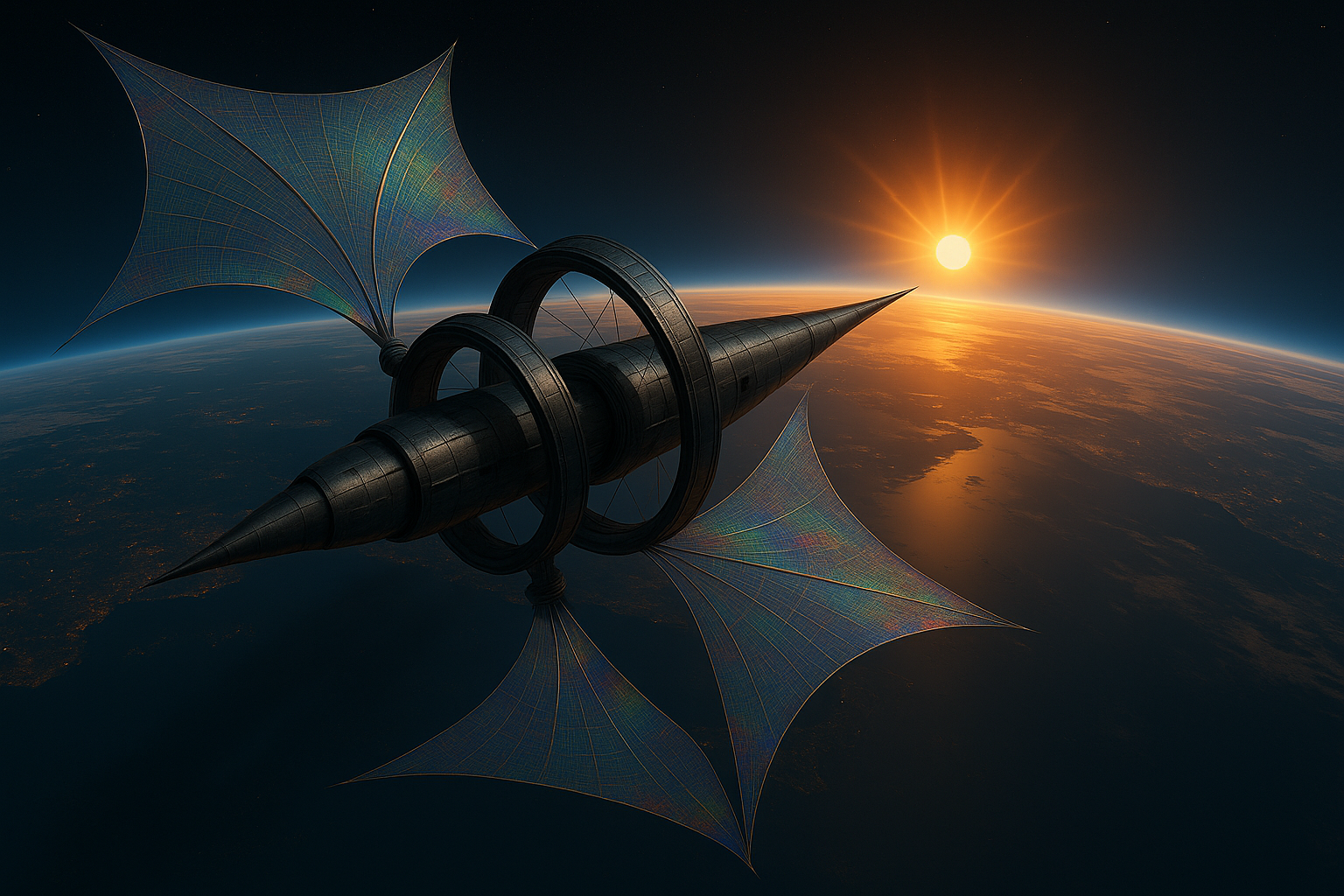
It was a curious fact that the object, for all its immensity, was not especially menacing in its visible effects. At an altitude of two thousand kilometers, skimming the underbelly of the Van Allen belt, the vessel measured some ten kilometers in length. The ship was needle-thin, adorned with vast rings and shimmering gossamer sails. By all rights, its passage should have been awe-inspiring, a sight to rival eclipses or the rare comets that visit the Earth. Instead, its shadow was a mere smudge, a faint darkening no wider than a provincial town, scattered by the vapor and dust of the upper air. Only the most ardent skywatchers took note, setting their watches by its regular orbit, eleven times a day, as precise as a metronome.
Children chased the fleeting shade across playgrounds. Dogs barked at the odd hush it cast upon the world. Sometimes, in larger cities, an enthusiastic crowd would gather in a square when the timing was right, to witness a partial eclipse, as the ship momentarily crossed the sun’s face. It never fully darkened, but always left a peculiar taste in the air, a sense of the uncanny.
“Hey, our Luna looked just like that before it became a black hole,” one might hear, the remark tossed off with the bravado of those who mock what they do not understand. But in quieter moments, old men in empty taverns, or students huddled on cold balconies, would look up and wonder what it meant, that something so vast and so silent had come home from the darkness between worlds.
The Ghosts of Caravelles
Among the learned and the curious, comparisons were soon drawn to the age of exploration, when the caravelles of Spain first appeared on the horizon of the New World. In those days, the Indians who glimpsed the white sails far off at sea had no name for what they saw. They knew ships and cloth, but not at such scale and not with such purpose, and so the Spanish vessels became as portents, harbingers of a world transformed.
The analogy was not lost on the present generation. Here, too, was something recognizably human, yet utterly foreign, technological in design but monstrous in execution. The rumor persisted, whispered in quiet corners, that this was no mere visitor. The great ship was Terran, sent out centuries before, a spear thrust toward Proxima Centauri, and now, miraculously or perhaps inevitably, returned to its cradle. Yet, unlike the Spanish ships, there were no drums, no gathering of tribes, no approach from the waiting shore. The vessel circled in its high orbit, silent and inscrutable, making no attempt at contact, as if indifferent to the world it once called home.
The Prodigal Son Returns
And so, the prodigal son returned, not to the jubilation of the waiting father, but to a world that had, in its fashion, moved on. No one truly ignored it, but neither did anyone approach. It was not for lack of technology, though much of the world’s might now lay hidden, buried in vaults or lurking beneath the seas. Rather, it was a matter of caution, of the peculiar reticence that afflicts civilizations grown wise in the ways of loss.
For weeks, the ship orbited, immense and implacable, its sails flickering with iridescent color only when the angle was right. Its hull remained black as obsidian, betraying nothing of its purpose or crew. Some claimed to see movement on its surface, tiny flashes as if of repair drones skittering across the metal, or the faint glow of life support deep within the rings. But no signals were broadcast, no shuttles launched, no banners unfurled to proclaim its return.
It would be comforting to think of this as an oversight, a glitch in some forgotten code, but the sense grew, first among the scientists, then among the public, that the silence was intentional. The ship circled, watching, and waited for something only it understood. The world, for its part, watched back in kind, the tension drawn out as thin as the vacuum between stars.
Menace in Silence
It is in this silence that the true menace lay. Not in the mass or speed of the vessel, nor in its ability to blot out the sun, but in its utter refusal to declare itself. For what prodigal returns without a word, slipping in on dawn’s edge, content only to cast its shadow and let the world puzzle out its meaning? What father, seeing his lost child upon the threshold, does not rush to embrace, or at least to ask what distant worlds he has seen?
But there was no embrace here. Only the shadow, and the slow realization that some journeys change both traveler and home. Whether the ship had come for peace, or conquest, or simply to drift in the cradle of its birth, none could say.
Yet, beneath the calm routine of daily life, a shiver ran through the world. The shadow was there, crossing the blue planet again, and all who saw it felt, if only for a moment, the possibility that everything was about to change.