

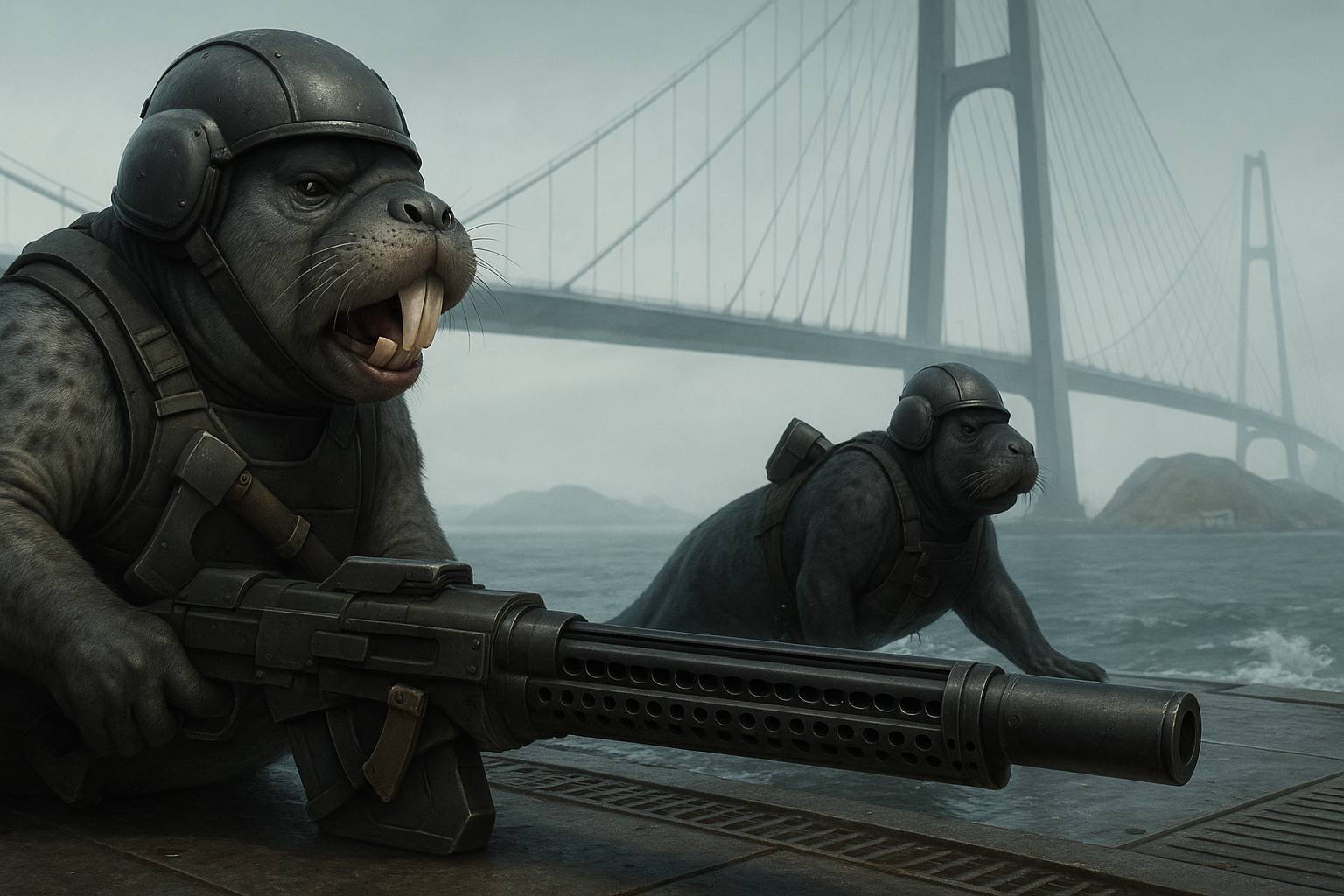
A Warrior’s Watch
Every morning, the mist comes thick and gray, rolling off the ice, blurring the far towers and muting the cries of gulls. The world here is cold, hard, and honest. The bridge rises from rock to rock, cables humming above water so cold it could stop a heart. I lie where steel deck meets wind, belly pressed to the metal, rifle across my chest, helmet close around my ears, eyes never at rest. In this place, a man is not made soft by comfort. He is sharpened by the cold, made lean by the hunger for victory and respect.
We are not the first to guard such a gate. Far to the south, others stand watch at the Suez and Panama crossings, eyes narrowed against desert sun or tropical haze. They guard gold and grain, oil and whispers of revolution. They dress in thin cloth, their bellies full, their houses shaded by trees. They have their wives and sons close, and their pay is rich. Here, at the end of the world, the pay is less, the food is harder, the fog is endless, and even in summer, the wind never loses its teeth.
But this is the bridge where the world turns. Every ship, every truck, every cargo of rare earths or synthetic drugs, every diplomat and merchant, must pass this line. They pay for the privilege. Some pay in coins, others in goods, a few in blood. I have known each kind.
Taxes and Honor
The law is simple: nothing passes without tribute. There are no exceptions. The fat captains from across the ocean understand that when they see me and my kin, weapons in hand, eyes bright and jaws heavy with scars. The tribe is hungry. The women wait for gifts. The children must be clothed and trained, and given hope. The chiefs want their cut, the elders want peace, and I want the world to remember my name. Taxes are not just coins, they are the price for peace, the proof of strength, the measure of respect.
Pirates test us. Sometimes they come in the night, black sails hugging the coast, hulls painted with the bones of old men. Sometimes they bribe a weakling to look the other way. But we have no patience for weakness. If a man lets a pirate pass, he brings shame to his house. Better to die fighting than live as a coward. When we catch a pirate, there is no trial, no speech, no long goodbye. The rifle is swift; the adze is silent. The river takes the rest.
The Burden of Command
In the old stories, a real man was a provider, a lover, a builder, and a killer. He took many wives, raised a dozen sons, and guarded his people from all comers. The gods would judge him not for his prayers but for his courage, his scars, his wisdom, and his generosity. Some days, when the wind claws at my face and the fog blots out even the closest cable, I wonder if I am living up to that ideal.
The truth is, a man in the north is always cold, always hungry, always half-dreaming of comfort he cannot reach. I have women enough, my house is loud with their laughter, heavy with their warmth. The children scramble over the stones, fighting, learning, always wanting more. But there is never enough. A real man must always give more: more food, more gifts, more protection, more blood. When the great ships come, stacked high with ore and electronics and rich Fogskins who never saw real hunger, I collect their tribute and think of what I could buy next. A new wife? A finer helmet? More meat for the tribe? Or just a softer bed, a warmer blanket, a night without the wind’s howl?
Watching the World Go By
It is a strange thing to watch the world flow past your gate, day after day. You see all kinds: the merchants, fat and sly, with ledgers thicker than their necks; the engineers, nervous, their hands shaking as they present their passes; the Fogskins, soft and pale, so sure that money can buy them any passage, any secret, any mercy. I have learned to measure a man by his walk, by how he meets my gaze, by the tremor in his voice when he asks, “May I cross?” Some, I respect. Others, I pity. A few, I despise.
Sometimes, when the crossing is quiet and the sea is calm, I imagine what it would be like to stand watch in the south, where the bridges are busy with ten thousand voices and the sun burns instead of chills. The men there have no need for fur, no need to break ice for their water, no need to fear a night without food. Their wives wear jewels, their sons ride in cars, their daughters go to school in silks. I am proud of my scars, but sometimes I envy their ease.
Brotherhood and Rivalry
Still, I would not trade places. The brotherhood here is real. On the bridge, a man knows his worth by the weight of his rifle, the bite of his adze, and the respect in the eyes of his fellow guards. We fight together, eat together, and mourn together. We know the price of weakness. There is no hiding here, every man is measured, every failure is remembered. The tribe depends on us, and we depend on each other.
We hear tales of guards in Panama and Suez, how they get soft, how they forget what it means to bleed for their people. Here, no one forgets. The cold and the hunger keep us sharp. The wind is our teacher. The bridge is our altar.
The Law Must Hold
The law of the crossing is more than rule, it is tradition, honor, lifeblood. If I fail, my tribe suffers. If the tribe suffers, the old men will die in the cold, the women will be sold to strangers, the children will beg in distant cities, learning to live without pride. I would rather die on this deck, rifle empty and adze broken, than see that day.
Some call us savage, but they do not understand. To protect is to love. To take is to give. To guard is to honor all that came before. I do not want the world’s pity; I want its fear, its respect, its tribute. I want my name sung by the fires in winter, remembered by women with strong sons and brave daughters. A man is not born worthy, he becomes worthy, on the bridge, in the cold, with every ship that passes and every foe that falls.
Night on the Bridge
Night comes early here. The fog thickens, the cables groan, and the lights flicker in the distance. My eyes grow heavy, but I will not sleep. My mate is down by the water, watching for the next tide, weapon slung across his massive back. We trust each other, as brothers and rivals must. There is pride in the silence, pride in the patience. I feel the weight of every coin in my pouch, every scar on my jaw, every promise I made to my women, my children, my tribe.
When the wind sings, I remember the old songs, songs of men who stood guard on bridges, on walls, on cliffs above the sea. They were not gentle men. They were not kind. But their people survived, and their names survived, and that is enough. It must be enough.
Tomorrow and After
Tomorrow, new ships will come. Some will pay easily, some will protest, a few may try to slip by. They will not succeed. My rifle is ready. My adze is sharp. My spirit is harder than the ice and truer than the current. The law of the crossing will hold, because I hold it.
My women will laugh again, my children will eat again, and the tribe will grow stronger. If envy stirs in me for the softness of southern guards, I let it freeze in the wind. I was born to this cold. I was shaped by it. Let the world pay for my warmth, for my strength, for the bridge that cannot be crossed without respect.
Here, at the edge of the world, a man still matters. Here, I will stand, as long as there is breath in my chest and blood in my veins. That is the law of the crossing. That is the measure of a man.